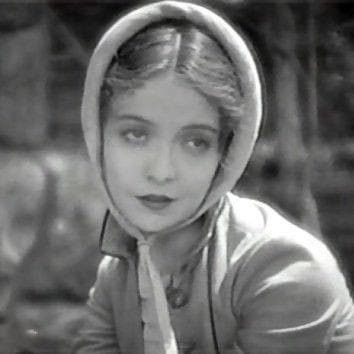
Mabel at the Wheel (USA,1914)

This is a very well-known and famous Keystone short but perhaps more because of Mabel Normand and Charlie Chaplin feud in the backstage than the film itself. Supposedly Chaplin had disagreements with Normand on the type of humor of the film and he also did not like the fact that he was directed by a very young woman. Apparently, Mack Sennett (the head and founder of Keystone studios) intended to fire Chaplin, but he had requests of more Chaplin’s films by film exhibitors, which showed Sennett that it would not be a good idea to get rid of an actor who was actually being successful.


However, film is good enough to be successful on its own right and much of this film’s merits come from Mabel Normand herself. She, like her character in the film, was a woman ahead of her time, very physically skilled and brave, which was something completely new compared with 1910s angelical, virginal standards of femininity.
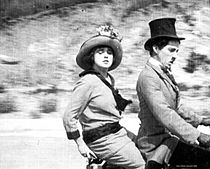

In his first year in films, Chaplin’s little tramp was not already the likeable fellow the world would admire so much. He was a rough man and far from being a gentleman, the kind of guy who would shamelessly make a woman fall on a water pond while taking her out, just like he did with Mabel in the beginning of film. He also did not hesitate in slapping Mabel back after she slapped him. Chaplin would also pursue this rough style of flirting in the film “Tillie’s Punctured Romance” with Canadian actress Marie Dressler, which was also produced by Keystone in that same year.


Something that also looks weird in this early representation of the little tramp is Chaplin’s top hat and exaggerated gestures, an acting that closely resembles Ford Sterling’s and villains of comedic vaudeville or stage plays. Fortunately to Chaplin, he soon improved his character, as those nearly surreal villains soon got out of fashion in films.


Chaplin, after being jealous of another suitor of Mabel, tried to destroy the other guy’s car. Both Mabel and the other suitor find out that Chaplin caused the harm and it caused a fight of bricks and even Mabel took an active part in it. After a while, we can see that the other guy would take part in a car race.


Unfortunately, her suitor ended up being kidnapped by Chaplin and his accomplices and did not show up for the race on time and Mabel, who was in the audience, realized there was something wrong. We can also see Mack Sennett himself in the audience, playing an unsophisticated and simple man. Having started his cinematic career as an actor in Biograph studios, in the first years after Keystone studios was founded, it was not unusual that the boss himself both acted and directed in films, a trend that would soon be over, as it did not take long until Sennett focused himself on administrative tasks of the studio.

Mabel stood up and approached the mechanic, she exchanged her clothes and got into the car that was supposed to be driven by her sweetheart. Many driving scenes were made, which was still a novelty back to 1914, considering that cars were not even very common yet and it was even more unusual to see a woman driving. But this did not stop Mabel and, considering she had even driven an airplane in a 1912 film (A Dash Through the Clouds) and wore a swim suit in another film also in 1912 (The Water Nymph), driving a car was not probably a big deal to her.


Despite the dangers along the way, Mabel drove so skillfully that she won the race and just in time to be observed by her sweetheart, who managed to free himself from the place where he was taken hostage. Rather than being victim of prejudice, Mabel was actually praised by the other guys, generated some publicity (we can see in the end of the film that a cameraman approached Mabel to film her) and was treated as an equal by the other pilots. Meanwhile, Chaplin was quarreling with his accomplices and looked even more mentally disturbed and evil than in the beginning of the film.

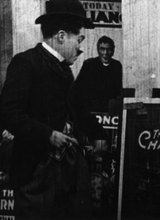
A Film Johnnie (USA, 1914)

Even for those who are not fond of silents, this film is full of historic value. By showing a sort of “film inside the film”, we can have a rare insight about what it was like to go to the cinema in the 1910s. We can also have an insight on the backstage of Keystone studios, as well as its working practices. 

Furthermore, Chaplin was at the very beginning of his career in films. We can see the evolution of the Little Tramp, who was originally a rough, impolite troublemaker, at first without the pathos that would soon make Chaplin famous worldwide. 

It is also possible to make comparisons between the plot of his film and the very beginning of Chaplin cinematic career, with him trying to be accepted in his new work and having a difficult attitude with his peers at the same time. There are stories of Chaplin having refused to be directed by Mabel Normand and clashed with other directors of Keystone studios. 

The Little Tramp goes to the cinema and falls in love with the girl in the picture of the publicity material outside the cinema. Of course that the girl turned out to be Mabel Normand and the film was produced by the Keystone studios. A noteworthy observation is that, even though it was Mabel Normand`s picture outside the cinema, the character turned out being played by another actress Peggy Pearce. 

There`s a rumor that Mabel Normand did not act in this comedy because Chaplin had previously clashed with Normand while making another film and she simply refused to work with him again. And that made the studio replace Normand by Pearce. 

Chaplin enters the cinema and ends up causing chaos with other moviegoers. He was not only impolite with other people, but also very naïve in taking what he saw on screen as if it was real. His love for the Keystone Girl only grows bigger. 

After a fight at the cinema and being kicked out by the audience, the Little Tramp ends up on the doorstep of Keystone studios. The reasons for it aren`t clear. Was he looking for his sweetheart? Looking for a job? Begging for money/food? We cannot say for sure. When the “Keystone players arrive at the studio”, as one of intertitles says, modern-day audiences can see some of the biggest stars of the studio of the day, including Roscoe “Fatty” Arbuckle, who in real life played an influence on how the Little Tramp character would be built up and was already an established comedy actor when Chaplin started working at Keystone studios in 1914. 

The Little Tramp finally got to enter the studio, but he created a huge chaos. Then, there was a fire and the actors and studio crew ran to the scenery in order to get some “atmosphere” for the film. In the first years of Keystone studios (which had been founded in 1912), it was a usual that films were made on the spot of real-life events.

This short film does provide a rare and accurate insight about entertainment early XX century, both under the perspective of young Hollywood industry and of audience and how they related to films. Highly recommended for those interested to know about the evolution of cinema in a fast and practical way.

A Muddy Romance (USA, 1913)

In the first few years of Keystone studios (founded in 1912), many of their films were one-reelers with quite simple storylines. Other studios produced similar comedies, both in the USA and abroad. Short films were still the most common length of films, as feature-length films were still at the very beginning. Films like Cabiria (Italy, 1914) and The Birth of a Nation (USA, 1915) –some of the films that would help to consolidate feature length films as more popular – were yet to be produced.

In a landscape that looked remarkably rural, Ford Sterling –with his typically exaggerated gestures and mannerisms – was by a window, flirting with Mabel Normand, who was in another window. However, there was another man interested in Mabel (“a persistent suitor”) and he came to her house to visit her. Sterling did not really seem pleased when he realized there was a competitor for Mabel`s affection. Sterling also came to visit Mabel, but the other suitor was still there and both men clashed. Sterling tried to attack the other guy, but ended up hitting Mabel with dirt instead. At this point, both men fought and Mabel tried to intervene and therefore she fell out of the window. The three of them threw things at each other.

A clergyman arrived at Mabel`s house in the middle of all chaos. It seems to have come to marry Mabel and the other suitor. Then, Mabel, the other suitor and the clergyman leave in a boat while Sterling tries to shoot them as he saw the boat departing. The Keystone cops were called to try to settle the mess. The cops started shooting too and embarked on another boat and one of cops fell on the river and a short time later they got stuck in the mud. Sterling attempted to stop the boat from leaving by throwing mud on the river.

More cops came to the scene with hoses and even a cannon. The hoses were useful to take their colleagues out of mud. Unfortunately Mabel fell in the mud right afterwards, but immediately the clergyman and her other suitor helped her out of the mud. And the three of them were eventually taken out of the muddy river. Meanwhile, Sterling was into trouble, as he was caught throwing dirt on the river.

Such simple one-reelers were very popular in the era and working-class audiences could easily relate to situations being shown. Keystone films were a hit since the beginning and its actors became successful comedians. As time passed, the studio produced feature-length films (the first one being Tillie`s Punctured Romance in 1914, with Mabel Normand, Marie Dressler and newcomer Charlie Chaplin in the cast). And Keystone studios became famous for discovering young comedians who would undeniably leave their mark in cinema history. For instance, young Roscoe ‘Fatty’ Arbuckle and Charlie Chaplin worked there in the 1910s. The studio was closed in 1933, already at the era of talkies.

Why do I have a site?

If you know of my good old blog of silent films, you can rest assured that it still exists and it will always do. Silent Beauties blog on silent films has always brought me lots of joy and I would never voluntarily end it. If you want to take a look at my dear, sweet blog, here is the link: https://silentbeauties.blogspot.com/

Nevertheless, time passed and I have felt the need of writing about other stuff, my interests – including, but not limited to, arts – life in general, random thoughts. Sure, I could definitely include those things in my blog, but I love the format of Silent Beauties blogger as it is and I do not want to change anything there, especially the focus on silent films. Another point is that I have missed the fact of expressing myself out of social medias, where I can write without time or space constraints, where the amount of followers is not important, but the quality of the community that is created. A place that isn’t easily bought by anyone with ulterior motives and that I can control more closely is advisable. And here I am.

We had in the last year the example of Twitter being taken over by problematic ideals and we witnessed the sudden death of a social media. Maybe it is the first time it happens this way, as what happened before was specific social medias losing relevance as time passed, but social media being bought and “killed” the way it was is something unprecedented. It shows that social media is great, but much more fragile than we can imagine. This is something we can already understand, but was unimaginable until a short time ago.

It is great that as time passes, I have had the intellectual urge of knowing about other subjects. It means I will never run short of hobbies. No matter the era or if people are rich or poor, the way they live, the cultural production of the world is always full of cultural opportunities and even common citizens can often have so many interesting things to say. The idea of writing on web site, which provides me a greater degree of control, makes things very exciting and I cannot wait to be here more and more, sharing my impressions of things.

At least initially, I intend to write small texts about topics of my interest. It includes silent films, which is an old passion of mine, but there will also be other things. The size of the posts will probably be no different from the posts of micro blogging applications (Twitter, Bluesky, Mastodon and all of them), but longer texts may also appear. Basically, I consider this site as a blank canvas where I can paint a portrait of my interests. As long as I do not insult anyone, there is no rule about size, subject or frequency of posts.

You may think that in the current world there are many problems, but there are great things too. The expansion of social media is giving room for people to be creative without necessarily having to spend money for that. The fact that communication has been easier to unprecedented levels has had a huge impact over our era and, if we have the wish to join this revolution and get our message across, we should definitely do it. The fact that we can research about so many subjects is wonderful and I never take it for granted.

There is always some insecurity involved in launching a writing project, especially because writing is something that we develop and improve all the time. But when we are too perfectionist, it ends up preventing us from doing things because we never think our texts are good enough. Therefore, I always find it good to write without many string attached. The point is recording our feelings and the moment, sharing it with others and anything else is often a mere waste of time. We all have the need to express ourselves according to our truths and beliefs and going for it just makes our lives better.

I am really grateful to everyone who has followed my adventures on line, regardless of media. Without having so many cool friends around, nothing would make sense. In the end of the way, we may become social nomads, the places where we connect may end, but what truly makes a difference is the friends we make. We have all this technology at our reach, but the human brain has not changed too much throughout history. We are social beings, we long for connection, understanding and kindness. And I have always had it all on line, thanks to everyone who has been in this on line journey with me. I hope you all feel comfortable, accepted and welcome in this space too.

A woman is sitting by a desk. We can see a laptop, some books and a glass of water between the books and the laptop.

Create a website or blog at WordPress.com

Up ↑