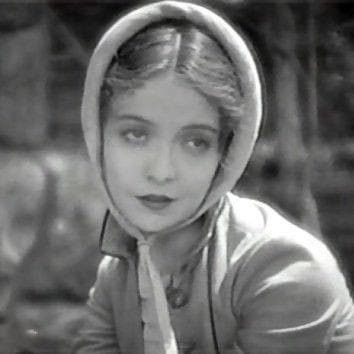
Saved from Himself (USA, 1911)

This is a film by Biograph studios of New York, directed by famous  D.W. Griffith (who started working at the studio in 1908 as an actor and soon became a director and chief direct of Biograph) and one of protagonists is Mabel Normand, one year before she moved together with Mack Sennett and Fred Mace to the Keystone studios, which had just been founded.  It is interesting to see Mabel acting in a non Keystone, drama film. 

Mabel Normand, despite being more famous for her comedies, was a versatile actress and did well in dramas too. When this film was made she was circa 18 years old and already had a natural and convincing acting.  In Biograph she played naïve young maidens, damsels in distress, in addition to comedic ladies.

Joseph Graybill (1887 – 1913) is an actor about whom not much is known. He passed away in 1913 still in his 20s and had a successful career both on stage and cinema and is more noteworthy for having worked with D.W. Griffith in his first years at Biograph studios. 

The title of this film is self-explanatory and the plot has some typical Griffith`s touches, especially in the moralizing end. An example of that is evident already in the first intertitle, which says: “His sweetheart`s influence saves him from dishonor”. Back to an era when having a good social reputation was something taken much more seriously than nowadays.

Motion picture poster for Three Friends, a Biograph Studios release, shows three men clasping hands while sitting at a table in a bar. 1 print (poster) : lithograph, color ; 104 x 70 cm.
Source: Wikimedia Commons

A young clerk (Joseph Graybill) is engaged to a stenographer (Mabel Normand). His old friend had just won lots of money in the stock market, which encouraged him to also invest his money this way. He was so impressed that he actually used all his savings to purchase stocks. Unfortunately, things did not happen as planned and he had to put up another two thousand dollars, otherwise he would be wiped out, as one of intertitles says. He could not afford doing so and the fear of losing all his money made him consider stealing money from a hotel. 

However, his sweetheart (Mabel Normand) found it out and prevented him from doing so. Also, his thoughts about his mother made him thinking twice and it became clear that he only considered stealing the money out of fear of losing all his savings and not being able to provide a good future both for himself and his future wife. The happy ending happened because honesty and morals were preserved and it is not worth it being unscrupulous or immoral, this is the usual message of Griffith`s cinematic work.

A plenty of Griffith`s films discussed the effects of addictions, poverty and adultery over families. A recurrent theme was also the virginal, Victorian heroines, who Lillian Gish embodied so well. Those women also had high morals and kept their families united, even when the father/husband was too weak to do it himself. It often turned out that the man regretted his mistakes and reunited with his family, immediately being forgiven by his understanding spouse. Although such plots would be a bit too sexist for nowadays` standards, they show to modern audiences how life was like when things were simpler and the urban life had not fully taken root. 

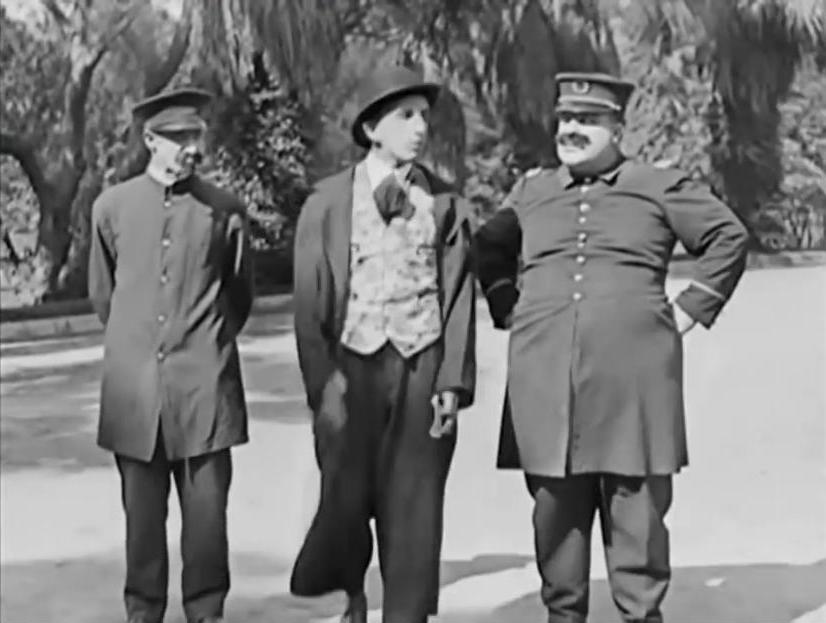
Frauds and Frenzies (USA,1918)

The theme of convicts trying to escape prison was relatively common in silent comedies. And comedies –specially slapstick ones – portraying policemen and authorities (who were usually incompetent, slow and lazy) were also abundant both in the USA and Europe. The laughter such films provided was also a relief to audiences, considering that a plenty of cinema goers belonged to working classes, who could laugh at those who had a more prominent position in society. 

Although not particularly innovative, this film had some funny physical gags, which can still be universally understood by modern audiences, regardless of culture. This is particularly true in the beginning of the film, when the convicts were shown performing forced labor. Stan Laurel, despite having engaged in such gags, also subtly showed to have a more self-contained type of humor, which he would also have during his pairing with Oliver Hardy. Speaking of Hardy, Semon would also work with him prior to his pairing with Stan Laurel. 

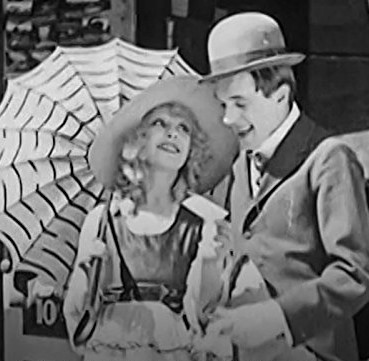
One day both Semon and Laurel got to escape and they suddenly became rivals for the love of a beautiful girl (with curly hair and a big umbrella, very much according to 1910s fashion standards). Such love interest is prone to make the former convicts having problems with the police again because the girl turned out being the daughter of one of policemen. At this point we can observe an ethnically insensitive gag, when they tried to kiss the girl, but it was actually a black woman below the umbrella, which makes both Semon and Laurel run away in disgust. Such gags were also common in silent comedies and not considered by some people as gross as it is considered nowadays. 

As usual, Semon happily engages in his cartoon-like special effects and gags of big proportions. There is even a chase (which is a type of gag considered by some laymen audience members as the symbol of silent films in general). It is also noteworthy that Stan Laurel gets less screen time in the second half of the film. Laurel had claimed that Semon reduced his time in the film in fear of being upstaged after a comment that Laurel was funnier than himself. 

Although not well-remembered nowadays, Larry Semon was a famous comedian in his day. He would pass away around one decade after this film, while in poor financial and health situation, but a plenty of his films are preserved nowadays and his distinctive cinematic style still stands out. 

A Film Johnnie (USA, 1914)

Even for those who are not fond of silents, this film is full of historic value. By showing a sort of “film inside the film”, we can have a rare insight about what it was like to go to the cinema in the 1910s. We can also have an insight on the backstage of Keystone studios, as well as its working practices. 

Furthermore, Chaplin was at the very beginning of his career in films. We can see the evolution of the Little Tramp, who was originally a rough, impolite troublemaker, at first without the pathos that would soon make Chaplin famous worldwide. 

It is also possible to make comparisons between the plot of his film and the very beginning of Chaplin cinematic career, with him trying to be accepted in his new work and having a difficult attitude with his peers at the same time. There are stories of Chaplin having refused to be directed by Mabel Normand and clashed with other directors of Keystone studios. 

The Little Tramp goes to the cinema and falls in love with the girl in the picture of the publicity material outside the cinema. Of course that the girl turned out to be Mabel Normand and the film was produced by the Keystone studios. A noteworthy observation is that, even though it was Mabel Normand`s picture outside the cinema, the character turned out being played by another actress Peggy Pearce. 

There`s a rumor that Mabel Normand did not act in this comedy because Chaplin had previously clashed with Normand while making another film and she simply refused to work with him again. And that made the studio replace Normand by Pearce. 

Chaplin enters the cinema and ends up causing chaos with other moviegoers. He was not only impolite with other people, but also very naïve in taking what he saw on screen as if it was real. His love for the Keystone Girl only grows bigger. 

After a fight at the cinema and being kicked out by the audience, the Little Tramp ends up on the doorstep of Keystone studios. The reasons for it aren`t clear. Was he looking for his sweetheart? Looking for a job? Begging for money/food? We cannot say for sure. When the “Keystone players arrive at the studio”, as one of intertitles says, modern-day audiences can see some of the biggest stars of the studio of the day, including Roscoe “Fatty” Arbuckle, who in real life played an influence on how the Little Tramp character would be built up and was already an established comedy actor when Chaplin started working at Keystone studios in 1914. 

The Little Tramp finally got to enter the studio, but he created a huge chaos. Then, there was a fire and the actors and studio crew ran to the scenery in order to get some “atmosphere” for the film. In the first years of Keystone studios (which had been founded in 1912), it was a usual that films were made on the spot of real-life events.

This short film does provide a rare and accurate insight about entertainment early XX century, both under the perspective of young Hollywood industry and of audience and how they related to films. Highly recommended for those interested to know about the evolution of cinema in a fast and practical way.

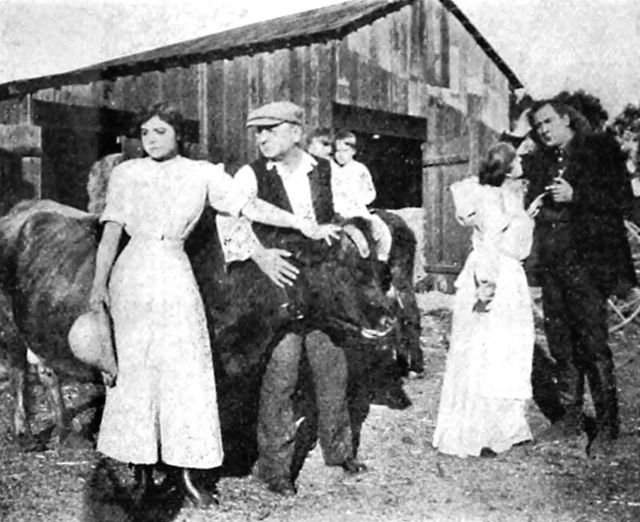
Dorothy Davenport (left) in The Best Man Wins (USA,1911)

Dorothy Davenport (left) in The Best Man Wins (USA,1911).

The World Photographic Publishing Company, Nestor Studios – The Moving Picture World, Volume 10, Number 13 (page 1036).

The Best Man Wins (USA,1911). IMDB link: http://www.imdb.com/title/tt0001502/

Promotional still from the 1911 film, The Best Man Wins From the weekly advertisement for Nestor in The Moving Picture World A MERRY XMAS AND A MERRY FILM Monday, December 25th, 1911 “THE BEST MAN WINS” A tender love romance; Dan Cupid’s victory; a jolly barn dance; an exciting ploughing bee, and the delightful charm of life on the farm are exquisitely shown in The Best Man Wins. You’ll win if you get it! DAVID HORSLEY, BAYONNE, N. J. SALES CO. SOLE DISTRIBUTORS Description on page 1079— “The Best Man Wins” is a very clever comedy amid rural surroundings in which a plowing contest is pulled off to decide who shall gain the favor of the farmer’s daughter. There is considerable competition between the farmers’ sons of the vicinity, but the real contest comes off between the young man the girl’s father wants her to marry and a young man from the East who has made quite an impression upon the girl and is anxious to marry her. By some strange good fortune the young man from the East wins the contest and, while the dance is at its height, slips away with her and gets her promise to marry him. It is not to be easy sailing, though, for the jealous lover sees them slip away and, finding the girl’s father who has no use for the Eastern boy, makes an attempt to stop the proceedings. The old man finds the young folks and proceeds to read the riot act to the young man. At this point the young man from the East plays his trump card: he hands the old farmer his credentials showing that he is a representative of the Agricultural Department at Washington, D. C. This wins the old man’s consent to the arrangements made by the young folks and everybody is happy but the disappointed lover. Harold Lockwood plays the part of the Eastern boy with dignity and spirit.

A Muddy Romance (USA, 1913)

In the first few years of Keystone studios (founded in 1912), many of their films were one-reelers with quite simple storylines. Other studios produced similar comedies, both in the USA and abroad. Short films were still the most common length of films, as feature-length films were still at the very beginning. Films like Cabiria (Italy, 1914) and The Birth of a Nation (USA, 1915) –some of the films that would help to consolidate feature length films as more popular – were yet to be produced.

In a landscape that looked remarkably rural, Ford Sterling –with his typically exaggerated gestures and mannerisms – was by a window, flirting with Mabel Normand, who was in another window. However, there was another man interested in Mabel (“a persistent suitor”) and he came to her house to visit her. Sterling did not really seem pleased when he realized there was a competitor for Mabel`s affection. Sterling also came to visit Mabel, but the other suitor was still there and both men clashed. Sterling tried to attack the other guy, but ended up hitting Mabel with dirt instead. At this point, both men fought and Mabel tried to intervene and therefore she fell out of the window. The three of them threw things at each other.

A clergyman arrived at Mabel`s house in the middle of all chaos. It seems to have come to marry Mabel and the other suitor. Then, Mabel, the other suitor and the clergyman leave in a boat while Sterling tries to shoot them as he saw the boat departing. The Keystone cops were called to try to settle the mess. The cops started shooting too and embarked on another boat and one of cops fell on the river and a short time later they got stuck in the mud. Sterling attempted to stop the boat from leaving by throwing mud on the river.

More cops came to the scene with hoses and even a cannon. The hoses were useful to take their colleagues out of mud. Unfortunately Mabel fell in the mud right afterwards, but immediately the clergyman and her other suitor helped her out of the mud. And the three of them were eventually taken out of the muddy river. Meanwhile, Sterling was into trouble, as he was caught throwing dirt on the river.

Such simple one-reelers were very popular in the era and working-class audiences could easily relate to situations being shown. Keystone films were a hit since the beginning and its actors became successful comedians. As time passed, the studio produced feature-length films (the first one being Tillie`s Punctured Romance in 1914, with Mabel Normand, Marie Dressler and newcomer Charlie Chaplin in the cast). And Keystone studios became famous for discovering young comedians who would undeniably leave their mark in cinema history. For instance, young Roscoe ‘Fatty’ Arbuckle and Charlie Chaplin worked there in the 1910s. The studio was closed in 1933, already at the era of talkies.

An Andalusian Dog (France, 1929)

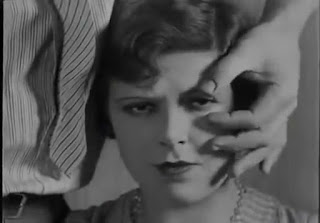
This famous silent film short is a result of the cooperation of Luiz Bunel and famous surrealist artist Salvador Dali in the production/direction. And much has been said – even by Dali himself -that nothing in this film was meant to make any sense, still many reviewers and scholars have tried to find some meaning and connection between all scenes throughout the decades. Maybe an attempt to try to find coherence by all means or would there be any sense in the images shown, after all?

The film starts with a tango song in the background and the image of a man sharpening a razor. He goes to a balcony while holding the razor and smoking a cigarette. Then a woman who is sitting down is shown with her eye being cut by the razor at night. Eight years later, a man is shown riding a bicycle on a deserted street in a sunny day. He is wearing unusual clothes and the street looks beautiful. Right afterwards, the woman who had her eye cut a while ago is shown while sitting down on a chair and reading something. The background music changes, the guy on a bicycle pops up again. The woman gets tense, stops reading and goes to the window. The guy on a bicycle is shown again, this time from above. He falls off the bicycle on the sidewalk and the woman goes downstairs to help him.

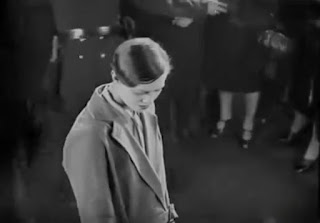
The woman is shown in her bedroom upstairs again. She is holding a tie and puts it on the bed together with the clothes that belonged to the man who fell off the bicycle. She sits down on a chair and stares at the bed with the man’s clothes on it. Suddenly, a man is shown in the bedroom and he’s looking at one of his own hands and there are ants on it, which seems to be a symbolism of his urge to kill. The images change abruptly, almost in a raw way, and we can now see a man with androgynous features and clothing playing with a human hand with a can while a crowd is around him. Would it mean the use of of human suffering and misery for the entertainment of masses? Would this man be blind or something like that? A policeman comes and disperses the crowd. The man keeps on playing with the human hand with his can and the policeman bents down to collect the hand, puts it on a small box and delivers the hand back to the man.

Both the man and woman in the bedroom follow up this commotion from their window. The man on the street remains there, lonely, holding his small box with the human hand in it until he is hit by a car. The other man by the window seems to be deeply impacted by the event unfolding downstairs. The background tango song is back. The man in the window looks at the woman besides him in a rather scary way and then the shock: He tries to sexually assault the woman by his side even though she refuses his advances. The woman pushes him and runs inside the bedroom and tries to protect herself in any way she can.

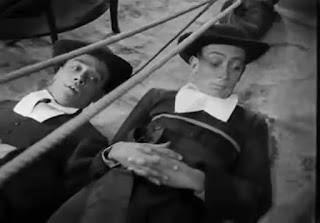
Then the man pushes the strings of two pianos and the audience can see two dead donkeys and two priests also being pushed, which weights down on the man heavily. Would it be a representation of the weight of the church and authorities over the back of common citizens? Upon seeing this, the woman leaves the room in horror. The man tries to follow her to no avail and then it is still visible to the audiences the ants on his hand, which might mean his wish to kill and the fact that his bad passions dominated him. Right afterwards the man is suddenly shown laying down on the bed in the same room where he was in the previous scenes.

“Around three in the morning” (as an intertitle says), another man rings the bell and the woman who was previously in the bedroom opens the door. This new man goes straight to the bed where the another man is laying down and he apparently urges him to stand up. The man laying down is quite puzzled and has a submissive attitude. Would this new man be the boss urging his employee to stand up and work, perhaps?

Another intertitle says “Sixteen years before”. Both guys now appear to look the same, even though the submissive guy keeps his oppressed attitude unchanged. There is a messy office desk with torn and dirty papers on it. One guy hands over a book to the other, the image blurs briefly and the submissive man is holding a gun towards the bossy man. He shoots. Would it be the embodiment of the oppressed becoming the oppressor and representing the change of luck of a person in life?

When the shot guy falls, he falls in a place outdoors and we can see the back of a half naked woman, who looks like the woman who was previously in the bedroom. The woman disappears after a short while. Some men are shown in this outdoors place and they find the body of the man who was shot and he is carried by the other man. It seems it was already too late to save his life. Would it be a representation that everything in life will eventually come to an end?

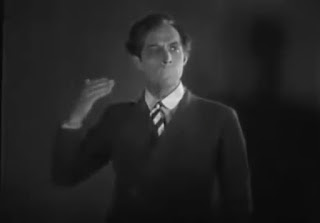
The old bedroom is shown once more. The woman is returning to the bedroom, there is the close up of a small butterfly. The man was waiting for her, which means that the old couple of the bedroom is reunited once more. The man rubs his hand on his lips and we can see that his mouth was deleted from his face. The woman applies some lipstick in her own lips. The man still has no mouth and the woman realizes that her body hair was also gone. She pulls a face on the man and leaves the bedroom again.

It’s windy outside, we can see the man on a beach, the woman walks towards him and the man on the beach is appears to be the same man who has just been seen in the bedroom but in another outfit. He shows his watch to the woman, as if he was reprehending for having arrived late. The woman kisses the man and they embrace. The beach gets muddy and they see some garbage, including old clothes, which look like the clothes that belonged to the man who fell off the bicycle in the beginning of the film. Would it be a representation of leaving the past behind and start a new life?

The couple walks happily on the beach and then another intertitle says “In the spring” and the couple is shown buried in the sand, apparently dead. A strong scene which maybe would mean that life is brief and that, despite all ups and downs, it eventually ends for everyone?

A surrealist work of art gives room for all sorts of interpretations. It can mean nothing and everything, all at the same time, but the imagery always makes people uncomfortable and raises lots of thoughts, which is the intent of the surrealist movement. Definitely it is not a film for everyone and it helps if audiences are open minded about non linear plots.

The Only Son (Japan, 1936)

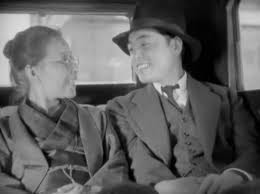
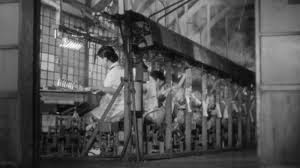
This film talks about a poor widow and her son. At first the mother couldn’t really afford the son to continue with his education. However, her son had a teacher who really encouraged her to make her son to keep on studying. But to do it, the mother would need to send her son away to Tokyo because they lived in a small city. She would need to send him to Tokyo and pay for his education, which was too much for her because it was a really poor family. However, she realized that the boys of the neighborhood were going to Tokyo to have an education and she didn’t want her son to miss an opportunity, so she made all the sacrifices possible, she struggled so her son could have an education in Tokyo. Many years have passed and her son was now 27 years old and then she decided to visit him there by surprise.

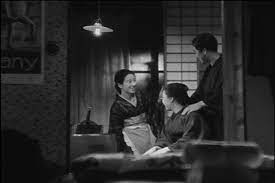
When she arrived in Tokyo, she realized that her son wasn’t as successful as she imagined. At first, she was scared, not necessarily with the city, but with the neighborhood where he lived, which was really poor, and she also got to know that her son was married and had a baby son of his own. And of course she was in shock because she imagined that her son would study and be successful. And the son, he was happy to see his mother, of course, but he was extremely sad that his mom saw him in this situation. He would rather her to visit him later when he had a better financial situation.

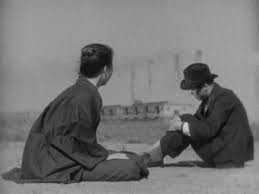
The son’s wife was a really good person. She treated his mother as it was her own mother. She was very gentle with her. The son treated his mom wonderfully too. He tried to borrow money from other people, so he could take his mom to places. But, of course, that she couldn’t disguise the fact that she was disappointed. The son talked to his mom in private and confronted her about it. And he said that he knew that she was very disappointed, that he did everything he could, that he was aware of how much she suffered to pay for his education, that he tried his best to honor all her effort. But Tokyo is a very populated and big city, competition was wild, that he wanted to be more than a night school teacher. Then the mother said that he shouldn’t give up so easily, he was still young, his life was just beginning, and he shouldn’t act like a coward, that he should keep on trying to improve his situation, he was still young, he had the means.

And then when they talked about the same subject again at night, his wife overheard everything and started crying. And she was feeling very bad that her mother-in-law was in this situation, sad all day long, taking care of her grandson. And then she decided to do something. She sold her kimono and gave the money to her husband so he could afford taking his mother to places, to go out with her so at least she could cheer up a little bit. And they planned to do just that. The entire family would go out, take his mother to no more corners of Tokyo. However, a boy of the neighborhood had an accident with a horse and he needed to go to the hospital.

Then the elderly mother’s son took the boy to the hospital and even helped his mother with some pocket money for the expenses because his son didn’t have anything serious in the accident but he broke her leg so he would need some care and it would be difficult for her because she was very poor too. After a while, when they left the hospital, the son told the mother that this event ruined all the plans that he had for today. He intended to go out with her, to do things together, but this accident, it destroyed everything. Then the mother told him that she was proud of him because when you very poor, the generosity of other people make you feel so grateful and that she knew how the neighbor felt because she was very poor too and she said that it was much better that her son had helped the neighbor than going out with her that it would be the best memory she would have from her time in Tokyo.

When they were talking about the financial situation of the son, she confessed to him that she had to sell her house to pay for his education and that she was sleeping in the dormitory of her workplace, but that he shouldn’t need about her, that she doesn’t care about the housing or anything. All she cares about is that he study hard and then improve his financial situation. After the mother left and returned for her city, the son told his wife that he would return to school and try to specialize to give classes to college students, so he would earn more money, because his son, his baby son, wouldn’t be a baby forever and he would need money.

We can see in the beginning of the film that the elderly mother returned to her village. And when her friend asked about Tokyo and about her son, she said that Tokyo was beautiful, that her son was well, that he became a great man. So she said good things about her son, that he found a good wife. She really liked his wife very much, but we could see on her face that she was extremely sad because she thought her son would be more successful. The plot of this film is very universal because parents always want their children to have a better situation than they have. They always want the best for their children. And when they realize that their children didn’t do as well as they expected of course that they feel sad.

On the other hand, she could recognize that her son was a very nice boy, who had a nice wife, a nice family, who never did anything wrong, never stole from anyone. She also saw that the teacher of her son, who also went to Tokyo, instead of still being a teacher, he was working in a restaurant frying food. So, things were very difficult for his former teacher too. So it wasn’t only her son was struggling. And that competition in a big city is indeed very bad. But she had the highest expectations about her son because he was everything she had in life. And unfortunately, it wasn’t as she imagined and it’s a very touching film, even sad, but it’s a plot that never gets old, it’s delicate as Ozu’s films usually are. It is one of the few Ozu’s films were his sentimentality is openly shown, in contract to most of his films, where it is more covered.

Why do I have a site?

If you know of my good old blog of silent films, you can rest assured that it still exists and it will always do. Silent Beauties blog on silent films has always brought me lots of joy and I would never voluntarily end it. If you want to take a look at my dear, sweet blog, here is the link: https://silentbeauties.blogspot.com/

Nevertheless, time passed and I have felt the need of writing about other stuff, my interests – including, but not limited to, arts – life in general, random thoughts. Sure, I could definitely include those things in my blog, but I love the format of Silent Beauties blogger as it is and I do not want to change anything there, especially the focus on silent films. Another point is that I have missed the fact of expressing myself out of social medias, where I can write without time or space constraints, where the amount of followers is not important, but the quality of the community that is created. A place that isn’t easily bought by anyone with ulterior motives and that I can control more closely is advisable. And here I am.

We had in the last year the example of Twitter being taken over by problematic ideals and we witnessed the sudden death of a social media. Maybe it is the first time it happens this way, as what happened before was specific social medias losing relevance as time passed, but social media being bought and “killed” the way it was is something unprecedented. It shows that social media is great, but much more fragile than we can imagine. This is something we can already understand, but was unimaginable until a short time ago.

It is great that as time passes, I have had the intellectual urge of knowing about other subjects. It means I will never run short of hobbies. No matter the era or if people are rich or poor, the way they live, the cultural production of the world is always full of cultural opportunities and even common citizens can often have so many interesting things to say. The idea of writing on web site, which provides me a greater degree of control, makes things very exciting and I cannot wait to be here more and more, sharing my impressions of things.

At least initially, I intend to write small texts about topics of my interest. It includes silent films, which is an old passion of mine, but there will also be other things. The size of the posts will probably be no different from the posts of micro blogging applications (Twitter, Bluesky, Mastodon and all of them), but longer texts may also appear. Basically, I consider this site as a blank canvas where I can paint a portrait of my interests. As long as I do not insult anyone, there is no rule about size, subject or frequency of posts.

You may think that in the current world there are many problems, but there are great things too. The expansion of social media is giving room for people to be creative without necessarily having to spend money for that. The fact that communication has been easier to unprecedented levels has had a huge impact over our era and, if we have the wish to join this revolution and get our message across, we should definitely do it. The fact that we can research about so many subjects is wonderful and I never take it for granted.

There is always some insecurity involved in launching a writing project, especially because writing is something that we develop and improve all the time. But when we are too perfectionist, it ends up preventing us from doing things because we never think our texts are good enough. Therefore, I always find it good to write without many string attached. The point is recording our feelings and the moment, sharing it with others and anything else is often a mere waste of time. We all have the need to express ourselves according to our truths and beliefs and going for it just makes our lives better.

I am really grateful to everyone who has followed my adventures on line, regardless of media. Without having so many cool friends around, nothing would make sense. In the end of the way, we may become social nomads, the places where we connect may end, but what truly makes a difference is the friends we make. We have all this technology at our reach, but the human brain has not changed too much throughout history. We are social beings, we long for connection, understanding and kindness. And I have always had it all on line, thanks to everyone who has been in this on line journey with me. I hope you all feel comfortable, accepted and welcome in this space too.

A woman is sitting by a desk. We can see a laptop, some books and a glass of water between the books and the laptop.

Create a website or blog at WordPress.com

Up ↑