The Big Parade (USA,1925)

There are not enough words to write about a such film. Its theme is more alive than ever, although it portrays a war back to an era when going to the war still had a somewhat romantic aura of dying for a cause in the name of your country. Although the horrors of WW2 could not even be predicted back then, WW1 brought enough tragedies and disrupted millions of lives. 

Some of the best war films show the lives of unknown people, their dreams, ambitions, their normal pace of life being completely engulfed in a war and changed forever. Common people, whose names are not in history books, but who borne most of toll of war. Families separated, love stories brutally interrupted, entire youths torn apart forever for reasons that were completely out of their control. People who either perished or had to carry on despite a huge amount of pain. It’s impossible not feeling overwhelmed. 
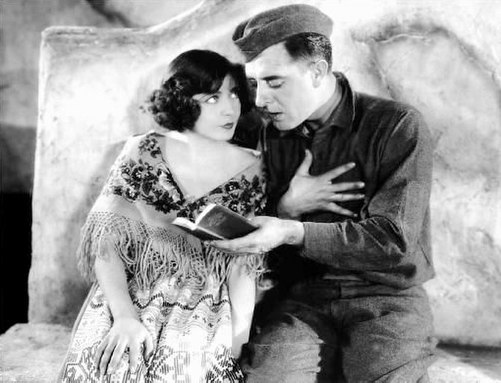
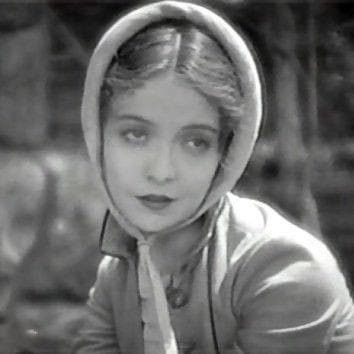
Back to late 1920s, the biggest Hollywood studios were already big and gave a plenty of examples of the sophistication that could be achieved with a high investment in both technology and human skills. John Gilbert and Renee Adoree provided beautiful pieces of acting without ever being over the top or stereotypical. Adoree is always a pleasant screen presence, showing lots of feelings in a restrained way, but really convincing, a type of acting that could resemble Lillian Gish in her heyday. 

This film can perhaps be considered the best work of John Gilbert on screen. Although he is perhaps more famous today for his films with Greta Garbo (where he also worked quite well, by the way), the character Gilbert played in The Big Parade was full of complexities and dramatic nuances that gave him full room to show off his passionate, energetic, emotional acting. And Gilbert really did not disappoint. A complex role, which he ran smoothly, in such realistic way that he could say we are seeing a friend or a relative right in front of us, as if the audience was just taking a look at a situation from real life portrayed in a documentary. 

Without focusing too much whether war was something justifiable or not, the film portrays the influence of facts out of ordinary people’s control into their lives. Although the plot could be quite sad there is a good balance between light comedy, fine irony, romance and drama. Although it is not uncommon to portray on screen the maturity of a young and careless young man into adulthood by suffering the horrors of war, this film shows it under a nice perspective. James Apperson (John Gilbert) not only endures terrible moments at war, but he also had a good time with his friends, found out true love in the arms of a French girl (Melisande, played by actress Renee Adoree), even though they both couldn’t speak each other’s language, for instance. 

The end might have been relatively happy, but until a balance is accomplished, it is portrayed how much James struggled to handle the death and suffering of his friends, but also his own physical wounds. The lives of everyone involved in war, either directly or indirectly, was changed forever. Love might have been unexpectedly found, but the mental scars would have to be handled. 

The “war to end all wars” turned out to be, both on screen and in real life, much more tragic and longer than expected. And many other wars would come. The Big Parade has the distinction of being the first great pacifist war film in the United States, even prior to famous All Quiet on the Western Front (USA,1930). Something that also unites both Adoree and Gilbert is not only the fact that this film brought them to stardom, but also that both of them would die young not too long after this film was released. It was also the first noteworthy picture of filmmaker King Vidor, who would have a successful directorial career ahead of him. 

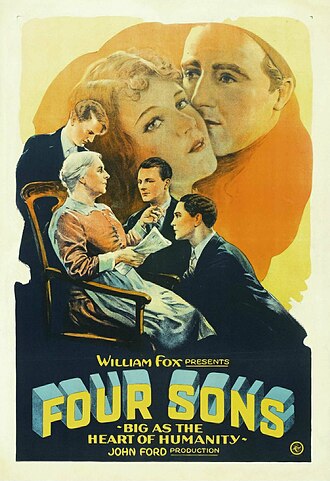
Four Sons (USA, 1928)

This film follows the same production and plot values of films like, The Big Parade (USA, 1925), among others. WW1 is shown irrespective of politics, focused on the impact of war in the lives of ordinary citizens, who for the first time in life have the deal with events completely beyond their control changing their future forever.

Without falling into melodrama, this film has a smooth, pleasant pace, quite familiar to modern-day audiences.  The fluid camera movement makes it looks like we are following those characters in real life. The film is so moving because it deals with facts with which most people can identify themselves quite easily, like the importance of having a harmonious family. 

Fox studios had recently hired prestigious German director F.W. Murnau. His influence can be observed in some scenes, for example, in the village, mobilized camera and mailman which is like the doorman in The Last Laugh (Germany, 1924).

The setting is Germany in the beginning of XX century and a widowed mother raising her four adult sons. The view of German lifestyle at that film is somehow stereotyped, as we can see even by the clothes of the village dwellers.  The Bavarian wearing their typical clothes everywhere all the time.

Then the war started. At first, the bothers are shown going to war in a rather romanticized way, as brave men who were fighting for the country and ideals and they left in a rather optimistic mood, saying they would be back in three months. At least, that was the atmosphere before the real horrors or death and suffering began. Three of those brothers fight for Germany, but the one of brothers had immigrated to the United States, being on the opposite side of his three other brothers. 

At first, the brother who immigrate to the USA had a calm life together with the family he formed there, after all the United States was neutral at first. But time passed and two of the brothers were unfortunately killed in action, which brought a huge grief to the mother. In addition to it, the life of the mother and her surviving son worsened terribly when they started being bullied by government authorities and things became hell after it was found out that her another surviving son is in America.

Finally, the last surviving brother in German soil is called to go to the army. At that point, the horrors of war were already undeniable. 

The mother eventually found her happiness again, after much struggle, when she managed to reunite in the United States with her surviving son, daughter in law and grandson. Things were not easy to her when she arrived, she was scared and sore, but after the entire family gathered together the wounds started to heal. Of course that to reach this happy end it was required a plenty of coincidences that we could only see in films. 

At the end we realize that it does not matter in which side of the war people are involved, the suffering and hardship affects everyone, family ties struggle and trauma is huge even in people who did not go to the front directly. 

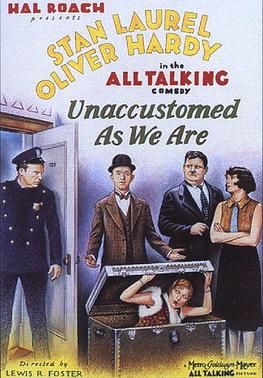
Unaccustomed As We Are (USA, 1929)

Although this film was Laurel and Hardy’s first talkie, some silent versions of this film with intertitles were also released. So, both silent and talkie versions of Unaccustomed As We Are can still be seen nowadays, even in DVD. And it was the silent version that was watched before writing this review.


The acting of Laurel and Hardy did not change very much compared with their previous silent films. Both actors had a more situational-oriented acting, not resorting too much on physical gags, even in the silent era, therefore sound films were actually quite favorable to those comedians. They also had pleasant voices, Stan Laurel even had an extensive experience on stage back to his native England (where he even worked with Charles Chaplin) and was pretty much used to dialogue in his career.


The themes of battle of sexes, henpecked husbands and rebelling wives have already been widely explored throughout the 1920s domestic situational comedies. Thus, the plot of this film was not really innovative, but it stands out due to the reliable acting of experienced comedians.


Oliver Hardy brings his good friend, Stan, to have dinner at his home to taste the delicious food of Mrs. Hardy. But unfortunately Oliver forgot to let his wife know about the visit in advance, so she could have proper time to make the arrangements. Mrs. Hardy got furious with that and says she will not cook for another crazy friend of Oliver and she leaves home rather angry, claiming she would spend some time in her mother’s house.


Oliver decides to cook for Stan, although he does not seem to be a skilled or experienced cook. Stan tries to help him, but he did not seem to be skilled with the housework either. Oliver’s next door neighbor, Mrs. Kennedy, realized both men were having problems and offered help for them to cook. However, there was an accident with Mrs. Kennedy while she was at Oliver’s house and her dress caught fire. When she was on her way back home to put on another dress, Mrs. Kennedy’s husband (Officer Kennedy) returned home.


Her husband was a though cop and Mrs. Kennedy was afraid that he would think she was actually cheating on him and would not believe she was half naked only because her dress was accidentally on fire. At first, Oliver volunteered to tell the truth to Officer Kennedy, but then he was also afraid of his neighbor’s reaction and the only solution was Mrs. Kennedy hiding herself in a trunk at Oliver’s house.

Since the silent era comedies could often revolve around misunderstandings it was not different in this film. Regretting her rant, Mrs. Hardy returned home very sad, determined to be in good terms with Oliver. She even said she would cook for Stan, but Mrs. Kennedy was locked in a trunk and had to leave the house. To disguise the delicate situation, Oliver claimed he was leaving Mrs. Hardy to go to South America and tried to go away from home taking the trunk with him.


Mrs. Hardy was furious, blaming Stan for Oliver’s decision and she got very angry again. In the middle of this chaos, Officer Kennedy arrived at Oliver’s house. Officer Kennedy volunteered to talk to Oliver, so Oliver would not abandon his wife.


He immediately realized Oliver was hiding a woman in the trunk and took it to his house, so Mrs. Hardy would not find it out what was truly happening with Oliver. What Officer Kennedy could not really imagine was it was his own wife who was in the trunk and he inadvertently started to talk to Oliver about his extramarital affairs, claiming he met some cute girls while out of home and that Mrs. Kennedy had never a clue about it.


Mrs. Kennedy heard everything while inside the trunk and was obviously furious. As soon as Officer Kennedy returned home she started arguing with her husband and even broke things on him. On the other hand, Officer Kennedy was furious with Oliver and Hardy, blaming them both for his marital problems.


Actress Telma Todd (Mrs. Kennedy) managed to show her good comedic time, funny facial expressions and a beauty that was very much within the 1930s standards. Although she was already acting back to the silent era, it was only in talkies where she could show off her comedic skills. Although she was mysteriously murdered in the 1930s, Todd made a name to herself.


Australian actress Mae Bush (Mrs. Hardy) was already an experienced comedienne when this film was made and had been in films since the 1910s. The same applies to Edgar Kennedy (Officer Kennedy), who worked with some of the best film comedians of Hollywood and had the distinction of being one of original Keystone Cops back to the 1910s. During silent era he also worked for both Mack Sennett and Hal Roach, who were among the most famous producers of comedies at the time.

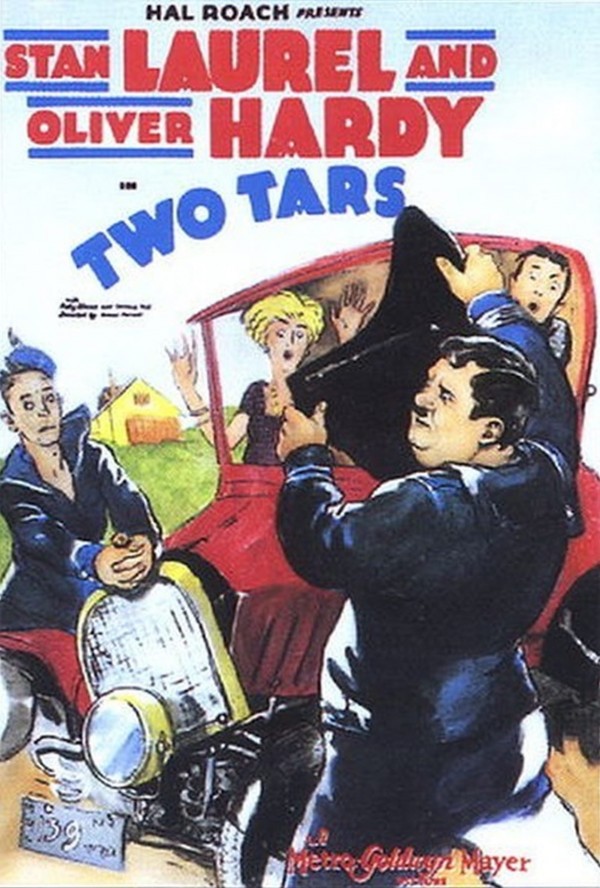
Two Tars (USA,1928)

This film is arguably among the most known silent shorts by Laurel and Hardy. This is a delicious mix of situational comedy and slapstick, of standard material of late 1920s with some subtle influence of slapstick of previous decade. Everything adapted to the so-called Jazz Era. 

Laurel and Hardy play the roles of two Navy men on their day off. They decide to rent a car, get involved in an accident and it does not take long until they meet two beautiful girls and get interested in them. An awkward conversation takes place, where the guys try to act though to impress the girls -without much success. 

The girls were having some problems with the candy machine, Laurel and Hardy tried to help them, but ended up worsening the situation by inadvertently breaking the machine and making all candies fall on the sidewalk. A furious employee of the store shows up. At first, Laurel and Hardy tried to comfront them, but after it was clear that they were not as though as they seemed, the girls took the problem into their own hands and one of them even beat up the store employee. This was a very interesting scene, as it was reversed the standard of “damsels in distress”, so popular in the 1910s, in favor of a new sort of woman that blossomed in the 1920s: The flappers, strong-willed young girls, who attended parties, smoked, and were much more liberated. 

Although the Laurel and Hardy were not exactly brave or skilled, the girls ended up going out with them in their car. The day was beautiful and everyone was happy, but then there was a traffic jam, and it is where it started the most famous part of the film. Actually, the idea of making a film in a traffic jam was pretty ingenious for 1928, as cars have not been around for too long yet. The drivers involved in the jam were understandably stressed and angry there and what started as a minor argument ended up having greater proportions, involving all drivers -including the girls themselves. 

Chaos happened and a fight started, with typical knockabout gags we could easily have seen in a slapstick comedy. This even included things being thrown, people falling down and getting dirty. This is not a very common type of a gag in Laurel and Hardy’s films, considering they have always been situational-oriented since the beginning of their duo. However, despite the clearly physical scenes of the fights during the traffic jam, we can also observe that the mechanical gags of the broken cars were well-elaborate and quite expensive for its era, especially because it was employed lots of damaged cars. Even the type of destruction each car endured were funny by themselves. 

Another noteworthy detail is how the policeman’s attempts to restore order ended up failing terribly and his authority was mercilessly ridiculed. We can see it clearly when his motorcycle was smashed in the middle of all confusion and how the policeman’s vehicle was so powerless in comparison with all those cards around him. This idea of making fun of authorities was very common in films by Keystone studios back to the 1910s, especially in films by the Keystone Cops. Although a full decade had passed and this film was produced by another studio we can see that cinema audiences still liked to laugh at the same things. 

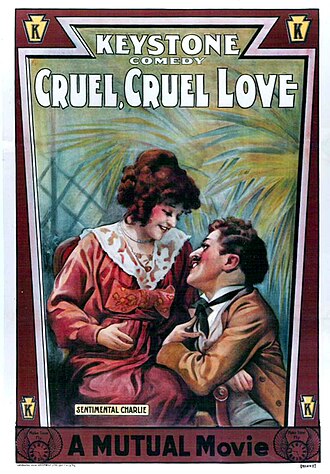
Cruel, Cruel Love (USA,1914)

This film was made during the first year of Chaplin in films, which he spent working for Keystone studios. Thus, the style of this comedy short was typical of the output of Keystone films of the era: Knockabout slapstick, actors in broad gestures to the point of situations often have a surreal aura, fast pace of films, misunderstandings, chases, fake facial hair. We can see it all in this film. Therefore, the pathos, slow pace of subsequent Chaplin films -which made him a legend of cinema worldwide – were still absent here. 

Another important fact is that this short film was considered lost for some decades and the existing footage was found in South America, with some missing minutes compared with the original film. Thus, current audiences must take it into consideration before analyzing this cute little slapstick comedy.

It must be highlighted that the actors do engage in broad, stagy gestures, which was an acting style already out of date back to 1910s films. This is particularly true when we realize that the subtle style of actresses like Mary Pickford, Lillian Gish, etc were already quite successful in Hollywood at that time. Minta Durfee had the most exaggerated acting among all main actors of this film, but it is really no surprise as she always acted quite stagy in her Keystone films.

The character of little tramp existed only as a rough draft of what the audiences would see years later. Actually, Chaplin plays a wealthy man who was left by his love interest (played by actress Minta Durfee, who in real life was back then the first wife of another silent comedy star of the same studio, Roscoe “Fatty” Arbuckle) after she caught Chaplin in an apparently compromising situation with the maid. In reality, Chaplin was only trying to help the maid, who had just hurt her foot and the supreme irony is that the maid had hurt herself right after meeting her own boyfriend (who, obviously was not Chaplin, as she already had another sweetheart).

Chaplin, in despair, tried to kill himself by taking poison even though he did not know that his butler had replaced the poison by water and was laughing out loud at Chaplin’s near-death reactions. As Chaplin was not aware he had only drank water, he thought his death was imminent. 

The real boyfriend of the maid showed up and explained the entire situation to Durfee, that Chaplin had not done anything wrong. Durfee sends Chaplin a letter saying she wants him back and the film has a happy end. 

Although those who are not familiar with Chaplin’s short films in his first years in Hollywood (before he took over full creative control on his films and when he was not a cinema star yet) will barely recognize him in this film, it is still worth watching. This comedy perhaps looks a bit “primitive” to nowadays’ standards, but they were quite usual and popular back to the 1910s and they were vehicles to catapult a plenty of actors into stardom, being Chaplin only one of them. 

The production values of Hollywood were already being consolidated back them. An example of it is that the first comedy feature-length comedy of Hollywood was produced exactly in 1914 by the same Keystone studios, having Charlie Chaplin in the cast and also Marie Dressler (who was already a famous theater actress). This short film was definitely part of all evolvement cinema was witnessing on early XX century. 

Mabel at the Wheel (USA,1914)

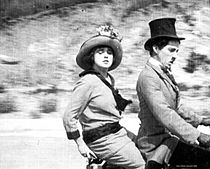
This is a very well-known and famous Keystone short but perhaps more because of Mabel Normand and Charlie Chaplin feud in the backstage than the film itself. Supposedly Chaplin had disagreements with Normand on the type of humor of the film and he also did not like the fact that he was directed by a very young woman. Apparently, Mack Sennett (the head and founder of Keystone studios) intended to fire Chaplin, but he had requests of more Chaplin’s films by film exhibitors, which showed Sennett that it would not be a good idea to get rid of an actor who was actually being successful.


However, film is good enough to be successful on its own right and much of this film’s merits come from Mabel Normand herself. She, like her character in the film, was a woman ahead of her time, very physically skilled and brave, which was something completely new compared with 1910s angelical, virginal standards of femininity.


In his first year in films, Chaplin’s little tramp was not already the likeable fellow the world would admire so much. He was a rough man and far from being a gentleman, the kind of guy who would shamelessly make a woman fall on a water pond while taking her out, just like he did with Mabel in the beginning of film. He also did not hesitate in slapping Mabel back after she slapped him. Chaplin would also pursue this rough style of flirting in the film “Tillie’s Punctured Romance” with Canadian actress Marie Dressler, which was also produced by Keystone in that same year.


Something that also looks weird in this early representation of the little tramp is Chaplin’s top hat and exaggerated gestures, an acting that closely resembles Ford Sterling’s and villains of comedic vaudeville or stage plays. Fortunately to Chaplin, he soon improved his character, as those nearly surreal villains soon got out of fashion in films.


Chaplin, after being jealous of another suitor of Mabel, tried to destroy the other guy’s car. Both Mabel and the other suitor find out that Chaplin caused the harm and it caused a fight of bricks and even Mabel took an active part in it. After a while, we can see that the other guy would take part in a car race.


Unfortunately, her suitor ended up being kidnapped by Chaplin and his accomplices and did not show up for the race on time and Mabel, who was in the audience, realized there was something wrong. We can also see Mack Sennett himself in the audience, playing an unsophisticated and simple man. Having started his cinematic career as an actor in Biograph studios, in the first years after Keystone studios was founded, it was not unusual that the boss himself both acted and directed in films, a trend that would soon be over, as it did not take long until Sennett focused himself on administrative tasks of the studio.

Mabel stood up and approached the mechanic, she exchanged her clothes and got into the car that was supposed to be driven by her sweetheart. Many driving scenes were made, which was still a novelty back to 1914, considering that cars were not even very common yet and it was even more unusual to see a woman driving. But this did not stop Mabel and, considering she had even driven an airplane in a 1912 film (A Dash Through the Clouds) and wore a swim suit in another film also in 1912 (The Water Nymph), driving a car was not probably a big deal to her.


Despite the dangers along the way, Mabel drove so skillfully that she won the race and just in time to be observed by her sweetheart, who managed to free himself from the place where he was taken hostage. Rather than being victim of prejudice, Mabel was actually praised by the other guys, generated some publicity (we can see in the end of the film that a cameraman approached Mabel to film her) and was treated as an equal by the other pilots. Meanwhile, Chaplin was quarreling with his accomplices and looked even more mentally disturbed and evil than in the beginning of the film.

The Close Call (USA, 1914)

Until Our Gang series of comedy short films started being made by Hal Roach studios, in the 1920s, it was not a commonplace in Hollywood children being portrayed simply playing and with their own universe being shown in films, where children played themselves in main roles, rather than being portrayed by adult actors, without plots being grounded on fantasy.

Without doubt, the most famous 1910s adult actress who played such fantasy roles was Mary Pickford. Pickford’s superstardom and the undeniable commercial success of her films, did trigger the appearance of other petit actresses playing children roles on screen, like Marguerite Clark, who would star Snow White (USA, 1916), among others. But, although those films did portray the children’s universe on screen, the actors were still adults and situations were not often real life ones.

In the 1910s, children did take part in films, more often in supporting roles when the plot was not really related to them. They could even be shown in films revolving around their matters, but studio moguls have not yet found out the potential of showing children’s actors in naturalistic acting, simply being themselves. But this situation would slowly change with time.

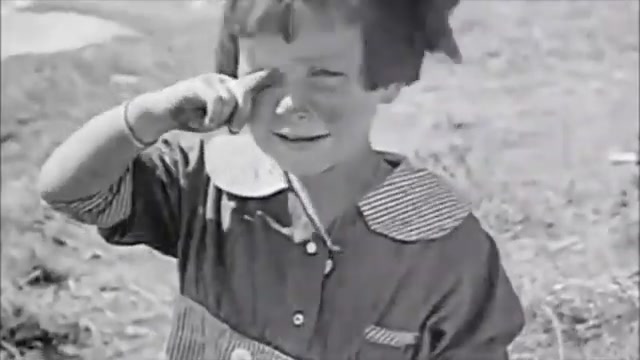
In this film we can see some cute children, boys and girls together, walking outdoors in a beautiful and tranquil nature landscape. A pair of children is younger than the other one. All of them are portrayed unaccompanied by adults and even mischievous. After a while, the youngest girl started walking all by herself and ended up falling down a cliff in a deserted place. 

The older children realized something wrong had happened and cried for help. Meanwhile, the young boy tried to save the younger girl. The mother of the little girl was located and she gathered more adults to help saving her daugther. 

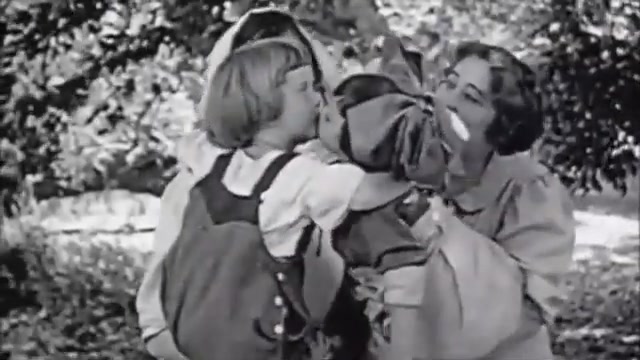
While the adults tried so hard to save the little girl, she was actually being saved by the little boy, who got to find his sweetheart before anyone else. As time passed and the adults could not find the girl on the cliff they got very nervous, but after a while the girl was found safe and sound in the company of the boy. Everyone was very happy and after the girl had told what happened and how she was rescued, both children embrace.

Something that may have helped giving a naturalistic touch to this film is that some of those children were too young to read, which made them not adhere to a script and it consequently gave more freedom to improvisation. The landscape, not much altered by the human hand and without cars and big cities around also give a good atmosphere. We can also observe that first love was shown subtly and innocently, which was also something uncommon in children’s films of the era. At this time, the border between films to adults and children was not still very clear, so this film was surely watched by both adults and children cinema audience members alike. All those elements reinforce the innocence of the playing. 

The Broken Spring Rose (Sweden, 1912)

A fine melodrama, with good and subtle acting, good use of nature landscapes and a narrative, straight plot. That means the plot has a narrative style which would become the norm in cinema ever since, opposite to so-called “trick films” (like those made by French director Georges Méliès on early XX century). When it comes to acting, the plot developed without broad gestures or epic plot twists, differently from some other melodramas of the 1910s.

Although the plot may seem manicheist and outdated, it is not very different from what many other directors produced at the same era, such as D.W. Griffith in the United States, Urban Gad in Denmark, Yevgeni Bauer in Russia, among many others.

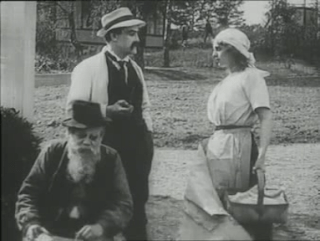
The film starts in a rather idyllic way, with good country people enjoying their lives in total connection with nature. The landscape helps to settle the atmosphere of tranquility to the audiences and gives an extra nostalgic touch to the film of an era that was already fading due to early XX century urbanization. Unfortunately, this tranquility is suddenly shattered due to an unsolved love story. 

The engagement between a wealthy boy and a girl who worked to his family was suddenly broken up by his father, which caused a big heartache on the couple. To make things worse, the boy’s father suddenly took an interest to the girl, until the point he started chasing her and raped her, which truly disgraced her life and made her fall into prostitution. The theme of the innocent girl who has a tragic fate due to circumstances had already been common both at the stage and cinema.

This film is also considered the first to ever be censored in Sweden. Although there were not any actual rape scenes and the event was mostly suggested rather than shown, this per se was enough to shock the censors. It was also considered a lost film for many decades until it was found in 1980 and it seems some scenes were removed from this printing compared with the original full film. 

The director Victor Sjöström, after already been successful in his native Sweden, became known worldwide in the 1920s due to his work in Hollywood, where he directed high-budget films and worked with the stars of his day. When the talkie era took over, he returned to Sweden and barely directed again, devoting himself solely to acting. This film shows that Swedish silents have already been quite well developed in the previous decade to such 1920s golden era and that professionals who went to Hollywood were already active and producing films at the same level of best silent films from Europe and the United States.

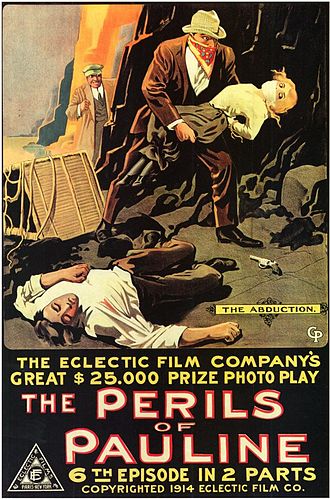
The Perils of Pauline (USA, 1914)

It was one of the first female series in Hollywood, although it was not the very first one. It is often mistaken as the very first serial because it was the first one to have had a huge popularity among audiences. Pauline was a rich heiress, who is pushed to marriage, but prefers to wait a little more and live more adventures in life, while she gets ready to become an author. Her refusal is understandable, as having a husband would make her leading a life totally focused on family affairs rather than exploring the outside world.


Furthermore, Pauline`s guardian wants to make sure that she will end up dying before getting married, so he can keep the money to himself. He interferes with Pauline`s adventures so that they are more dangerous than they were supposed to be.


Although the psychological profile of characters is somehow shallow, including in some rather simple matters like, for instance, who were Pauline`s parents? Which was her past? Was she a romantic lady or more modern-oriented? And so on. We can compare her with other 1910s characters, such as those made by Lillian Gish in Biograph studios and we can see how independent and less Victorian Pauline was compared with her contemporaries. This approaches Pauline to characters played by actress Mabel Normand in Keystone studios, all of them independent, bold, fierce, untamable women, ready for an adventure and strong in their own right.


Broad gestures and exaggerated facial expressions are still noticeable in acting by different actors and it is understandable, as the transition to a more natural acting style was still ongoing in American films in middle 1910s. However, a more natural style was starting to take root and it would not take a long time until the theater-based gestures and mannerisms was overcame.  For example, films by D.W. Griffith and Mary Pickford were already popular when this serial was launched and the subtle acting portrayed in them would soon become the norm in Hollywood.


Although associated with the stereotype of “damsel in distress” Pauline was less helpless than typical women of her era and despite all problems, she did get to have adventure moments. The plot has a plenty of adventure and exoticism, both of which were into fashion back to the 1910s. In this first chapter we can even see Pauline in a balloon. In an era when travelling was difficult and time-consuming, audiences could experience different things, even though those things were often portrayed in a stereotyped way.


It was originally filmed 20 chapters, but the only surviving version is from a French print edited into nine chapters, released in 1916. We can also observe that the villain had a German name (Koerner) due to animosity against Germany during World War I. There were also problems with the re-translation into English of intertitles which were previously translated into French in this nine-chapter version which gives modern audiences the impression of involuntary humor due to typos and weird structure of sentences.
Actress Pearl White made most of stunts of this serial and while filming it she suffered a spine injury which would bother her for the rest of her days. White was athletic in real life and her physical skills matched her role completely.


As it was previously said, many chapters were cut off this re-release, but the remaining ones give a good overall idea of how this serial was like. In an era when cartoons were not popular yet, it was real-life actors who had to make the dangerous stunts, so audiences would get their own thrill. Years later, it would become hard for actors to keep up with cartoon characters and the nearly infinite possibilities of what they could do to endanger their lives and remain alive anyway, but it was not yet a reality back to the 1910s. It must also be added that this series does not use the cliffhanger, but the episodes are self-contained instead. It was a popular hit and made Pearl White become a star. She remained in high demand in serials until the end of the decade and after this time she worked in Europe until her retirement some years later. 

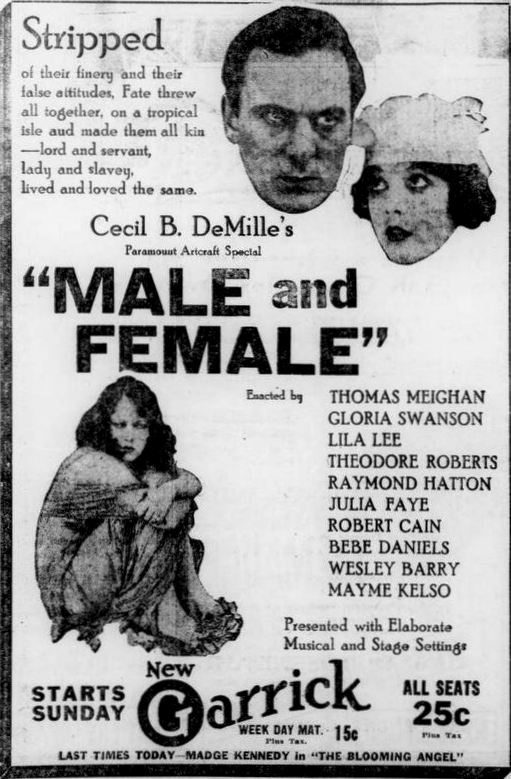
Male and Female (USA, 1919)

Cecil B. de Mille being himself in a film that turns extravagant –and also with sceneries of great proportions at some moments – and a young Gloria Swanson. Although unknown for many people, Swanson started her career very young being an actress in slapstick comedies (she even worked for Keystone studios, which produced some of the most frantic comedies of silent era), but she had dramatic ambitions all along and by the time this film was made she started pursuing them.

An adaptation of the play “The Admirable Crichton” by J.M. Barrie, the film approaches differences of classes with subtle humor and sometimes audiences do not even feel time pass because the film has a very relaxed vibe. How a British aristocrat (Gloria Swanson) connected with her butler gives room to some original gags, especially after they both get involved in a shipwreck. Needless to say that none of those rich aristocrats have the required skills to survive in a stranded land, but it turned out that the butler could handle the situation. It also comes from this film the famous scene where Swanson is lying down with a real lion around her. 

In the beginning of the film lives of rich people are depicted as opulent and empty. The scenes are funny with the futility of people`s requests towards the servants and we can also see Gloria Swanson in beautiful clothes. The servants are shown as slightly more grounded people, as their lives are closer to realism. A maid is in love with the butler, who is in love with Swanson. On the other hand, Swanson has a friend who married her chauffeur and had to face lots of social difficulties because of that. Needless to say that Swanson disapproved the marriage, which made her butler heartbroken.

The scenes of those people mingling together while stranded in the islands are entertaining, even though they are far from realistic. Clothes were always in good conservation state, they never faced real famine and could even have access to some comforts, such as books. This gives a touch of involuntary humor to the film, which makes it even more enjoyable to modern audiences.  Although the plot is sometimes exaggerated, the acting of main actors remain relatively self-controlled and subtle and it reinforces the good portrait of lives of educated and refined characters.

There is also the interesting approach of not sugar coating the difference of classes and that love does not always overcome it. No, the plot is not about the so-called battle of the sexes. Intertitles can be witty but they are also sometimes a bit too long, even tiresome. If they were kept simpler, it would be perhaps easier for audiences to understand the subtle humor and it is also a factor that makes the film seem outdated nowadays.

The Babylonian sequence may be a feast for the eyes, but it is not really necessary to the development of the plot. By the way, a Babylonian king having a Christian slave? Perhaps it is a little historically inaccurate? We can see here the famous sequence of Swanson with a real lion (who was presumably dangerous) and legend has it that she insisted on doing that scene herself. This might be true, because if we analyze the comedy films Gloria Swanson made earlier in her career we can observe that she have already done a plenty of relatively dangerous stunts already in her teens. 

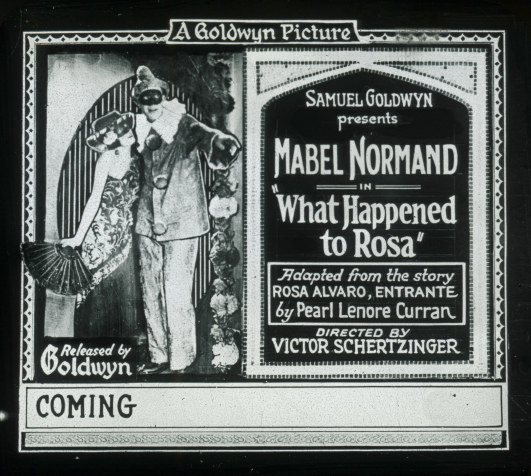
What Happened to Rosa (USA,1920)

Mabel Normand made a name for herself for her slapstick comedies for Keystone studios in the 1910s, even though she had worked for other studios both before and after that.  And even had her own modelling career before becoming an actress. Normand was a real pioneer of early cinema because she was brave, did her own stunts with competence and got a really spontaneous and relaxed screen persona back to an era when the helpless damsels in distress were so popular. Furthermore, she also directed her own films already at the time when she worked at Keystone (consequently, before this film was shot).


At the time this film was made, Normand was inclined to make more situational-oriented romantic comedies, without the frantic rhythm, broad gestures and physical gags of slapstick comedies, similar to those by her real-life friend Mary Pickford. This shift in her career could show the audiences that Normand was also a very good, natural actress, who could be funny and emotional in all kinds of films.
Produced by Goldwyn studios, this film is not usually considered one of her best, it is entertaining and in touch with cinematic trends of its era, including those of exotic environments being portrayed in the most stereotypical way possible.


A hard-working saleswoman in a department store with a boring life, looking forward to some excitement, once met a clairvoyant woman while working. Although it was clear that the clairvoyant was a charlatan, Mabel ended up scheduling an appointment and ended up being told she was a Spanish dancer in a previous life. Mabel got carried away with this story and started acting like a Spanish dancer, which made those around her think she was losing her mind.


The appointment`s scenes are among the funniest of the film. The clairvoyant`s house was full of exotic objects from Egypt and at the same time that Mabel was scared, she was also fascinated for being there. The more exaggerated acting of the clairvoyant is also a good contrast to the more self-contained acting by Mabel, which highlights the awkwardness of the entire situation.


Although Normand`s acting is not as groundbreaking as it was back to 1910s, her talent was still there and she got to be entertaining and the audiences can even see pathos in the poor working girl who was stuck in a life of hard work and boredom and only wanted some excitement and distraction from routine. Things would be even more complicated to Normand after she fell in love, especially because she was often more awkward than seductive towards her love interest.


It is sad to think that Normand would pass away circa 10 years later, but her versatility could be seen in her 1920s output in films that could be modern fairy tales of the ordinary next-door girl with a heart of gold who only wanted to find some happiness in life. It is impossible not to see similarities with the role played by Clara Bow in It (USA, 1927), starting with the similar occupations of characters of both films. The difference was that Bow had a touch of innocent seduction in her character, was Normand was a romantic, optimistic girl.


It is also noteworthy that actor Adolphe Menjou can be spotted in some scenes. His career would still continue throughout the talkie era. 

Help! Help! (USA,1912)

This film was not made at Keystone studios of California, but at Biograph studios of New York, the same that gave D.W. Griffith to the world. The film was directed by Mack Sennett, who in later years would say he learned a lot while working with Griffith at Biograph.  However, while already in Biograph studios, Sennett focused his work in comedies, both as an actor and director and it was where he started honing the comedic pattern that would soon be famous at Keystone studios.

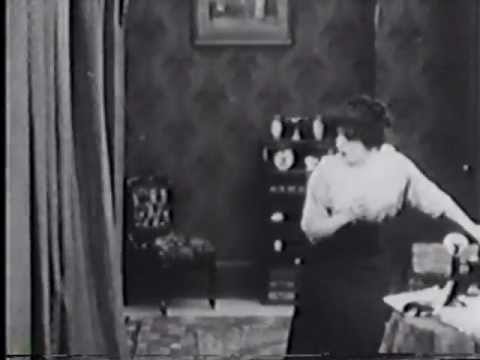
The style of the plot was not the frantic slapstick yet and even Mabel Normand’s acting was different from what she would show at Keystone studios. She played the role of a typical damsel in distress with some touches of overacting, which was something still common in Hollywood at that era. It was portrayed in this film the lifestyle of middle class citizens, rather than working class ones, as it would be so common in Keystone films. 

Mrs. Suburbanite (Mabel Normand) read in a newspaper that burglars were operating in the neighborhood, as one of intertitles says, and she immediately talked about it to her husband because she was really impressed with what she read. Then, Mr. Suburbanite (Mabel’s husband, played by actor Fred Mace) went to his workplace, an office in the city. Meanwhile, Mabel saw some suspicious-looking men and she locked the door and hide the key. 

Mabel called her husband at his office because she thought there were burglars at their house. He left the office by car at once, but unfortunately the car stopped in the middle of the road. At the same time, Mabel was even more afraid at home, as she realized the curtains were moving. The husband got to make the car work again but it ended up stopping on the road again. After a short time, the he got to find another vehicle to take him back home but no success again. Against all odds, the husband got to return home on foot.

As a typical damsel in distress, Mrs. Suburbanite nearly fainted when she realized her husband was back. The happy end was assured when it was found out that the burglar was actually only a small animal.

Some reviewers claim that this film was probably a parody of some previous films by D.W. Griffith, such as The Lonely Villa (USA,1909) and The Lonedale Operator (USA, 1911). The statement makes sense and it could also be a parody of the stereotype of damsels in distress, a spoof that would be included in subsequent films of Keystone studios directed by Mack Sennett, such as Barney Oldfield’s Race for a Life (USA,1913). 

Fred Mace followed both Sennett and Mabel to Keystone studios when it was founded in 1912 and made a plenty of films there in the first few years and became a rather popular actor, but his career would not last much longer. Firstly, he left the studio and then returned and finally Mace passed away in 1917 with only 38 years old. 

Create a website or blog at WordPress.com

Up ↑