Just Pals (USA, 1920)

With naturalistic acting of children, similar to what the audiences would see years later in Our Gang films, this film deals with the theme of friendship that crosses social statuses and social rules. Behind the Western scenery there is a rather universal plot. The tender relationship between a boy and an adult man would also be brilliantly shown in another famous film, launched by Charlie Chaplin on the following year, The Kid (USA, 1921).

A recurrent character is classic westerns is of the rude cowboy with a heart of gold and strong sense of ethics and loyalty despite the lack of a formal education and such character is also shown in this film. A kid who was not liked by the adults of his place because he was considered too indisciplined. A man (Bim), who was as marginalized at the town as the boy, develop a solid friendship after Bim defended the boy of being beaten up. At first, they were just colleagues who got along well regardless of the difference of age. Time passes, the mutual affection between them develop until it becomes a virtually fatherly connection, especially after the boy risked his life in a moving train so he could get a uniform, as Bim would only be offered a job as a porter if he had a uniform. So, the boy tried to get a uniform to Bim.
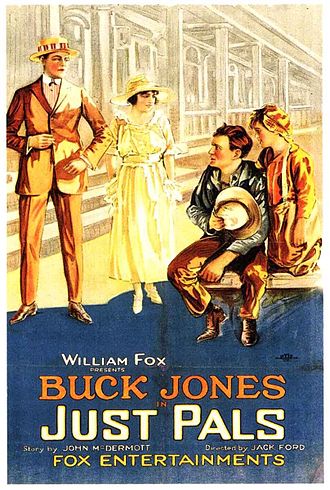
Their mutual bonds of affection have deeply positive effects on both Bim and boy. Bim managed to persuade the boy to attend the school and Bim realized he had to be more responsible and find a job so he could provide for the boy. But the boy got injured after falling off the train in an attempt to get the uniform. Bim got desolated and took the boy the house of the city’s doctor. The doctor and his wife tried to separate Bim from the boy by saying to Bim that he should cut off contact with the boy and afterwards by telling to the boy that Bim had abandoned him. 

A dishonest accountant persuaded the town’s elementary school teacher to deliver him the school’s fund to compensate a loss he had while making business and claimed he would return her the money as soon as the school needed it. The school suddenly needed the funds, the teacher asked the accountant to return the money, but he did not do it. In desperation and afraid of having her reputation misjudged, the teacher attempted suicide by drowning herself in the local river, but she survived. Bim took the blame of the money deviation to protect the teacher’s reputation. He did it out of love, as it had been previously shown in the film that he loved her, but he was embarrassed of saying it to her, as he was the bum of the town and not socially respected.

A gang of robbers threatened to rob the city, Bim tried to stop the criminals from doing so but he was misjudged as a member of the gang by the town’s sheriff. There was an attempted lynching of Bim and chaos happened. He is about to be hanged on a tree by furious dwellers of the city, but the boy appeared on the scene and told the adults that the man who really planned to robbery of the town was inside of the school. While the lynching was taking place, the crooked accountant showed up at the school and demanded the teacher to hide him and that he was running away from the city and the teacher had to go with him.  

The boy’s plead took the desired effect. Bim is released and the furious mob enters the school in time to find the accountant fighting with the teacher. The accountant tried to run away, but he is caught by the police and the money of the school’s fund was with him. The teacher was very touched by the sacrifice Bim made for her sake and both him and the boy became the heroes of the town. Bim was almost separated from the boy again when a man arrived in town saying he was the boy’s father, but it turned out his son was actually another kid.

After a while, after enjoying respectability for a while, both Bim and the boy arrive at the school, in socially accepted clothing and looking a bit awkward. It is clear from the beginning that Bim wanted to ask the teacher if she would date him and she apparently gladly accepted it. And the film ended happily, with Bim keeping the boy, both of them leading straight lives, and Bim also had the girl he had always loved.

Four Sons (USA, 1928)

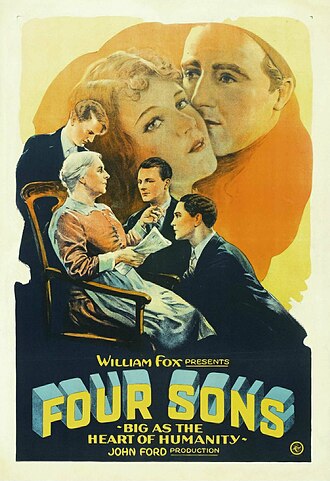
This film follows the same production and plot values of films like, The Big Parade (USA, 1925), among others. WW1 is shown irrespective of politics, focused on the impact of war in the lives of ordinary citizens, who for the first time in life have the deal with events completely beyond their control changing their future forever.

Without falling into melodrama, this film has a smooth, pleasant pace, quite familiar to modern-day audiences.  The fluid camera movement makes it looks like we are following those characters in real life. The film is so moving because it deals with facts with which most people can identify themselves quite easily, like the importance of having a harmonious family. 

Fox studios had recently hired prestigious German director F.W. Murnau. His influence can be observed in some scenes, for example, in the village, mobilized camera and mailman which is like the doorman in The Last Laugh (Germany, 1924).

The setting is Germany in the beginning of XX century and a widowed mother raising her four adult sons. The view of German lifestyle at that film is somehow stereotyped, as we can see even by the clothes of the village dwellers.  The Bavarian wearing their typical clothes everywhere all the time.

Then the war started. At first, the bothers are shown going to war in a rather romanticized way, as brave men who were fighting for the country and ideals and they left in a rather optimistic mood, saying they would be back in three months. At least, that was the atmosphere before the real horrors or death and suffering began. Three of those brothers fight for Germany, but the one of brothers had immigrated to the United States, being on the opposite side of his three other brothers. 

At first, the brother who immigrate to the USA had a calm life together with the family he formed there, after all the United States was neutral at first. But time passed and two of the brothers were unfortunately killed in action, which brought a huge grief to the mother. In addition to it, the life of the mother and her surviving son worsened terribly when they started being bullied by government authorities and things became hell after it was found out that her another surviving son is in America.

Finally, the last surviving brother in German soil is called to go to the army. At that point, the horrors of war were already undeniable. 

The mother eventually found her happiness again, after much struggle, when she managed to reunite in the United States with her surviving son, daughter in law and grandson. Things were not easy to her when she arrived, she was scared and sore, but after the entire family gathered together the wounds started to heal. Of course that to reach this happy end it was required a plenty of coincidences that we could only see in films. 

At the end we realize that it does not matter in which side of the war people are involved, the suffering and hardship affects everyone, family ties struggle and trauma is huge even in people who did not go to the front directly. 

The Close Call (USA, 1914)

Until Our Gang series of comedy short films started being made by Hal Roach studios, in the 1920s, it was not a commonplace in Hollywood children being portrayed simply playing and with their own universe being shown in films, where children played themselves in main roles, rather than being portrayed by adult actors, without plots being grounded on fantasy.

Without doubt, the most famous 1910s adult actress who played such fantasy roles was Mary Pickford. Pickford’s superstardom and the undeniable commercial success of her films, did trigger the appearance of other petit actresses playing children roles on screen, like Marguerite Clark, who would star Snow White (USA, 1916), among others. But, although those films did portray the children’s universe on screen, the actors were still adults and situations were not often real life ones.

In the 1910s, children did take part in films, more often in supporting roles when the plot was not really related to them. They could even be shown in films revolving around their matters, but studio moguls have not yet found out the potential of showing children’s actors in naturalistic acting, simply being themselves. But this situation would slowly change with time.

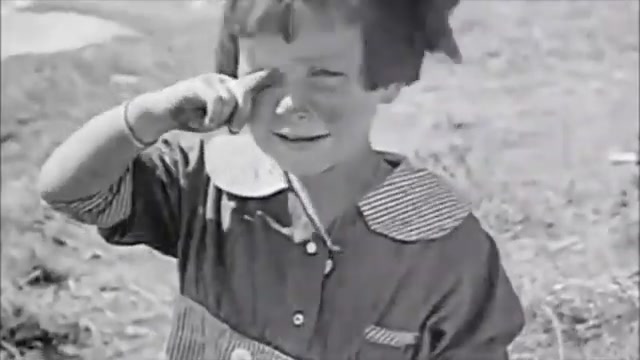
In this film we can see some cute children, boys and girls together, walking outdoors in a beautiful and tranquil nature landscape. A pair of children is younger than the other one. All of them are portrayed unaccompanied by adults and even mischievous. After a while, the youngest girl started walking all by herself and ended up falling down a cliff in a deserted place. 

The older children realized something wrong had happened and cried for help. Meanwhile, the young boy tried to save the younger girl. The mother of the little girl was located and she gathered more adults to help saving her daugther. 

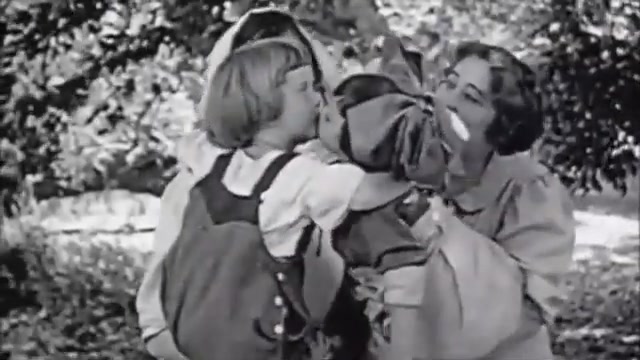
While the adults tried so hard to save the little girl, she was actually being saved by the little boy, who got to find his sweetheart before anyone else. As time passed and the adults could not find the girl on the cliff they got very nervous, but after a while the girl was found safe and sound in the company of the boy. Everyone was very happy and after the girl had told what happened and how she was rescued, both children embrace.

Something that may have helped giving a naturalistic touch to this film is that some of those children were too young to read, which made them not adhere to a script and it consequently gave more freedom to improvisation. The landscape, not much altered by the human hand and without cars and big cities around also give a good atmosphere. We can also observe that first love was shown subtly and innocently, which was also something uncommon in children’s films of the era. At this time, the border between films to adults and children was not still very clear, so this film was surely watched by both adults and children cinema audience members alike. All those elements reinforce the innocence of the playing. 

Create a website or blog at WordPress.com

Up ↑