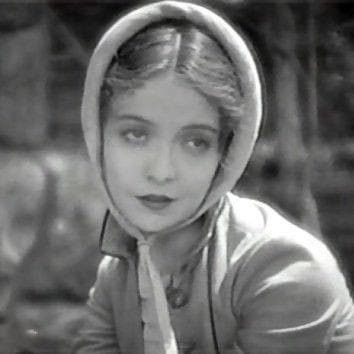
What Happened to Rosa (USA,1920)

Mabel Normand made a name for herself for her slapstick comedies for Keystone studios in the 1910s, even though she had worked for other studios both before and after that.  And even had her own modelling career before becoming an actress. Normand was a real pioneer of early cinema because she was brave, did her own stunts with competence and got a really spontaneous and relaxed screen persona back to an era when the helpless damsels in distress were so popular. Furthermore, she also directed her own films already at the time when she worked at Keystone (consequently, before this film was shot).


At the time this film was made, Normand was inclined to make more situational-oriented romantic comedies, without the frantic rhythm, broad gestures and physical gags of slapstick comedies, similar to those by her real-life friend Mary Pickford. This shift in her career could show the audiences that Normand was also a very good, natural actress, who could be funny and emotional in all kinds of films.
Produced by Goldwyn studios, this film is not usually considered one of her best, it is entertaining and in touch with cinematic trends of its era, including those of exotic environments being portrayed in the most stereotypical way possible.
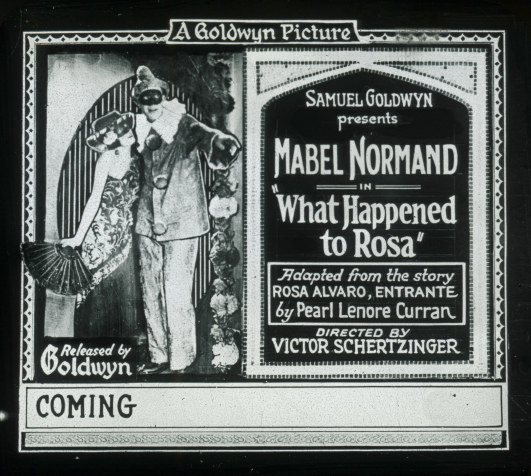

A hard-working saleswoman in a department store with a boring life, looking forward to some excitement, once met a clairvoyant woman while working. Although it was clear that the clairvoyant was a charlatan, Mabel ended up scheduling an appointment and ended up being told she was a Spanish dancer in a previous life. Mabel got carried away with this story and started acting like a Spanish dancer, which made those around her think she was losing her mind.


The appointment`s scenes are among the funniest of the film. The clairvoyant`s house was full of exotic objects from Egypt and at the same time that Mabel was scared, she was also fascinated for being there. The more exaggerated acting of the clairvoyant is also a good contrast to the more self-contained acting by Mabel, which highlights the awkwardness of the entire situation.


Although Normand`s acting is not as groundbreaking as it was back to 1910s, her talent was still there and she got to be entertaining and the audiences can even see pathos in the poor working girl who was stuck in a life of hard work and boredom and only wanted some excitement and distraction from routine. Things would be even more complicated to Normand after she fell in love, especially because she was often more awkward than seductive towards her love interest.


It is sad to think that Normand would pass away circa 10 years later, but her versatility could be seen in her 1920s output in films that could be modern fairy tales of the ordinary next-door girl with a heart of gold who only wanted to find some happiness in life. It is impossible not to see similarities with the role played by Clara Bow in It (USA, 1927), starting with the similar occupations of characters of both films. The difference was that Bow had a touch of innocent seduction in her character, was Normand was a romantic, optimistic girl.


It is also noteworthy that actor Adolphe Menjou can be spotted in some scenes. His career would still continue throughout the talkie era. 

Saved from Himself (USA, 1911)

This is a film by Biograph studios of New York, directed by famous  D.W. Griffith (who started working at the studio in 1908 as an actor and soon became a director and chief direct of Biograph) and one of protagonists is Mabel Normand, one year before she moved together with Mack Sennett and Fred Mace to the Keystone studios, which had just been founded.  It is interesting to see Mabel acting in a non Keystone, drama film. 

Mabel Normand, despite being more famous for her comedies, was a versatile actress and did well in dramas too. When this film was made she was circa 18 years old and already had a natural and convincing acting.  In Biograph she played naïve young maidens, damsels in distress, in addition to comedic ladies.

Joseph Graybill (1887 – 1913) is an actor about whom not much is known. He passed away in 1913 still in his 20s and had a successful career both on stage and cinema and is more noteworthy for having worked with D.W. Griffith in his first years at Biograph studios. 

The title of this film is self-explanatory and the plot has some typical Griffith`s touches, especially in the moralizing end. An example of that is evident already in the first intertitle, which says: “His sweetheart`s influence saves him from dishonor”. Back to an era when having a good social reputation was something taken much more seriously than nowadays.

Motion picture poster for Three Friends, a Biograph Studios release, shows three men clasping hands while sitting at a table in a bar. 1 print (poster) : lithograph, color ; 104 x 70 cm.
Source: Wikimedia Commons

A young clerk (Joseph Graybill) is engaged to a stenographer (Mabel Normand). His old friend had just won lots of money in the stock market, which encouraged him to also invest his money this way. He was so impressed that he actually used all his savings to purchase stocks. Unfortunately, things did not happen as planned and he had to put up another two thousand dollars, otherwise he would be wiped out, as one of intertitles says. He could not afford doing so and the fear of losing all his money made him consider stealing money from a hotel. 

However, his sweetheart (Mabel Normand) found it out and prevented him from doing so. Also, his thoughts about his mother made him thinking twice and it became clear that he only considered stealing the money out of fear of losing all his savings and not being able to provide a good future both for himself and his future wife. The happy ending happened because honesty and morals were preserved and it is not worth it being unscrupulous or immoral, this is the usual message of Griffith`s cinematic work.

A plenty of Griffith`s films discussed the effects of addictions, poverty and adultery over families. A recurrent theme was also the virginal, Victorian heroines, who Lillian Gish embodied so well. Those women also had high morals and kept their families united, even when the father/husband was too weak to do it himself. It often turned out that the man regretted his mistakes and reunited with his family, immediately being forgiven by his understanding spouse. Although such plots would be a bit too sexist for nowadays` standards, they show to modern audiences how life was like when things were simpler and the urban life had not fully taken root. 

A Muddy Romance (USA, 1913)

In the first few years of Keystone studios (founded in 1912), many of their films were one-reelers with quite simple storylines. Other studios produced similar comedies, both in the USA and abroad. Short films were still the most common length of films, as feature-length films were still at the very beginning. Films like Cabiria (Italy, 1914) and The Birth of a Nation (USA, 1915) –some of the films that would help to consolidate feature length films as more popular – were yet to be produced.

In a landscape that looked remarkably rural, Ford Sterling –with his typically exaggerated gestures and mannerisms – was by a window, flirting with Mabel Normand, who was in another window. However, there was another man interested in Mabel (“a persistent suitor”) and he came to her house to visit her. Sterling did not really seem pleased when he realized there was a competitor for Mabel`s affection. Sterling also came to visit Mabel, but the other suitor was still there and both men clashed. Sterling tried to attack the other guy, but ended up hitting Mabel with dirt instead. At this point, both men fought and Mabel tried to intervene and therefore she fell out of the window. The three of them threw things at each other.

A clergyman arrived at Mabel`s house in the middle of all chaos. It seems to have come to marry Mabel and the other suitor. Then, Mabel, the other suitor and the clergyman leave in a boat while Sterling tries to shoot them as he saw the boat departing. The Keystone cops were called to try to settle the mess. The cops started shooting too and embarked on another boat and one of cops fell on the river and a short time later they got stuck in the mud. Sterling attempted to stop the boat from leaving by throwing mud on the river.

More cops came to the scene with hoses and even a cannon. The hoses were useful to take their colleagues out of mud. Unfortunately Mabel fell in the mud right afterwards, but immediately the clergyman and her other suitor helped her out of the mud. And the three of them were eventually taken out of the muddy river. Meanwhile, Sterling was into trouble, as he was caught throwing dirt on the river.

Such simple one-reelers were very popular in the era and working-class audiences could easily relate to situations being shown. Keystone films were a hit since the beginning and its actors became successful comedians. As time passed, the studio produced feature-length films (the first one being Tillie`s Punctured Romance in 1914, with Mabel Normand, Marie Dressler and newcomer Charlie Chaplin in the cast). And Keystone studios became famous for discovering young comedians who would undeniably leave their mark in cinema history. For instance, young Roscoe ‘Fatty’ Arbuckle and Charlie Chaplin worked there in the 1910s. The studio was closed in 1933, already at the era of talkies.

Create a website or blog at WordPress.com

Up ↑