One Hundred Percent American (USA, 1918)

This is a typical propaganda film, even the intertitles are clear enough about it. In one of them it can be read: “President Wilson is giving every ounce of his energy! The war workers are giving twenty-four hours a day! Pershing[1] and millions of our boys are giving their life blood”. Clear enough, right? So, before you think this film is just a simple piece of propaganda and there is no reason to watch it, let’s talk about Mary Pickford and how good she is in this film.

One Hundred Percent American (1918) - MARY PICKFORD - Arthur Rosson 26
One Hundred Percent American (1918) - MARY PICKFORD - Arthur Rosson 12

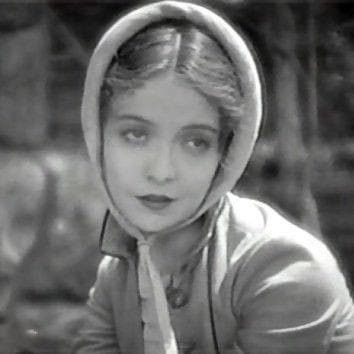
Regardless of any political view whatsoever, this film is worthwhile, as Mary Pickford shines in it. She looks as cute as ever within the last fashion. Already a superstar in 1918, she was personally involved together with fellow stars Douglas Fairbanks and Charlie Chaplin in helping the sale of Liberty Bonds, which was a war bond sold in the United States to support the allied cause in World War 1. Being the speakers of an official patriotic campaign of the American government meant that actors had obtained a high level of respectability as people capable of influencing the opinions and choices of a whole country. Things weren’t really like that when most actors’ of Mary Pickfords’ generation started in films, specially in the previous decade, but that was changed relatively fast.

Mary’s acting does not disappoint in any minute. She started acting on stage when she was a child and always did whatever she could to improve her technique.  As a result, she was an experienced actress already in her teens. Her debut in cinema was in 1909 in Biograph studios, just one year after filmmaker D.W. Griffith had joined. Although, as usual, she plays a nearly virginal girl with noble heart, she does not play here a child role and can show much of her versatility as an actress. Here she is a selfless girl who realizes the importance of not spending money with unnecessary things and use this money to purchase liberty bonds and help her country. We must not forget that Pickford was a Canadian in real life and IMDB web site says that when this film was launched in Canada, it was named “One Hundred Percent Canadian”.

One Hundred Percent American (1918) - MARY PICKFORD - Arthur Rosson 05

In 1918 Mary was already the first mega star of films, famous and beloved worldwide. She saw films as a work of art and she was personally involved in every aspect of film production. In this film, for instance, Mary wrote the scenario. As she was such good and successful actress, she obtained a level of artistic independence that was unprecedented for the time. And she made a wonderful use of that to make films that were better and better.

She was so beloved by the audiences that she became admired as a person too. Not only as a great businesswoman, but her way of dressing, her marriage with Fairbanks in 1920 and her charity work became symbols of stardom wherever she went. And that was already in 1910ies. Isn’t it wonderful?

 All in all, no matter what you think about the film’s plot, this cute little girl with a big TALENT called Mary Pickford will put a smile on your face. A good and intelligent actress, who will likely make you fall in love with her films.  And here you are some pictures that prove how beautiful Mary looked throughout the film and how her clothes were beautifully chosen.
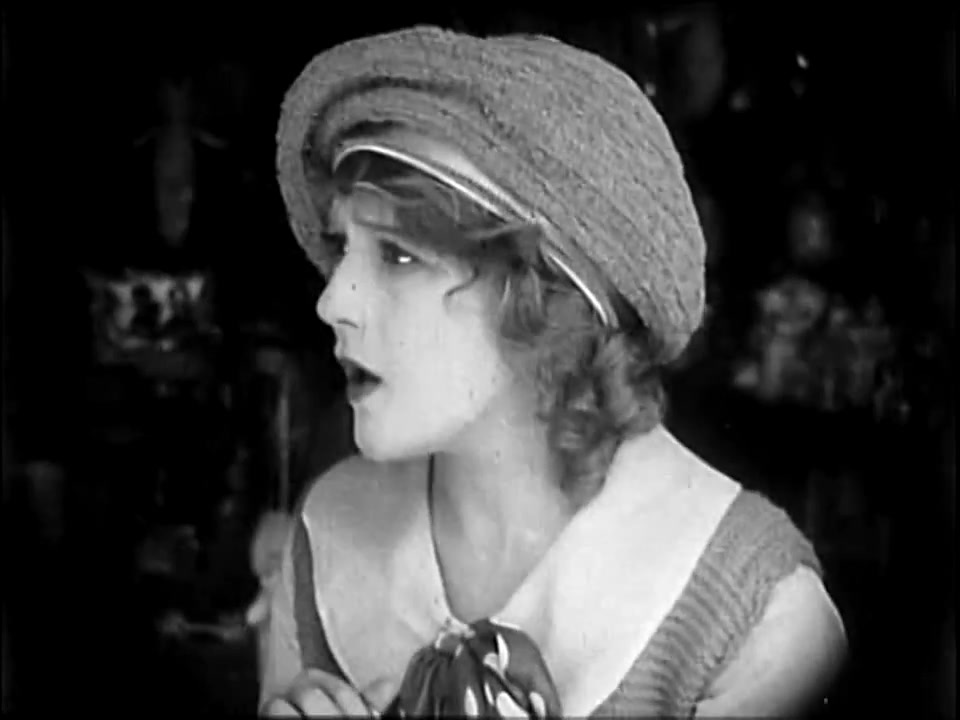
One Hundred Percent American (1918) - MARY PICKFORD - Arthur Rosson 08
One Hundred Percent American (1918) - MARY PICKFORD - Arthur Rosson 14
One Hundred Percent American (1918) - MARY PICKFORD - Arthur Rosson 40

[1] John Joseph “Black Jack” Pershing (September 13, 1860 – July 15, 1948), was a general officer in the United States Army who led the American Expeditionary Forces in World War I. Pershing is the only person to be promoted in his own life time to the highest rank ever held in the United States Army—General of the Armies (a retroactive Congressional edict passed in 1976 promoted George Washington to the same rank but with higher seniority[1]).

Source: Wikipedia http://en.wikipedia.org/wiki/John_J._Pershing

Accessed on August05th 2013

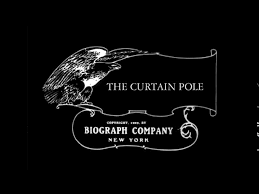
The Curtain Pole (USA,1909)

In addition to be a valuable historical witness of a era gone a long time ago, when cars were still rather new, hats were commonly worn by both men and women, etc this film is also famous for having placed together two people, who were then working for a studio which would become a integral part of history of cinema, D.W.Griffith, Mack Sennett and Biograph studios. Although they both started their cinematic careers in the same studio and were even friends in real life, their careers would turn completely different ways only some years later. 

One of few common points among both Griffith and Sennett is that both of them gave up acting in favor of directing, Griffith having remained a director throughout his career and Sennett having given up firstly acting, then directing during his first years with Keystone studios, to focus only on being a studio mogul, which he was until his studio was closed in 1933. 

It is definitively unusual to realize that Griffith directed a slapstick comedy with such simplistic plot, but we must have in mind that Griffith was still at the very beginning of his career as a director, after previously been a actor. His first directorial experience was in Biograph studios, after having briefly been a actor there. At this same studio, Mack Sennett began his career before founding the Keystone Studios in 1912. 

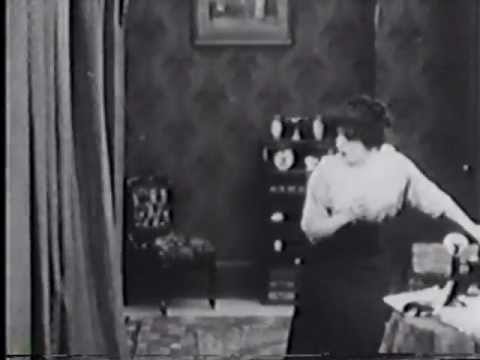
Sennett (who is barely recognizable due to a fake mustache and a disguise) is in a party in a upper class residence (the very opposite to sceneries of his subsequent comedies with Keystone studios, which usually portrayed the reality of working class citizens) and inadvertently breaks the curtain pole of the owner of the house. He volunteers to buy a new one, but ended up tripping and hitting everyone on the street with the pole on his way back to the house were he was, which caused Sennett to be chased by nearly everyone he upset. 

Against all odds, Sennett managed to return to the house, but the pole had already been replaced. The final scene shows him chewing the curtain pole out of frustration.

It is impossible not to see the similarity with 1910s films by Keystone studios, whose one of main characteristics were the fast-paced chases. Who could guess that a film with uneventful gags, broad gestures and no psychological deepening of characters could be a sample of history if cinema? Although not a particularly funny film, it is still very worthy of being watched by nowadays’ audiences. 

Help! Help! (USA,1912)

This film was not made at Keystone studios of California, but at Biograph studios of New York, the same that gave D.W. Griffith to the world. The film was directed by Mack Sennett, who in later years would say he learned a lot while working with Griffith at Biograph.  However, while already in Biograph studios, Sennett focused his work in comedies, both as an actor and director and it was where he started honing the comedic pattern that would soon be famous at Keystone studios.

The style of the plot was not the frantic slapstick yet and even Mabel Normand’s acting was different from what she would show at Keystone studios. She played the role of a typical damsel in distress with some touches of overacting, which was something still common in Hollywood at that era. It was portrayed in this film the lifestyle of middle class citizens, rather than working class ones, as it would be so common in Keystone films. 

Mrs. Suburbanite (Mabel Normand) read in a newspaper that burglars were operating in the neighborhood, as one of intertitles says, and she immediately talked about it to her husband because she was really impressed with what she read. Then, Mr. Suburbanite (Mabel’s husband, played by actor Fred Mace) went to his workplace, an office in the city. Meanwhile, Mabel saw some suspicious-looking men and she locked the door and hide the key. 

Mabel called her husband at his office because she thought there were burglars at their house. He left the office by car at once, but unfortunately the car stopped in the middle of the road. At the same time, Mabel was even more afraid at home, as she realized the curtains were moving. The husband got to make the car work again but it ended up stopping on the road again. After a short time, the he got to find another vehicle to take him back home but no success again. Against all odds, the husband got to return home on foot.

As a typical damsel in distress, Mrs. Suburbanite nearly fainted when she realized her husband was back. The happy end was assured when it was found out that the burglar was actually only a small animal.

Some reviewers claim that this film was probably a parody of some previous films by D.W. Griffith, such as The Lonely Villa (USA,1909) and The Lonedale Operator (USA, 1911). The statement makes sense and it could also be a parody of the stereotype of damsels in distress, a spoof that would be included in subsequent films of Keystone studios directed by Mack Sennett, such as Barney Oldfield’s Race for a Life (USA,1913). 

Fred Mace followed both Sennett and Mabel to Keystone studios when it was founded in 1912 and made a plenty of films there in the first few years and became a rather popular actor, but his career would not last much longer. Firstly, he left the studio and then returned and finally Mace passed away in 1917 with only 38 years old. 

A Muddy Romance (USA, 1913)

In the first few years of Keystone studios (founded in 1912), many of their films were one-reelers with quite simple storylines. Other studios produced similar comedies, both in the USA and abroad. Short films were still the most common length of films, as feature-length films were still at the very beginning. Films like Cabiria (Italy, 1914) and The Birth of a Nation (USA, 1915) –some of the films that would help to consolidate feature length films as more popular – were yet to be produced.

In a landscape that looked remarkably rural, Ford Sterling –with his typically exaggerated gestures and mannerisms – was by a window, flirting with Mabel Normand, who was in another window. However, there was another man interested in Mabel (“a persistent suitor”) and he came to her house to visit her. Sterling did not really seem pleased when he realized there was a competitor for Mabel`s affection. Sterling also came to visit Mabel, but the other suitor was still there and both men clashed. Sterling tried to attack the other guy, but ended up hitting Mabel with dirt instead. At this point, both men fought and Mabel tried to intervene and therefore she fell out of the window. The three of them threw things at each other.

A clergyman arrived at Mabel`s house in the middle of all chaos. It seems to have come to marry Mabel and the other suitor. Then, Mabel, the other suitor and the clergyman leave in a boat while Sterling tries to shoot them as he saw the boat departing. The Keystone cops were called to try to settle the mess. The cops started shooting too and embarked on another boat and one of cops fell on the river and a short time later they got stuck in the mud. Sterling attempted to stop the boat from leaving by throwing mud on the river.

More cops came to the scene with hoses and even a cannon. The hoses were useful to take their colleagues out of mud. Unfortunately Mabel fell in the mud right afterwards, but immediately the clergyman and her other suitor helped her out of the mud. And the three of them were eventually taken out of the muddy river. Meanwhile, Sterling was into trouble, as he was caught throwing dirt on the river.

Such simple one-reelers were very popular in the era and working-class audiences could easily relate to situations being shown. Keystone films were a hit since the beginning and its actors became successful comedians. As time passed, the studio produced feature-length films (the first one being Tillie`s Punctured Romance in 1914, with Mabel Normand, Marie Dressler and newcomer Charlie Chaplin in the cast). And Keystone studios became famous for discovering young comedians who would undeniably leave their mark in cinema history. For instance, young Roscoe ‘Fatty’ Arbuckle and Charlie Chaplin worked there in the 1910s. The studio was closed in 1933, already at the era of talkies.

Create a website or blog at WordPress.com

Up ↑