Oranges and Lemons (USA, 1923)

Having a very simple rural plot of an orange packer involved in conflicts and trying to escape his pursuers and with the support of the scenery for its gags, this film is still entertaining today. As the western world was still relatively rural on early 1920ies, the plot of this film comes as no surprise.

It is a typical product of Hal Roach’s studio, which produced comedies with a much less frantic pace than his competitor Mack Sennett. This film stars a relatively young Stan Laurel before his successful pairing with Oliver Hardy. Stan was English and a member of famous Fred Karno English music hall troupe that also gave Charlie Chaplin to the cinematic world. An experienced comedian even before entering films, he was in Hal Roach comedies for a while before working with American comedian Oliver Hardy.

Even though this short has a less frantic style than many of its counterparts, it is, however, a bit more physical and fast even compared to other films produced by Roach. In this film we can also see some witty intertitles, a standard practice in films by Hal Roach studios, which had some quite funny ones.

Every gag the scenery could provide was employed in this film, for instance with fruits, machinery, facilities, etc. 

An institution of silent comedies is also evident in one of the characters. A crazy fake moustache, which also emphasizes who menacing the man is. 

Some people might think it is a poorly produced film, but it is not true. We must have in mind that those “bread and butter” comedy shorts were highly popular during silent era and studios kept a steady and growing output of them to meet audiences’ demands. Some studios even produced those shorts on a weekly basis.

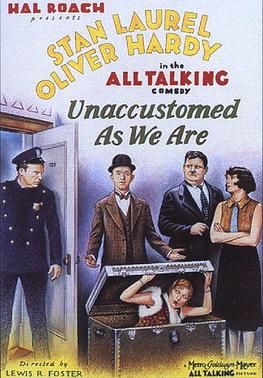
Unaccustomed As We Are (USA, 1929)

Although this film was Laurel and Hardy’s first talkie, some silent versions of this film with intertitles were also released. So, both silent and talkie versions of Unaccustomed As We Are can still be seen nowadays, even in DVD. And it was the silent version that was watched before writing this review.


The acting of Laurel and Hardy did not change very much compared with their previous silent films. Both actors had a more situational-oriented acting, not resorting too much on physical gags, even in the silent era, therefore sound films were actually quite favorable to those comedians. They also had pleasant voices, Stan Laurel even had an extensive experience on stage back to his native England (where he even worked with Charles Chaplin) and was pretty much used to dialogue in his career.


The themes of battle of sexes, henpecked husbands and rebelling wives have already been widely explored throughout the 1920s domestic situational comedies. Thus, the plot of this film was not really innovative, but it stands out due to the reliable acting of experienced comedians.


Oliver Hardy brings his good friend, Stan, to have dinner at his home to taste the delicious food of Mrs. Hardy. But unfortunately Oliver forgot to let his wife know about the visit in advance, so she could have proper time to make the arrangements. Mrs. Hardy got furious with that and says she will not cook for another crazy friend of Oliver and she leaves home rather angry, claiming she would spend some time in her mother’s house.


Oliver decides to cook for Stan, although he does not seem to be a skilled or experienced cook. Stan tries to help him, but he did not seem to be skilled with the housework either. Oliver’s next door neighbor, Mrs. Kennedy, realized both men were having problems and offered help for them to cook. However, there was an accident with Mrs. Kennedy while she was at Oliver’s house and her dress caught fire. When she was on her way back home to put on another dress, Mrs. Kennedy’s husband (Officer Kennedy) returned home.


Her husband was a though cop and Mrs. Kennedy was afraid that he would think she was actually cheating on him and would not believe she was half naked only because her dress was accidentally on fire. At first, Oliver volunteered to tell the truth to Officer Kennedy, but then he was also afraid of his neighbor’s reaction and the only solution was Mrs. Kennedy hiding herself in a trunk at Oliver’s house.

Since the silent era comedies could often revolve around misunderstandings it was not different in this film. Regretting her rant, Mrs. Hardy returned home very sad, determined to be in good terms with Oliver. She even said she would cook for Stan, but Mrs. Kennedy was locked in a trunk and had to leave the house. To disguise the delicate situation, Oliver claimed he was leaving Mrs. Hardy to go to South America and tried to go away from home taking the trunk with him.


Mrs. Hardy was furious, blaming Stan for Oliver’s decision and she got very angry again. In the middle of this chaos, Officer Kennedy arrived at Oliver’s house. Officer Kennedy volunteered to talk to Oliver, so Oliver would not abandon his wife.


He immediately realized Oliver was hiding a woman in the trunk and took it to his house, so Mrs. Hardy would not find it out what was truly happening with Oliver. What Officer Kennedy could not really imagine was it was his own wife who was in the trunk and he inadvertently started to talk to Oliver about his extramarital affairs, claiming he met some cute girls while out of home and that Mrs. Kennedy had never a clue about it.


Mrs. Kennedy heard everything while inside the trunk and was obviously furious. As soon as Officer Kennedy returned home she started arguing with her husband and even broke things on him. On the other hand, Officer Kennedy was furious with Oliver and Hardy, blaming them both for his marital problems.


Actress Telma Todd (Mrs. Kennedy) managed to show her good comedic time, funny facial expressions and a beauty that was very much within the 1930s standards. Although she was already acting back to the silent era, it was only in talkies where she could show off her comedic skills. Although she was mysteriously murdered in the 1930s, Todd made a name to herself.


Australian actress Mae Bush (Mrs. Hardy) was already an experienced comedienne when this film was made and had been in films since the 1910s. The same applies to Edgar Kennedy (Officer Kennedy), who worked with some of the best film comedians of Hollywood and had the distinction of being one of original Keystone Cops back to the 1910s. During silent era he also worked for both Mack Sennett and Hal Roach, who were among the most famous producers of comedies at the time.
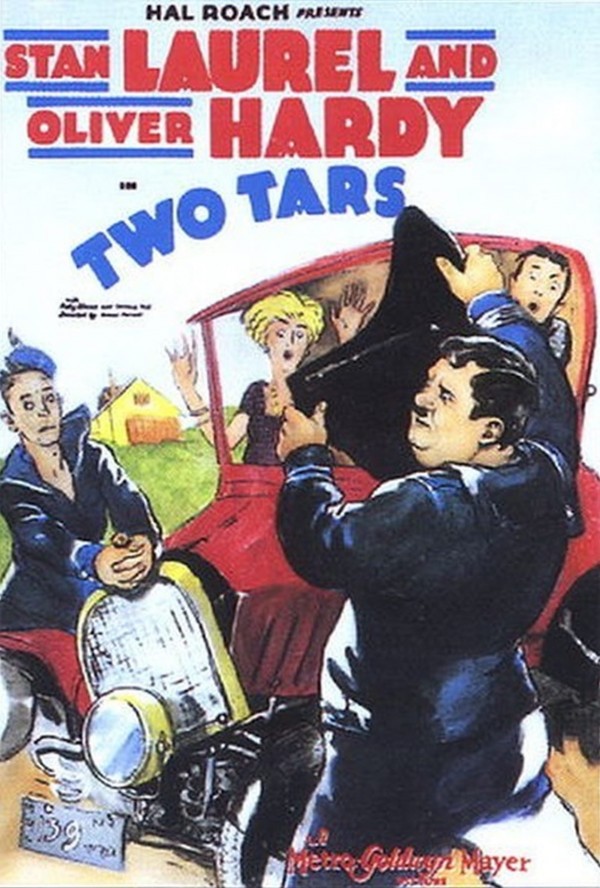
Two Tars (USA,1928)

This film is arguably among the most known silent shorts by Laurel and Hardy. This is a delicious mix of situational comedy and slapstick, of standard material of late 1920s with some subtle influence of slapstick of previous decade. Everything adapted to the so-called Jazz Era. 

Laurel and Hardy play the roles of two Navy men on their day off. They decide to rent a car, get involved in an accident and it does not take long until they meet two beautiful girls and get interested in them. An awkward conversation takes place, where the guys try to act though to impress the girls -without much success. 

The girls were having some problems with the candy machine, Laurel and Hardy tried to help them, but ended up worsening the situation by inadvertently breaking the machine and making all candies fall on the sidewalk. A furious employee of the store shows up. At first, Laurel and Hardy tried to comfront them, but after it was clear that they were not as though as they seemed, the girls took the problem into their own hands and one of them even beat up the store employee. This was a very interesting scene, as it was reversed the standard of “damsels in distress”, so popular in the 1910s, in favor of a new sort of woman that blossomed in the 1920s: The flappers, strong-willed young girls, who attended parties, smoked, and were much more liberated. 

Although the Laurel and Hardy were not exactly brave or skilled, the girls ended up going out with them in their car. The day was beautiful and everyone was happy, but then there was a traffic jam, and it is where it started the most famous part of the film. Actually, the idea of making a film in a traffic jam was pretty ingenious for 1928, as cars have not been around for too long yet. The drivers involved in the jam were understandably stressed and angry there and what started as a minor argument ended up having greater proportions, involving all drivers -including the girls themselves. 

Chaos happened and a fight started, with typical knockabout gags we could easily have seen in a slapstick comedy. This even included things being thrown, people falling down and getting dirty. This is not a very common type of a gag in Laurel and Hardy’s films, considering they have always been situational-oriented since the beginning of their duo. However, despite the clearly physical scenes of the fights during the traffic jam, we can also observe that the mechanical gags of the broken cars were well-elaborate and quite expensive for its era, especially because it was employed lots of damaged cars. Even the type of destruction each car endured were funny by themselves. 

Another noteworthy detail is how the policeman’s attempts to restore order ended up failing terribly and his authority was mercilessly ridiculed. We can see it clearly when his motorcycle was smashed in the middle of all confusion and how the policeman’s vehicle was so powerless in comparison with all those cards around him. This idea of making fun of authorities was very common in films by Keystone studios back to the 1910s, especially in films by the Keystone Cops. Although a full decade had passed and this film was produced by another studio we can see that cinema audiences still liked to laugh at the same things. 

Create a website or blog at WordPress.com

Up ↑