A Trap for Santa Claus (USA, 1909)

A simply story of humanity and feelings, a story of simple people…

Revered, controversial, famous and complex, American filmmaker David Llewelyn Wark Griffith (January 22, 1875 – July 23, 1948) had an undeniable influence in early cinema and his name is familiar to anyone who has studied cinema at an academic level and even people who are not very familiar with earlier cinema. Many great actors and actresses blossomed under his tutelage, including Lillian Gish and Mary Pickford. Loved and hated, nobody could ever imagine that a struggling actor who started his cinematic career at American Mutoscope and Biograph Company in 1908 would reach such mythical heights at his own lifetime.

Being known for feature films such as The Birth of a Nation (1915) and Intolerance (1916), the short films he directed at the beginning of his career are sometimes overlooked. Although they are clearly not as lavish and elaborate as his feature films, they represent valuable tools to understand Griffith’s style, especially when it comes to storytelling. Then we can see and assess his style in its pure form, without many resources but with careful production.

Before describing the plot of the film, you should forget about naturalistic actresses such as Lillian Gish, Mary Pickford and Mae Marsh. The Gish sisters would not enter films for a couple years. Mary was beginning her cinematic career at that studio in 1909, but is not in this film, Mae wasn’t in Biograph yet either. Acting here is much more stagey and exaggerated, particularly when it comes to women. It was Victorian-era acting in its final breath.       

This film has a quite touching story, that retains its appeal regardless of time and place. This is early 20th century, United States, but it could have happened even before that or nowadays and in virtually all corners of the world.

The father of the family is unemployed and the whole family is in a quite bad financial situation. Both husband and wife are despondent. As an intertitle says, the father is “crushed in spirit” and then he finds comfort in drinking. In addition to drinking, he also attended bars with other men who looked quite tough, which were definitely not appropriate places for a family head and father. After a while, he returns to his home entirely drunk, which only increases the despair of his wife and two children (a boy and a girl). 

After a particularly stressful argument, the father leaves “the house of sorrow”, an euphemism that means he abandoned his family. Anyway, euphemisms apart, it becomes 100% clear that he was leaving his family out of shame because he left a note to his wife before going away, claiming they would be better without him. But considering that the husband was usually the family’s sole breadwinner in the early 20th century, his departure was a dreadful shadow over the future of the family he left behind. How the wife would support her children, then? After reading the note, the woman gets understandably desperate, throws herself on a chair and nearly faints, which was typical melodramatic acting of that time. 

After leaving his family, the husband’s alcoholism probably worsened, unsurprisingly. One day, the wife goes to the city with her daughter, leaving her son alone at home, trying to find a job. Unfortunately, she wasn’t successful. While the boy was alone at home, he found some food and ate it. It was probably the last food the whole family had to fall back on and when the mother arrives back home with her little daughter and finds it out, she gets very sad.

Anyway, divine providence exists and God helps the ones who suffer and one of the wife’s aunts left her a good inheritance. The woman becomes wealthy and all her troubles are solved and she moves with her children to a fine house. Unfortunately she still doesn’t know the whereabouts of her husband. 

So it comes the night before Christmas. In an interesting plot twist, it is said in an intertitle that “There is no chimney, so Santa Claus will come through the window”. The children don’t want to sleep, they want to see Santa Claus but, with some effort, the mother made them to pray and go to the bed. But the children get to run away from bed after a short time and they set a trap for poor Santa. As a matter of fact, the mother is going to dress up as Santa Claus. 

While it all happened inside the house, we can see the father nearby and he was forced to “desperate deeds”. In other words, not having any job and having a drinking habit, his only option was robbery and he attempts to burglarize a house. It was the house where his wife and children were living. After he enters through the window, the husband is immediately caught red-handed by his wife. She recognizes him, starts overacting like crazy and the husband wonders what on Earth is she doing in that sophisticated house. 

The woman realizes her husband has become a petty criminal and the man, out of shame, begs his wife to forgive him and also starts overacting as much and she does. He tries to run away, but the wife begs him not to. His family is wealthy now and he doesn’t need to steal anymore. They both hug and reconcile. 

Then the wife has the idea of the husband making a surprise to his children by dressing up as Santa Claus. After he is dressed up, the wife calls the children to see Santa and everybody gets very happy. It’s Christmas and family is united again.

According to Kevin Brownlow[1], some of the characteristics of D.W. Griffith’s films (which in my opinion can all be seen in this film in a way or another) are the following ones:

  • The use of melodrama amid settings of complete reality;
  • The exaggerated, yet still truthful characters;
  • The fascination with detail;
  • The accuracy of dress and behavior;
  • The sentimentality;
  • The attitude toward religion;
  • The outrage over social injustice.

And you, dear reader? After reading this article, do you see any of those aforementioned characteristics in the film? Only some of them? None of all? Feel free to leave a comment and say what you think.

The Big Parade (USA,1925)

There are not enough words to write about a such film. Its theme is more alive than ever, although it portrays a war back to an era when going to the war still had a somewhat romantic aura of dying for a cause in the name of your country. Although the horrors of WW2 could not even be predicted back then, WW1 brought enough tragedies and disrupted millions of lives. 

Some of the best war films show the lives of unknown people, their dreams, ambitions, their normal pace of life being completely engulfed in a war and changed forever. Common people, whose names are not in history books, but who borne most of toll of war. Families separated, love stories brutally interrupted, entire youths torn apart forever for reasons that were completely out of their control. People who either perished or had to carry on despite a huge amount of pain. It’s impossible not feeling overwhelmed. 

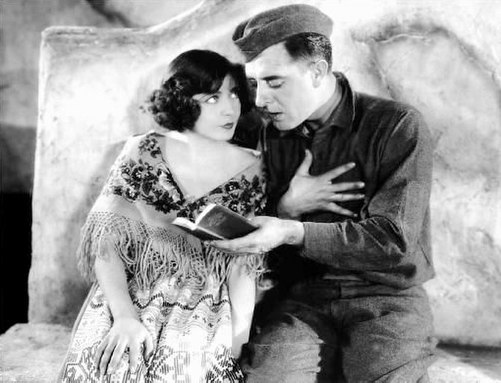
Back to late 1920s, the biggest Hollywood studios were already big and gave a plenty of examples of the sophistication that could be achieved with a high investment in both technology and human skills. John Gilbert and Renee Adoree provided beautiful pieces of acting without ever being over the top or stereotypical. Adoree is always a pleasant screen presence, showing lots of feelings in a restrained way, but really convincing, a type of acting that could resemble Lillian Gish in her heyday. 

This film can perhaps be considered the best work of John Gilbert on screen. Although he is perhaps more famous today for his films with Greta Garbo (where he also worked quite well, by the way), the character Gilbert played in The Big Parade was full of complexities and dramatic nuances that gave him full room to show off his passionate, energetic, emotional acting. And Gilbert really did not disappoint. A complex role, which he ran smoothly, in such realistic way that he could say we are seeing a friend or a relative right in front of us, as if the audience was just taking a look at a situation from real life portrayed in a documentary. 

Without focusing too much whether war was something justifiable or not, the film portrays the influence of facts out of ordinary people’s control into their lives. Although the plot could be quite sad there is a good balance between light comedy, fine irony, romance and drama. Although it is not uncommon to portray on screen the maturity of a young and careless young man into adulthood by suffering the horrors of war, this film shows it under a nice perspective. James Apperson (John Gilbert) not only endures terrible moments at war, but he also had a good time with his friends, found out true love in the arms of a French girl (Melisande, played by actress Renee Adoree), even though they both couldn’t speak each other’s language, for instance. 

The end might have been relatively happy, but until a balance is accomplished, it is portrayed how much James struggled to handle the death and suffering of his friends, but also his own physical wounds. The lives of everyone involved in war, either directly or indirectly, was changed forever. Love might have been unexpectedly found, but the mental scars would have to be handled. 

The “war to end all wars” turned out to be, both on screen and in real life, much more tragic and longer than expected. And many other wars would come. The Big Parade has the distinction of being the first great pacifist war film in the United States, even prior to famous All Quiet on the Western Front (USA,1930). Something that also unites both Adoree and Gilbert is not only the fact that this film brought them to stardom, but also that both of them would die young not too long after this film was released. It was also the first noteworthy picture of filmmaker King Vidor, who would have a successful directorial career ahead of him. 

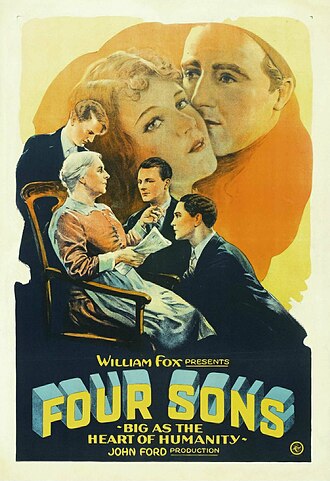
Four Sons (USA, 1928)

This film follows the same production and plot values of films like, The Big Parade (USA, 1925), among others. WW1 is shown irrespective of politics, focused on the impact of war in the lives of ordinary citizens, who for the first time in life have the deal with events completely beyond their control changing their future forever.

Without falling into melodrama, this film has a smooth, pleasant pace, quite familiar to modern-day audiences.  The fluid camera movement makes it looks like we are following those characters in real life. The film is so moving because it deals with facts with which most people can identify themselves quite easily, like the importance of having a harmonious family. 

Fox studios had recently hired prestigious German director F.W. Murnau. His influence can be observed in some scenes, for example, in the village, mobilized camera and mailman which is like the doorman in The Last Laugh (Germany, 1924).

The setting is Germany in the beginning of XX century and a widowed mother raising her four adult sons. The view of German lifestyle at that film is somehow stereotyped, as we can see even by the clothes of the village dwellers.  The Bavarian wearing their typical clothes everywhere all the time.

Then the war started. At first, the bothers are shown going to war in a rather romanticized way, as brave men who were fighting for the country and ideals and they left in a rather optimistic mood, saying they would be back in three months. At least, that was the atmosphere before the real horrors or death and suffering began. Three of those brothers fight for Germany, but the one of brothers had immigrated to the United States, being on the opposite side of his three other brothers. 

At first, the brother who immigrate to the USA had a calm life together with the family he formed there, after all the United States was neutral at first. But time passed and two of the brothers were unfortunately killed in action, which brought a huge grief to the mother. In addition to it, the life of the mother and her surviving son worsened terribly when they started being bullied by government authorities and things became hell after it was found out that her another surviving son is in America.

Finally, the last surviving brother in German soil is called to go to the army. At that point, the horrors of war were already undeniable. 

The mother eventually found her happiness again, after much struggle, when she managed to reunite in the United States with her surviving son, daughter in law and grandson. Things were not easy to her when she arrived, she was scared and sore, but after the entire family gathered together the wounds started to heal. Of course that to reach this happy end it was required a plenty of coincidences that we could only see in films. 

At the end we realize that it does not matter in which side of the war people are involved, the suffering and hardship affects everyone, family ties struggle and trauma is huge even in people who did not go to the front directly. 

Create a website or blog at WordPress.com

Up ↑