Cruel, Cruel Love (USA,1914)

This film was made during the first year of Chaplin in films, which he spent working for Keystone studios. Thus, the style of this comedy short was typical of the output of Keystone films of the era: Knockabout slapstick, actors in broad gestures to the point of situations often have a surreal aura, fast pace of films, misunderstandings, chases, fake facial hair. We can see it all in this film. Therefore, the pathos, slow pace of subsequent Chaplin films -which made him a legend of cinema worldwide – were still absent here. 

Another important fact is that this short film was considered lost for some decades and the existing footage was found in South America, with some missing minutes compared with the original film. Thus, current audiences must take it into consideration before analyzing this cute little slapstick comedy.
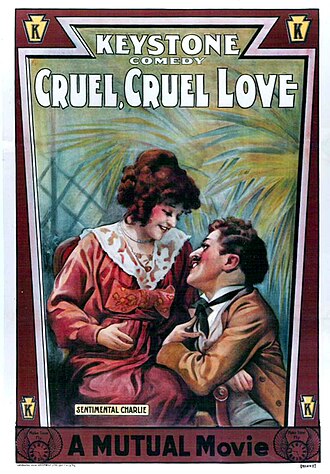
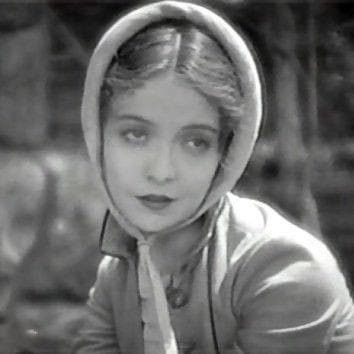
It must be highlighted that the actors do engage in broad, stagy gestures, which was an acting style already out of date back to 1910s films. This is particularly true when we realize that the subtle style of actresses like Mary Pickford, Lillian Gish, etc were already quite successful in Hollywood at that time. Minta Durfee had the most exaggerated acting among all main actors of this film, but it is really no surprise as she always acted quite stagy in her Keystone films.

The character of little tramp existed only as a rough draft of what the audiences would see years later. Actually, Chaplin plays a wealthy man who was left by his love interest (played by actress Minta Durfee, who in real life was back then the first wife of another silent comedy star of the same studio, Roscoe “Fatty” Arbuckle) after she caught Chaplin in an apparently compromising situation with the maid. In reality, Chaplin was only trying to help the maid, who had just hurt her foot and the supreme irony is that the maid had hurt herself right after meeting her own boyfriend (who, obviously was not Chaplin, as she already had another sweetheart).

Chaplin, in despair, tried to kill himself by taking poison even though he did not know that his butler had replaced the poison by water and was laughing out loud at Chaplin’s near-death reactions. As Chaplin was not aware he had only drank water, he thought his death was imminent. 

The real boyfriend of the maid showed up and explained the entire situation to Durfee, that Chaplin had not done anything wrong. Durfee sends Chaplin a letter saying she wants him back and the film has a happy end. 

Although those who are not familiar with Chaplin’s short films in his first years in Hollywood (before he took over full creative control on his films and when he was not a cinema star yet) will barely recognize him in this film, it is still worth watching. This comedy perhaps looks a bit “primitive” to nowadays’ standards, but they were quite usual and popular back to the 1910s and they were vehicles to catapult a plenty of actors into stardom, being Chaplin only one of them. 

The production values of Hollywood were already being consolidated back them. An example of it is that the first comedy feature-length comedy of Hollywood was produced exactly in 1914 by the same Keystone studios, having Charlie Chaplin in the cast and also Marie Dressler (who was already a famous theater actress). This short film was definitely part of all evolvement cinema was witnessing on early XX century. 

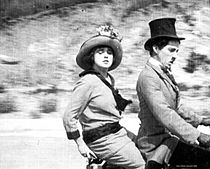
Mabel at the Wheel (USA,1914)

This is a very well-known and famous Keystone short but perhaps more because of Mabel Normand and Charlie Chaplin feud in the backstage than the film itself. Supposedly Chaplin had disagreements with Normand on the type of humor of the film and he also did not like the fact that he was directed by a very young woman. Apparently, Mack Sennett (the head and founder of Keystone studios) intended to fire Chaplin, but he had requests of more Chaplin’s films by film exhibitors, which showed Sennett that it would not be a good idea to get rid of an actor who was actually being successful.


However, film is good enough to be successful on its own right and much of this film’s merits come from Mabel Normand herself. She, like her character in the film, was a woman ahead of her time, very physically skilled and brave, which was something completely new compared with 1910s angelical, virginal standards of femininity.


In his first year in films, Chaplin’s little tramp was not already the likeable fellow the world would admire so much. He was a rough man and far from being a gentleman, the kind of guy who would shamelessly make a woman fall on a water pond while taking her out, just like he did with Mabel in the beginning of film. He also did not hesitate in slapping Mabel back after she slapped him. Chaplin would also pursue this rough style of flirting in the film “Tillie’s Punctured Romance” with Canadian actress Marie Dressler, which was also produced by Keystone in that same year.


Something that also looks weird in this early representation of the little tramp is Chaplin’s top hat and exaggerated gestures, an acting that closely resembles Ford Sterling’s and villains of comedic vaudeville or stage plays. Fortunately to Chaplin, he soon improved his character, as those nearly surreal villains soon got out of fashion in films.


Chaplin, after being jealous of another suitor of Mabel, tried to destroy the other guy’s car. Both Mabel and the other suitor find out that Chaplin caused the harm and it caused a fight of bricks and even Mabel took an active part in it. After a while, we can see that the other guy would take part in a car race.


Unfortunately, her suitor ended up being kidnapped by Chaplin and his accomplices and did not show up for the race on time and Mabel, who was in the audience, realized there was something wrong. We can also see Mack Sennett himself in the audience, playing an unsophisticated and simple man. Having started his cinematic career as an actor in Biograph studios, in the first years after Keystone studios was founded, it was not unusual that the boss himself both acted and directed in films, a trend that would soon be over, as it did not take long until Sennett focused himself on administrative tasks of the studio.

Mabel stood up and approached the mechanic, she exchanged her clothes and got into the car that was supposed to be driven by her sweetheart. Many driving scenes were made, which was still a novelty back to 1914, considering that cars were not even very common yet and it was even more unusual to see a woman driving. But this did not stop Mabel and, considering she had even driven an airplane in a 1912 film (A Dash Through the Clouds) and wore a swim suit in another film also in 1912 (The Water Nymph), driving a car was not probably a big deal to her.


Despite the dangers along the way, Mabel drove so skillfully that she won the race and just in time to be observed by her sweetheart, who managed to free himself from the place where he was taken hostage. Rather than being victim of prejudice, Mabel was actually praised by the other guys, generated some publicity (we can see in the end of the film that a cameraman approached Mabel to film her) and was treated as an equal by the other pilots. Meanwhile, Chaplin was quarreling with his accomplices and looked even more mentally disturbed and evil than in the beginning of the film.

A Film Johnnie (USA, 1914)

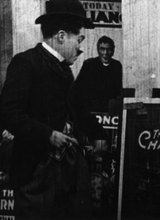
Even for those who are not fond of silents, this film is full of historic value. By showing a sort of “film inside the film”, we can have a rare insight about what it was like to go to the cinema in the 1910s. We can also have an insight on the backstage of Keystone studios, as well as its working practices. 

Furthermore, Chaplin was at the very beginning of his career in films. We can see the evolution of the Little Tramp, who was originally a rough, impolite troublemaker, at first without the pathos that would soon make Chaplin famous worldwide. 

It is also possible to make comparisons between the plot of his film and the very beginning of Chaplin cinematic career, with him trying to be accepted in his new work and having a difficult attitude with his peers at the same time. There are stories of Chaplin having refused to be directed by Mabel Normand and clashed with other directors of Keystone studios. 

The Little Tramp goes to the cinema and falls in love with the girl in the picture of the publicity material outside the cinema. Of course that the girl turned out to be Mabel Normand and the film was produced by the Keystone studios. A noteworthy observation is that, even though it was Mabel Normand`s picture outside the cinema, the character turned out being played by another actress Peggy Pearce. 

There`s a rumor that Mabel Normand did not act in this comedy because Chaplin had previously clashed with Normand while making another film and she simply refused to work with him again. And that made the studio replace Normand by Pearce. 

Chaplin enters the cinema and ends up causing chaos with other moviegoers. He was not only impolite with other people, but also very naïve in taking what he saw on screen as if it was real. His love for the Keystone Girl only grows bigger. 

After a fight at the cinema and being kicked out by the audience, the Little Tramp ends up on the doorstep of Keystone studios. The reasons for it aren`t clear. Was he looking for his sweetheart? Looking for a job? Begging for money/food? We cannot say for sure. When the “Keystone players arrive at the studio”, as one of intertitles says, modern-day audiences can see some of the biggest stars of the studio of the day, including Roscoe “Fatty” Arbuckle, who in real life played an influence on how the Little Tramp character would be built up and was already an established comedy actor when Chaplin started working at Keystone studios in 1914. 

The Little Tramp finally got to enter the studio, but he created a huge chaos. Then, there was a fire and the actors and studio crew ran to the scenery in order to get some “atmosphere” for the film. In the first years of Keystone studios (which had been founded in 1912), it was a usual that films were made on the spot of real-life events.

This short film does provide a rare and accurate insight about entertainment early XX century, both under the perspective of young Hollywood industry and of audience and how they related to films. Highly recommended for those interested to know about the evolution of cinema in a fast and practical way.

Create a website or blog at WordPress.com

Up ↑