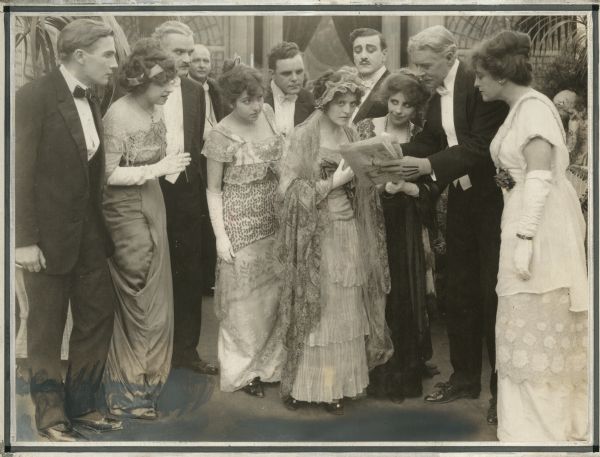
The Perils of Pauline (USA, 1914)

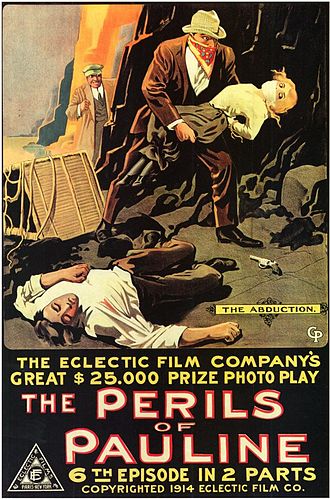
It was one of the first female series in Hollywood, although it was not the very first one. It is often mistaken as the very first serial because it was the first one to have had a huge popularity among audiences. Pauline was a rich heiress, who is pushed to marriage, but prefers to wait a little more and live more adventures in life, while she gets ready to become an author. Her refusal is understandable, as having a husband would make her leading a life totally focused on family affairs rather than exploring the outside world.


Furthermore, Pauline`s guardian wants to make sure that she will end up dying before getting married, so he can keep the money to himself. He interferes with Pauline`s adventures so that they are more dangerous than they were supposed to be.

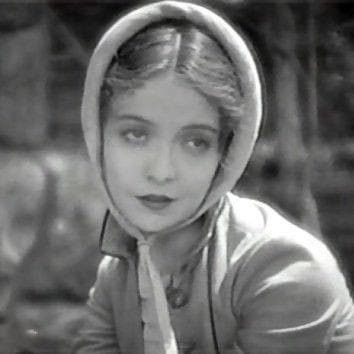
Although the psychological profile of characters is somehow shallow, including in some rather simple matters like, for instance, who were Pauline`s parents? Which was her past? Was she a romantic lady or more modern-oriented? And so on. We can compare her with other 1910s characters, such as those made by Lillian Gish in Biograph studios and we can see how independent and less Victorian Pauline was compared with her contemporaries. This approaches Pauline to characters played by actress Mabel Normand in Keystone studios, all of them independent, bold, fierce, untamable women, ready for an adventure and strong in their own right.


Broad gestures and exaggerated facial expressions are still noticeable in acting by different actors and it is understandable, as the transition to a more natural acting style was still ongoing in American films in middle 1910s. However, a more natural style was starting to take root and it would not take a long time until the theater-based gestures and mannerisms was overcame.  For example, films by D.W. Griffith and Mary Pickford were already popular when this serial was launched and the subtle acting portrayed in them would soon become the norm in Hollywood.


Although associated with the stereotype of “damsel in distress” Pauline was less helpless than typical women of her era and despite all problems, she did get to have adventure moments. The plot has a plenty of adventure and exoticism, both of which were into fashion back to the 1910s. In this first chapter we can even see Pauline in a balloon. In an era when travelling was difficult and time-consuming, audiences could experience different things, even though those things were often portrayed in a stereotyped way.


It was originally filmed 20 chapters, but the only surviving version is from a French print edited into nine chapters, released in 1916. We can also observe that the villain had a German name (Koerner) due to animosity against Germany during World War I. There were also problems with the re-translation into English of intertitles which were previously translated into French in this nine-chapter version which gives modern audiences the impression of involuntary humor due to typos and weird structure of sentences.
Actress Pearl White made most of stunts of this serial and while filming it she suffered a spine injury which would bother her for the rest of her days. White was athletic in real life and her physical skills matched her role completely.
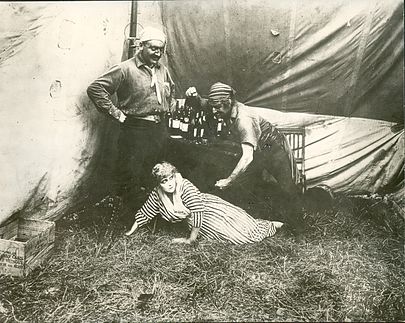

As it was previously said, many chapters were cut off this re-release, but the remaining ones give a good overall idea of how this serial was like. In an era when cartoons were not popular yet, it was real-life actors who had to make the dangerous stunts, so audiences would get their own thrill. Years later, it would become hard for actors to keep up with cartoon characters and the nearly infinite possibilities of what they could do to endanger their lives and remain alive anyway, but it was not yet a reality back to the 1910s. It must also be added that this series does not use the cliffhanger, but the episodes are self-contained instead. It was a popular hit and made Pearl White become a star. She remained in high demand in serials until the end of the decade and after this time she worked in Europe until her retirement some years later. 

Male and Female (USA, 1919)

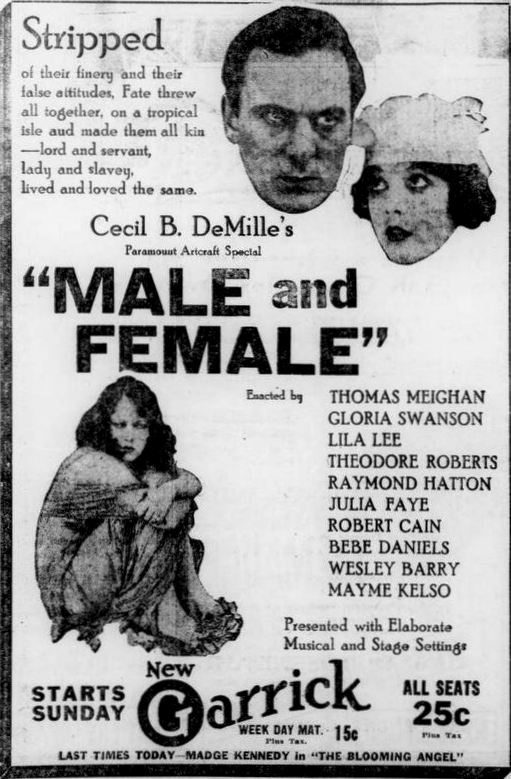
Cecil B. de Mille being himself in a film that turns extravagant –and also with sceneries of great proportions at some moments – and a young Gloria Swanson. Although unknown for many people, Swanson started her career very young being an actress in slapstick comedies (she even worked for Keystone studios, which produced some of the most frantic comedies of silent era), but she had dramatic ambitions all along and by the time this film was made she started pursuing them.

An adaptation of the play “The Admirable Crichton” by J.M. Barrie, the film approaches differences of classes with subtle humor and sometimes audiences do not even feel time pass because the film has a very relaxed vibe. How a British aristocrat (Gloria Swanson) connected with her butler gives room to some original gags, especially after they both get involved in a shipwreck. Needless to say that none of those rich aristocrats have the required skills to survive in a stranded land, but it turned out that the butler could handle the situation. It also comes from this film the famous scene where Swanson is lying down with a real lion around her. 

In the beginning of the film lives of rich people are depicted as opulent and empty. The scenes are funny with the futility of people`s requests towards the servants and we can also see Gloria Swanson in beautiful clothes. The servants are shown as slightly more grounded people, as their lives are closer to realism. A maid is in love with the butler, who is in love with Swanson. On the other hand, Swanson has a friend who married her chauffeur and had to face lots of social difficulties because of that. Needless to say that Swanson disapproved the marriage, which made her butler heartbroken.

The scenes of those people mingling together while stranded in the islands are entertaining, even though they are far from realistic. Clothes were always in good conservation state, they never faced real famine and could even have access to some comforts, such as books. This gives a touch of involuntary humor to the film, which makes it even more enjoyable to modern audiences.  Although the plot is sometimes exaggerated, the acting of main actors remain relatively self-controlled and subtle and it reinforces the good portrait of lives of educated and refined characters.

There is also the interesting approach of not sugar coating the difference of classes and that love does not always overcome it. No, the plot is not about the so-called battle of the sexes. Intertitles can be witty but they are also sometimes a bit too long, even tiresome. If they were kept simpler, it would be perhaps easier for audiences to understand the subtle humor and it is also a factor that makes the film seem outdated nowadays.

The Babylonian sequence may be a feast for the eyes, but it is not really necessary to the development of the plot. By the way, a Babylonian king having a Christian slave? Perhaps it is a little historically inaccurate? We can see here the famous sequence of Swanson with a real lion (who was presumably dangerous) and legend has it that she insisted on doing that scene herself. This might be true, because if we analyze the comedy films Gloria Swanson made earlier in her career we can observe that she have already done a plenty of relatively dangerous stunts already in her teens. 

What Happened to Rosa (USA,1920)

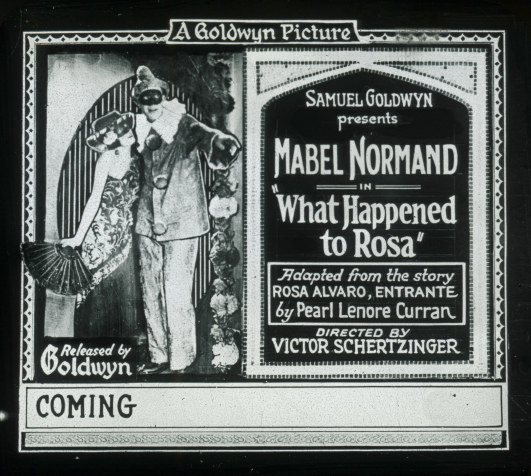
Mabel Normand made a name for herself for her slapstick comedies for Keystone studios in the 1910s, even though she had worked for other studios both before and after that.  And even had her own modelling career before becoming an actress. Normand was a real pioneer of early cinema because she was brave, did her own stunts with competence and got a really spontaneous and relaxed screen persona back to an era when the helpless damsels in distress were so popular. Furthermore, she also directed her own films already at the time when she worked at Keystone (consequently, before this film was shot).


At the time this film was made, Normand was inclined to make more situational-oriented romantic comedies, without the frantic rhythm, broad gestures and physical gags of slapstick comedies, similar to those by her real-life friend Mary Pickford. This shift in her career could show the audiences that Normand was also a very good, natural actress, who could be funny and emotional in all kinds of films.
Produced by Goldwyn studios, this film is not usually considered one of her best, it is entertaining and in touch with cinematic trends of its era, including those of exotic environments being portrayed in the most stereotypical way possible.


A hard-working saleswoman in a department store with a boring life, looking forward to some excitement, once met a clairvoyant woman while working. Although it was clear that the clairvoyant was a charlatan, Mabel ended up scheduling an appointment and ended up being told she was a Spanish dancer in a previous life. Mabel got carried away with this story and started acting like a Spanish dancer, which made those around her think she was losing her mind.


The appointment`s scenes are among the funniest of the film. The clairvoyant`s house was full of exotic objects from Egypt and at the same time that Mabel was scared, she was also fascinated for being there. The more exaggerated acting of the clairvoyant is also a good contrast to the more self-contained acting by Mabel, which highlights the awkwardness of the entire situation.


Although Normand`s acting is not as groundbreaking as it was back to 1910s, her talent was still there and she got to be entertaining and the audiences can even see pathos in the poor working girl who was stuck in a life of hard work and boredom and only wanted some excitement and distraction from routine. Things would be even more complicated to Normand after she fell in love, especially because she was often more awkward than seductive towards her love interest.


It is sad to think that Normand would pass away circa 10 years later, but her versatility could be seen in her 1920s output in films that could be modern fairy tales of the ordinary next-door girl with a heart of gold who only wanted to find some happiness in life. It is impossible not to see similarities with the role played by Clara Bow in It (USA, 1927), starting with the similar occupations of characters of both films. The difference was that Bow had a touch of innocent seduction in her character, was Normand was a romantic, optimistic girl.


It is also noteworthy that actor Adolphe Menjou can be spotted in some scenes. His career would still continue throughout the talkie era. 

Young Romance (USA,1915)

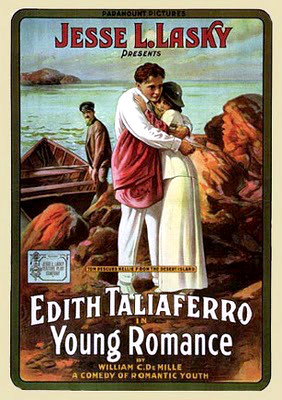
Two youths (Tom Clancy and Nellie Nolan) worked in different sections of the same department store without knowing each other and longed for both romance and adventure. Therefore, they decided on their own to pretend for one week that they were upper class members and ended up travelling to Hotel Imperia and Belleview Mansion, places attended by such wealthy people. During this time they met and fell in love with each other.

During her trip, Nellie took the identity of a wealthy client of the store, but while she was travelling she was notified that the person she was impersonating had inherited a fortune due to recent death of an uncle who lived abroad. And some people thought Nellie was the actual heir. Another funny scene is when the couple go to a fancy restaurant not too long after they met and Tom was very nervous about how he would pay for such expensive dinner. 

Unfortunately, the publicity around the inheritance of Nellie made her being the target of unscrupulous people who wanted to steal her money and another guy started romancing Nellie, who unfortunately fell for him.  Nellie was invited for a ride in his motor boat and she accepted it. However, Nellie was left in an abandoned island and forced to give part of the money to the guy who was romancing her, but ended up being a scoundrel.  Even after she agreed to give 10 thousand dollars to the guy, he still kept her in that island until the money was cashed.

Nellie`s ordeal is over when Tom overheard a conversation about the scheme to rob Nellie and went to the island to save her. Love was still there and flourished smoothly.

After one week passed, they both returned home, without having the courage to tell to each other that they were actually poor and their love story was over, although the heartache remained. Tom ended up being promoted to the same section where Nellie worked and they immediately bumped into each other. Rather than questioning each other about why they lied that they were rich, they got so happy to be reunited that they fell into each other`s arms and there was the expected happy end. 

A film worth seeing also for its romantic, nostalgic touch of an era when love was far more innocent and life was simpler. This has an undeniable appeal with modern audiences. The storytelling is also easy to follow and beautiful sea landscapes are also pleasant to the eyes. Subtle, light acting with the bonus of beautiful clothing and furniture. The female protagonist is played by actress Edith Taliaferro, who made a name for herself at the stage, but made only three silent films in the 1910s.  This film is also noteworthy for having been written by William C. de Mille, brother of famous director Cecil B. DeMille. Actor Tom Forman, who played the role of Tom Clancy, despite having been a popular actor, started having career problems already in the silent era and unfortunately committed suicide in 1926. 

Prompt of the Day

Daily writing prompt
Do you spend more time thinking about the future or the past? Why?

Thinking about the past is something I have done since I was a kid and I have no idea why; I just know that I have always loved history and to compare life in the past with life nowadays. Even in my childhood I read many history books although it is not common someone so young do it. I have always loved the entire new world that history can bring to us and how we can travel throughout so many different lifestyles without even leaving home.

Then, I grew up, started to attend college and pursued other hobbies and studies, but history has always been with me even though I have never professionally worked with it. However, I still think that history is a wonderful tool to decision making because it gives a chance of learning with past mistakes. I know that it is not really healthy to live in the past and I consider it that I have done it for a while in my younger days, but those days have been gone for a long time.

Thinking about the future is tempting for most of us, but I never did it too often because it causes anxiety and the truth is that we have no control over the future. All we can do is living in the best way and hope that it will bring back good things, but nothing is certain. On the other hand, we suffer for thinking too much about the past exactly because it is so certain. It is certain we cannot change it, all is there, fixed, it is over even if we do the very same things all over again because now is already a different moment and it will cause different consequences. The ability of moving on is very important for human happiness and knowing how much we should stick to the past is an art.

So by nature, I have spent much more time thinking about the past than the future because I am a historian at heart. There is also a touch of escapism in it. Many people like to think about the past as an ideal place when things were so much simpler and easier, a place where we can somehow return in case things go wrong right now. “The grass is always greener on the other side”, according to the saying. We all want a place to rest when feeling tired, somewhere safe and for some people the safety can be the past.

But past thoughts can also be useful for us to cherish what we have nowadays, how much people fought and obtained throughout the eras and how in many regards we are much luckier than our ancestors. We have a bigger lifespan, better health care and comfort standards, among many other things. We can study, get better informed and it means that, no matter how problematic is, we will always have alternatives to make life happier and more comfortable. So, thinking about the past can be a very positive activity whenever it is used wisely.

Create a website or blog at WordPress.com

Up ↑