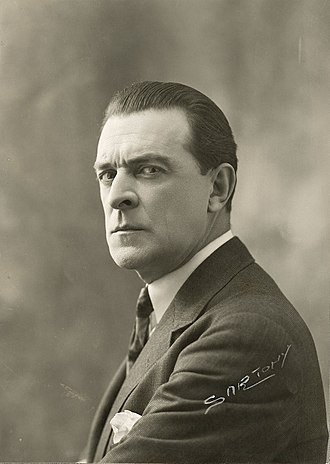
Werner Pittschau (24 March 1902 – 28 October 1928)

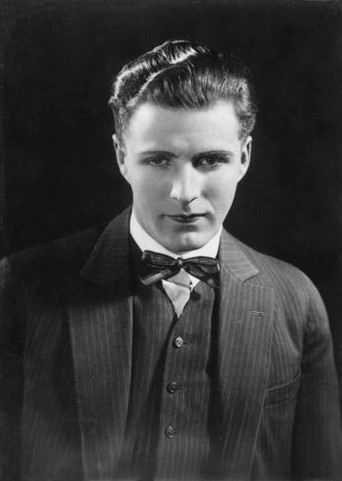
Werner Pittschau (24 March 1902 – 28 October 1928) was a German theater and film actor of the silent film era. During the 1920s he was a leading man in 30 films with famous film partners (Asta Nielsen, Anny Ondra, Tamara Karsavina, Carmen Cartellieri, Dina Gralla, Mady Christians, Carla Bartheel etc.), but his career was cut short by his death in an automobile accident, aged 26.

Wikipedia link: https://en.wikipedia.org/wiki/Werner_Pittschau

Mabel’s Dramatic Career (USA,1913)

Mack fell for the kitchen maid. They were a happy couple, but Mack’s mother (played by actress Alice Davenport in a rather stagy acting) was against the romance and her opposition caused lots of conflict between Mabel and her.

After a while, it came a woman from the city and Mack’s mother thought she was a better partner to her son. Understandably, Mabel got jealous of the newcomer. After a while, Mack started to get along very well with this new girl and Mabel became outraged. Therefore, a fight was inevitable, and Mabel was forced to leave the house, heartbroken.

Mack proposed to the other girl, but he ended up being rejected as the woman seemed to be tired of Mack after a short time and they both ended up fighting in the most typically slapstick way possible, including things being thrown against each other (an element that was relatively common when romantic arguments were portrayed in films by Keystone studios).

Mack regretted having let Mabel go. Meanwhile, she arrived at the city and looked for a job in a cinema studio full of actors with fake facial hair and portraying exaggerated characters (which turned out to be the own Keystone studios and actors in real life). Mabel showed the actors that she could act, was hired by the studio and had steady work there for the next few years.

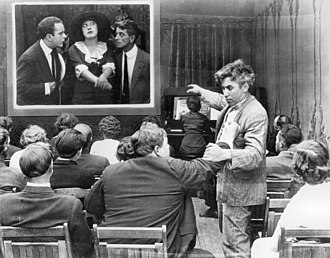
One day, Mack saw Mabel’s picture in the publicity poster of a film and recognized her immediately. Mack entered the cinema and watched a film by Keystone studios (Yes, the studio was not really shy of doing some self-propaganda) and was really overexcited by seeing Mabel on screen. His excitement was so over the top that he disturbed other audience members to watch the film quietly. At this point, it must be highlighted that one of audience members is played by actor Roscoe ‘Fatty’ Arbuckle, who had started working at Keystone studios in that same year.

Chaos broke out when Mack Started shooting at the screen and scared everyone around him, including the projectionist. Despite all problems he caused, Mack did not give up as he was determined to kill the onscreen villain (played by actor Ford Sterling, who was very popular at the time). Mack got to find the villain and soon discovered that the actor who played the villain was married to Mabel in real life and they had two children together.

As always, Mabel Normand acts in a very natural, vibrant way. There is a rumor that Mack Sennett was mocked by the own employees of Keystone studios for not exactly being the best actor in the world. That is an exaggeration, Sennett’s humor was simple but very much in line with the typical acting of 1910s comedians, especially when he played hobos and not particularly smart characters on screen. I personally think Mabel is even more beautiful than usual in this film and it is a joy merely to look at her facial expressions and the joy she conveyed on screen. Mack Sennett was very active as an actor in the first years of Keystone studios, but after a while he left acting to focus on management and directorial tasks at the studio, until it closed its doors in 1933.

This simple one-reeler can still be very easily understood and the occasional overacting does not make it any less funny. It is a relaxing and entertaining slapstick comedy short up to this day. This film also has great historic value because it provides modern-day audiences with a rare glimpse of how it was like to go to the cinema back to the 1910s.
His Wedding Night (USA,1917)

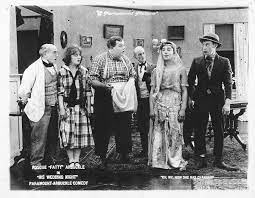
This film (together with Coney Island, released in that same year) can show to modern audiences how daily life was like back to the 1910s, which sort of items could be sold in a drugstore, for instance (Including beverages), purchasing habits of people, etc. It has two stars, Keaton was in the beginning of his career at the time and had immediately shown his competence, but he was not yet a star on his own right. He had not yet consolidated his world-famous stone face character. However, it would not take long until Keaton achieved prominence. Roscoe `Fatty’ Arbuckle was a mega star at the time and his comedies were full of physical gags.

In this film, Arbuckle worked as a clerk in a drugstore. Both he and St. John loved the same girl (Alice). Alice`s father ended up giving her hand to Arbuckle. St John got angry and planned a revenge. Meanwhile, Keaton showed up to deliver a wedding dress to Alice and ended up dressing it to show her how it looked like. St John and his accomplices ended up kidnapping Keaton by mistake, there was a huge mess but the expected happy end came.

Although still playing the role of a grown up baby, sometimes with silly facial expressions, we can see the evolution of acting of Roscoe ‘Fatty’ Arbuckle compared with his films at Keystone studios only some years before. His gestures were more self-contained, gags more elaborate and scenery was modern. Furthermore, there was a troupe of comedians who worked with him and they formed a rather uniform and experienced team.

Of course, that there was still lots of physical humor, especially when his real-life nephew, Al St. John, came to the scene. Nevertheless, it is actually an accomplishment, considering the good physical abilities, not only of Arbuckle himself (who was reportedly even very flexible and an excellent dancer in real life), but also of St. John and Buster Keaton. All those actors excelled in physical humor and that is one of things that made them so popular among audiences back then. Some stereotypes of slapstick comedies are present here, like rather unromantic arguments among couples, ethnically insensitive jokes, food being thrown, people being thrown as well, etc. However, situations themselves were a bit closer to reality than typically slapstick comedies.

In the end of film, the actors could show his skills to physically demanding scenes even better. Unfortunately Arbuckle`s career would be virtually over four years later due to a huge scandal. Buster Keaton would enjoy lots of fame in the 1920s and his output stands out to this day. Unfortunately Keaton`s career would fall into obscurity for some decades as of 1930s, but he lived long enough to regain his popularity and further recognition to his work. Al St John would find steady work in westerns for some decades and made a smooth transition to talkies. Even though he was not immensely popular, he got to reinvent himself and remained in films for a very long time.

Prompt of the Day

Daily writing prompt
Do you spend more time thinking about the future or the past? Why?

Thinking about the past is something I have done since I was a kid and I have no idea why; I just know that I have always loved history and to compare life in the past with life nowadays. Even in my childhood I read many history books although it is not common someone so young do it. I have always loved the entire new world that history can bring to us and how we can travel throughout so many different lifestyles without even leaving home.

Then, I grew up, started to attend college and pursued other hobbies and studies, but history has always been with me even though I have never professionally worked with it. However, I still think that history is a wonderful tool to decision making because it gives a chance of learning with past mistakes. I know that it is not really healthy to live in the past and I consider it that I have done it for a while in my younger days, but those days have been gone for a long time.

Thinking about the future is tempting for most of us, but I never did it too often because it causes anxiety and the truth is that we have no control over the future. All we can do is living in the best way and hope that it will bring back good things, but nothing is certain. On the other hand, we suffer for thinking too much about the past exactly because it is so certain. It is certain we cannot change it, all is there, fixed, it is over even if we do the very same things all over again because now is already a different moment and it will cause different consequences. The ability of moving on is very important for human happiness and knowing how much we should stick to the past is an art.

So by nature, I have spent much more time thinking about the past than the future because I am a historian at heart. There is also a touch of escapism in it. Many people like to think about the past as an ideal place when things were so much simpler and easier, a place where we can somehow return in case things go wrong right now. “The grass is always greener on the other side”, according to the saying. We all want a place to rest when feeling tired, somewhere safe and for some people the safety can be the past.

But past thoughts can also be useful for us to cherish what we have nowadays, how much people fought and obtained throughout the eras and how in many regards we are much luckier than our ancestors. We have a bigger lifespan, better health care and comfort standards, among many other things. We can study, get better informed and it means that, no matter how problematic is, we will always have alternatives to make life happier and more comfortable. So, thinking about the past can be a very positive activity whenever it is used wisely.

A Muddy Romance (USA, 1913)

In the first few years of Keystone studios (founded in 1912), many of their films were one-reelers with quite simple storylines. Other studios produced similar comedies, both in the USA and abroad. Short films were still the most common length of films, as feature-length films were still at the very beginning. Films like Cabiria (Italy, 1914) and The Birth of a Nation (USA, 1915) –some of the films that would help to consolidate feature length films as more popular – were yet to be produced.

In a landscape that looked remarkably rural, Ford Sterling –with his typically exaggerated gestures and mannerisms – was by a window, flirting with Mabel Normand, who was in another window. However, there was another man interested in Mabel (“a persistent suitor”) and he came to her house to visit her. Sterling did not really seem pleased when he realized there was a competitor for Mabel`s affection. Sterling also came to visit Mabel, but the other suitor was still there and both men clashed. Sterling tried to attack the other guy, but ended up hitting Mabel with dirt instead. At this point, both men fought and Mabel tried to intervene and therefore she fell out of the window. The three of them threw things at each other.

A clergyman arrived at Mabel`s house in the middle of all chaos. It seems to have come to marry Mabel and the other suitor. Then, Mabel, the other suitor and the clergyman leave in a boat while Sterling tries to shoot them as he saw the boat departing. The Keystone cops were called to try to settle the mess. The cops started shooting too and embarked on another boat and one of cops fell on the river and a short time later they got stuck in the mud. Sterling attempted to stop the boat from leaving by throwing mud on the river.

More cops came to the scene with hoses and even a cannon. The hoses were useful to take their colleagues out of mud. Unfortunately Mabel fell in the mud right afterwards, but immediately the clergyman and her other suitor helped her out of the mud. And the three of them were eventually taken out of the muddy river. Meanwhile, Sterling was into trouble, as he was caught throwing dirt on the river.

Such simple one-reelers were very popular in the era and working-class audiences could easily relate to situations being shown. Keystone films were a hit since the beginning and its actors became successful comedians. As time passed, the studio produced feature-length films (the first one being Tillie`s Punctured Romance in 1914, with Mabel Normand, Marie Dressler and newcomer Charlie Chaplin in the cast). And Keystone studios became famous for discovering young comedians who would undeniably leave their mark in cinema history. For instance, young Roscoe ‘Fatty’ Arbuckle and Charlie Chaplin worked there in the 1910s. The studio was closed in 1933, already at the era of talkies.

The Gusher (USA,1913)

Exaggerated gestures, fake mustaches, simple plots, one-reelers (films that lasted around 11 minutes), actors falling on their butts, scenes with lots of smoke, and actresses performing their own stunts were a commonplace in films produced in the first years of Keystone studios. The studio was founded the previous year and we can see a relatively small number of studio regulars in comparison with subsequent years. Mabel Normand and Ford Sterling (among others, like Fred Mace, Mack Sennett himself and Roscoe `Fatty` Arbuckle as of 1913) had worked in Keystone studios since the beginning and were quite popular among audiences.

The Gusher is a story about a young Mabel Normand who has two suitors (Ford Sterling and Charles Inslee) and has to choose one of them (Ford Sterling). As revenge, the rejected suitor made up a plan to sell bad land of an oil field to Mabel`s sweetheart. Sterling ended up actually buying the land, only to listen right afterwards that it was not a real oil well. He was devastated (which only increased his overacting) and, to make matters worse, Sterling even caught the rejected suitor (Charles Inslee) trying to seduce Normand.

However, in the middle of all despair, the field started to actually produce oil and Sterling became wealthy enough to marry Mabel. The rejected suitor set fire to the field while the wedding was being held. A man told Sterling about it in the middle of the celebration and chaos ensued when everyone present at the wedding (including the bride and groom) went to the field on fire. The Keystone Cops were called to solve the situation, even though they were not very smart themselves, as we all know. We can see it by the fact that the cops kept repeatedly falling on the ground without any apparent reason.

It turned out that Sterling himself got to find the rejected suitor and punish him. But the field was still on fire at the end of the film and no one had even attempted to control it, not even the firefighters were called. The end was weak and left audiences in the dark about some very crucial points. For instance: Did Sterling got to recover his oil field and keep on earning money with it? It is also not known if the rejected suitor was arrested and it seemed that he got to leave the scene of crime, despite being caught by Sterling. It is a one-reeler, but the plot could have been better developed without even adding extra time to the film or only adding a few minutes more.

Something different added in this film was an oil field. It seems that the plot could have been merely an excuse to use the stock footage of an oil field on fire, but the different setting gives a touch of originality to the film anyway. It is worth paying attention not only to the technology of the 1910ies, but also to the glimpse of both female and male fashion that this film provides.

Create a website or blog at WordPress.com

Up ↑