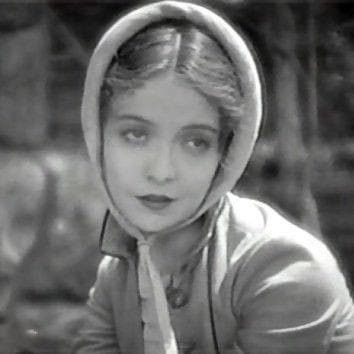
Saved from Himself (USA, 1911)

This is a film by Biograph studios of New York, directed by famous  D.W. Griffith (who started working at the studio in 1908 as an actor and soon became a director and chief direct of Biograph) and one of protagonists is Mabel Normand, one year before she moved together with Mack Sennett and Fred Mace to the Keystone studios, which had just been founded.  It is interesting to see Mabel acting in a non Keystone, drama film. 

Mabel Normand, despite being more famous for her comedies, was a versatile actress and did well in dramas too. When this film was made she was circa 18 years old and already had a natural and convincing acting.  In Biograph she played naïve young maidens, damsels in distress, in addition to comedic ladies.

Joseph Graybill (1887 – 1913) is an actor about whom not much is known. He passed away in 1913 still in his 20s and had a successful career both on stage and cinema and is more noteworthy for having worked with D.W. Griffith in his first years at Biograph studios. 

The title of this film is self-explanatory and the plot has some typical Griffith`s touches, especially in the moralizing end. An example of that is evident already in the first intertitle, which says: “His sweetheart`s influence saves him from dishonor”. Back to an era when having a good social reputation was something taken much more seriously than nowadays.

Motion picture poster for Three Friends, a Biograph Studios release, shows three men clasping hands while sitting at a table in a bar. 1 print (poster) : lithograph, color ; 104 x 70 cm.
Source: Wikimedia Commons

A young clerk (Joseph Graybill) is engaged to a stenographer (Mabel Normand). His old friend had just won lots of money in the stock market, which encouraged him to also invest his money this way. He was so impressed that he actually used all his savings to purchase stocks. Unfortunately, things did not happen as planned and he had to put up another two thousand dollars, otherwise he would be wiped out, as one of intertitles says. He could not afford doing so and the fear of losing all his money made him consider stealing money from a hotel. 

However, his sweetheart (Mabel Normand) found it out and prevented him from doing so. Also, his thoughts about his mother made him thinking twice and it became clear that he only considered stealing the money out of fear of losing all his savings and not being able to provide a good future both for himself and his future wife. The happy ending happened because honesty and morals were preserved and it is not worth it being unscrupulous or immoral, this is the usual message of Griffith`s cinematic work.

A plenty of Griffith`s films discussed the effects of addictions, poverty and adultery over families. A recurrent theme was also the virginal, Victorian heroines, who Lillian Gish embodied so well. Those women also had high morals and kept their families united, even when the father/husband was too weak to do it himself. It often turned out that the man regretted his mistakes and reunited with his family, immediately being forgiven by his understanding spouse. Although such plots would be a bit too sexist for nowadays` standards, they show to modern audiences how life was like when things were simpler and the urban life had not fully taken root. 

Frauds and Frenzies (USA,1918)

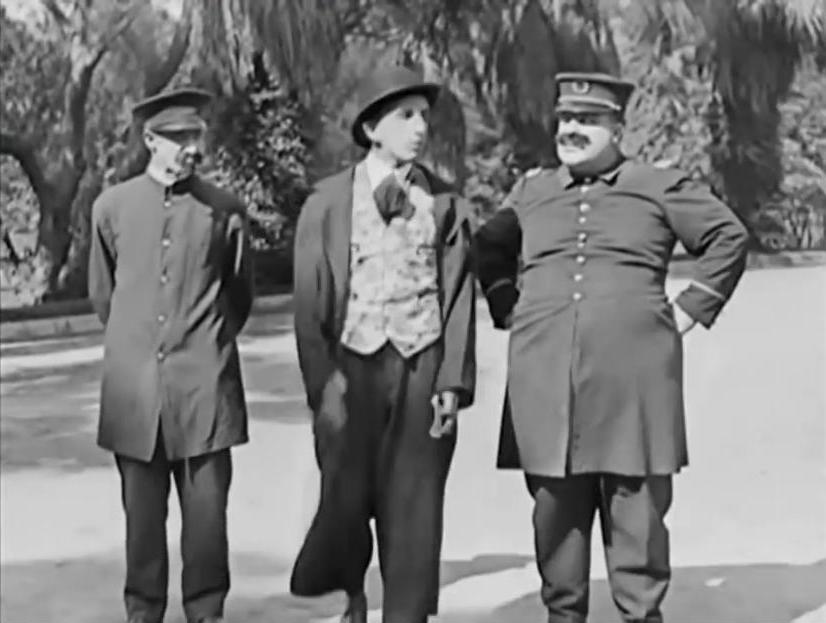
The theme of convicts trying to escape prison was relatively common in silent comedies. And comedies –specially slapstick ones – portraying policemen and authorities (who were usually incompetent, slow and lazy) were also abundant both in the USA and Europe. The laughter such films provided was also a relief to audiences, considering that a plenty of cinema goers belonged to working classes, who could laugh at those who had a more prominent position in society. 

Although not particularly innovative, this film had some funny physical gags, which can still be universally understood by modern audiences, regardless of culture. This is particularly true in the beginning of the film, when the convicts were shown performing forced labor. Stan Laurel, despite having engaged in such gags, also subtly showed to have a more self-contained type of humor, which he would also have during his pairing with Oliver Hardy. Speaking of Hardy, Semon would also work with him prior to his pairing with Stan Laurel. 

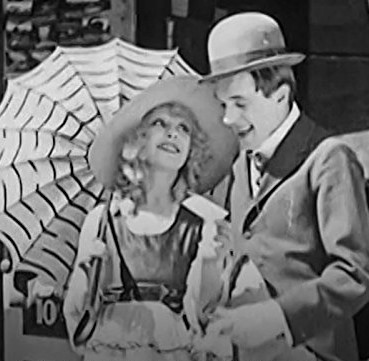
One day both Semon and Laurel got to escape and they suddenly became rivals for the love of a beautiful girl (with curly hair and a big umbrella, very much according to 1910s fashion standards). Such love interest is prone to make the former convicts having problems with the police again because the girl turned out being the daughter of one of policemen. At this point we can observe an ethnically insensitive gag, when they tried to kiss the girl, but it was actually a black woman below the umbrella, which makes both Semon and Laurel run away in disgust. Such gags were also common in silent comedies and not considered by some people as gross as it is considered nowadays. 

As usual, Semon happily engages in his cartoon-like special effects and gags of big proportions. There is even a chase (which is a type of gag considered by some laymen audience members as the symbol of silent films in general). It is also noteworthy that Stan Laurel gets less screen time in the second half of the film. Laurel had claimed that Semon reduced his time in the film in fear of being upstaged after a comment that Laurel was funnier than himself. 

Although not well-remembered nowadays, Larry Semon was a famous comedian in his day. He would pass away around one decade after this film, while in poor financial and health situation, but a plenty of his films are preserved nowadays and his distinctive cinematic style still stands out. 

A Film Johnnie (USA, 1914)

Even for those who are not fond of silents, this film is full of historic value. By showing a sort of “film inside the film”, we can have a rare insight about what it was like to go to the cinema in the 1910s. We can also have an insight on the backstage of Keystone studios, as well as its working practices. 

Furthermore, Chaplin was at the very beginning of his career in films. We can see the evolution of the Little Tramp, who was originally a rough, impolite troublemaker, at first without the pathos that would soon make Chaplin famous worldwide. 

It is also possible to make comparisons between the plot of his film and the very beginning of Chaplin cinematic career, with him trying to be accepted in his new work and having a difficult attitude with his peers at the same time. There are stories of Chaplin having refused to be directed by Mabel Normand and clashed with other directors of Keystone studios. 

The Little Tramp goes to the cinema and falls in love with the girl in the picture of the publicity material outside the cinema. Of course that the girl turned out to be Mabel Normand and the film was produced by the Keystone studios. A noteworthy observation is that, even though it was Mabel Normand`s picture outside the cinema, the character turned out being played by another actress Peggy Pearce. 

There`s a rumor that Mabel Normand did not act in this comedy because Chaplin had previously clashed with Normand while making another film and she simply refused to work with him again. And that made the studio replace Normand by Pearce. 

Chaplin enters the cinema and ends up causing chaos with other moviegoers. He was not only impolite with other people, but also very naïve in taking what he saw on screen as if it was real. His love for the Keystone Girl only grows bigger. 

After a fight at the cinema and being kicked out by the audience, the Little Tramp ends up on the doorstep of Keystone studios. The reasons for it aren`t clear. Was he looking for his sweetheart? Looking for a job? Begging for money/food? We cannot say for sure. When the “Keystone players arrive at the studio”, as one of intertitles says, modern-day audiences can see some of the biggest stars of the studio of the day, including Roscoe “Fatty” Arbuckle, who in real life played an influence on how the Little Tramp character would be built up and was already an established comedy actor when Chaplin started working at Keystone studios in 1914. 

The Little Tramp finally got to enter the studio, but he created a huge chaos. Then, there was a fire and the actors and studio crew ran to the scenery in order to get some “atmosphere” for the film. In the first years of Keystone studios (which had been founded in 1912), it was a usual that films were made on the spot of real-life events.

This short film does provide a rare and accurate insight about entertainment early XX century, both under the perspective of young Hollywood industry and of audience and how they related to films. Highly recommended for those interested to know about the evolution of cinema in a fast and practical way.

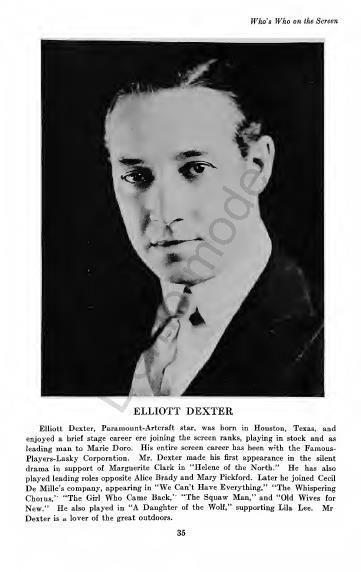
Elliott Dexter (March 29, 1870 – June 21, 1941) in Who’s Who on the Screen, 1920, Publisher New York City: Ross publishing co., United States

Picture taken from Who’s Who on the Screen, 1920, Publisher New York City: Ross publishing co., United States.

Elliott Dexter (March 29, 1870, Galveston, Texas – June 21, 1941, Amityville, New York) was an American film and stage actor. Dexter started his career in vaudeville and did not move to films until he was 45. He retired from acting in 1925. Wikipedia link: https://en.wikipedia.org/wiki/Elliott_Dexter

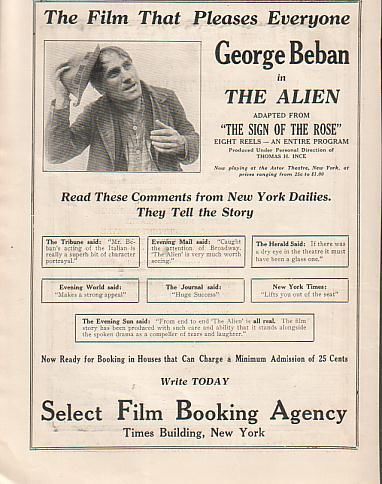
The Alien (USA,1915)

George Beban Ad- The Alien – 1915.

George Beban (December 13, 1873 – October 5, 1928) was an American actor, director, writer and producer. He was best known for his portrayal of Italian immigrant characters, including his starring roles in the play, “The Sign of the Rose” and the 1915 silent film classic, The Italian. Wikipedia link: http://en.wikipedia.org/wiki/George_Beban

The Alien (USA,1915). IMDB link: https://www.imdb.com/title/tt0004874/

Create a website or blog at WordPress.com

Up ↑