Some people have already said that Mack Sennett, the head of Keystone studios, was an uneducated man. I will not argue with this statement, although I am a big fan of his work. However, there is something that even his detractors have to admit: He knew what the audiences liked and it is no wonder why his films set some standards of slapstick comedy.
This film has a very simple plot and is less physical than typical films of the studio, which usually involved relatively dangerous stunts. On the other hand, it is a typical Keystone film in some regards. The female star of the company, Mabel Normand, is one of the protagonists, together with some cute little girls wearing big ribbons. One of the girls is playing hide and seek with Mabel. While Mabel closes her eyes, so the little girl could hide, the little girl ends up entering the vault near them. Mabel finds the girl at once, but she is called out of the room as soon as she spots the girl in the vault and this makes Mabel lose track of the girl. Meanwhile, the clerk locks the vault. Mabel comes back to the room, realizes the vault is locked and thinks the little girl was locked inside. As a matter of fact, the girl had gone to the street to play while Mabel was away. Mabel raises the alarm and everyone in the house get very nervous.
While everyone is trying to rescue the girl who they thought was locked in the vault, the little girl was having a great time playing on the street with her peers. And the group even finds a four-legged friend, a dog.
The family looks for help and called guys who looked like firemen or similar officers. Then the comedy becomes a typical Keystone film: Chaos ensues, the firemen start fighting and we can see a man who clearly looks like a policeman, with a fake moustache and everything which would really qualify him as a Keystone Cop.
Then, the policeman opens the vault and, for any unexplained reason, much smoke shows up, the door of the vault falls right over the poor incompetent mustached policeman. While this chaos happened, the girl was found playing on the street and brought back home.
The film ends with everyone celebrating the girl returning home and with the policeman being released of the door over him.
Some highlights of this film: Here Mabel is more fragile than she would be in other films by the studio, as she does not perform the dangerous stunts she would do in other films. However, the faces she pulls and how she express her anxiety with the whereabouts of the girl are very funny.
This comedy has really stood the test of time and still stands out today. Being grounded on absurd and nonsense situations, it can still make people laugh. One of best performances of the film is delivered by Al St. John, the highly acrobatic nephew of famous Roscoe “Fatty” Arbuckle, who was very different from his uncle not only physically, but also in comedic style. Having a steady career in silent-era comedies, he also made a name for himself in westerns during the talkie era.
The film starts in a party where social climbers gather, as it says one of intertitles. After some weird dancing and matrimonial arguments, we see Al St. John, who becomes instantly popular among the women at the party.
However, regardless of how good Al St. John is in the film, the acting of a great scene-stealer, and one of the most menacing creatures ever produced by a film, must be emphasized. There is no Frankenstein, there is no Dracula, there is Fido, the poodle. Lol! The dog was owned by the always-competent Louise Fazenda, a sophisticated woman to whom both Al St. John and his “bossom friend” are attracted. Apparently their attraction for the same woman shakes their friendship and Fido was the victim of St. John’s friend rage after he realized that his friend was being too friendly with the woman he liked.
Fido embodied very well the old comedic joke of the coward who got to succeed in his adversities due to luck and good intentions. Fido’s complete helpless look while the craziest situations happened around him added some more laughs to the scenes, specially when he shivered and stood on his rear paws.
The dog was unfortunately caught in the fight of two friends for the love of Fazenda and ended up being put adrift. Then, the film starts getting even more bizarre when hostilities peak into a duel with swords while poor little Fido was all alone on the lake trying to fight for his life. After a crazy duel involving swords on men’s butts and some attempted cheating, Fido is finally found and the guys are called to save the poor little poodle before it’s too late.
The dog was found shivering, on his rear paws, wet, and looking as if he would fall apart at any moment. This is perhaps the funniest moment of the film. And the worst was about to happen: Fido was at the point of being attacked by a crocodile. Fortunately, both Fazenda’s suitors get to jump in the lake and save the dog. Something that is noteworthy is the fact that although those men swam and spent some time on the water, their fake moustaches bravely resisted and did not fall off. They were probably quite well-attached to their faces.
All in all, with a competent gag and a comedy focused on quite crazy situations and the acting of an excellent and funny dog, this is a fine example of a film by Keystone studios at its top form.
Having a very simple rural plot of an orange packer involved in conflicts and trying to escape his pursuers and with the support of the scenery for its gags, this film is still entertaining today. As the western world was still relatively rural on early 1920ies, the plot of this film comes as no surprise.
It is a typical product of Hal Roach’s studio, which produced comedies with a much less frantic pace than his competitor Mack Sennett. This film stars a relatively young Stan Laurel before his successful pairing with Oliver Hardy. Stan was English and a member of famous Fred Karno English music hall troupe that also gave Charlie Chaplin to the cinematic world. An experienced comedian even before entering films, he was in Hal Roach comedies for a while before working with American comedian Oliver Hardy.
Even though this short has a less frantic style than many of its counterparts, it is, however, a bit more physical and fast even compared to other films produced by Roach. In this film we can also see some witty intertitles, a standard practice in films by Hal Roach studios, which had some quite funny ones.
Every gag the scenery could provide was employed in this film, for instance with fruits, machinery, facilities, etc.
An institution of silent comedies is also evident in one of the characters. A crazy fake moustache, which also emphasizes who menacing the man is.
Some people might think it is a poorly produced film, but it is not true. We must have in mind that those “bread and butter” comedy shorts were highly popular during silent era and studios kept a steady and growing output of them to meet audiences’ demands. Some studios even produced those shorts on a weekly basis.
This film follows the tradition of situational comedies by Hal Roach studios, as opposed to the faster pace and greater emphasis on physical humor and typical of slapstick comedies of that era. Featuring Australian actor Clyde Cook, a silent comedian not well known today, the plot deals with the inversion of gender roles in society. This film was made in the Roaring Twenties and its plot reflects the values of its time. Indeed, it is no surprise that henpecked husbands were shown with some frequency in films by Hal Roach’s studios back then.
In 100 years from now (as the first intertitle says) newlyweds live with the wife being the prominent member of the family while the husband had his traditional role dramatically reduced. This has made clear all along even with the bride wearing more masculine clothes and having a more proactive attitude while the husband acts shyly, just like a Victoriam “blushing bride” would do.
Those stereotyped scenes reflect a common misconception theoretically held decades ago that more liberated women would have end up being too masculine, aggressive rather than delicate and motherly, as they were supposed to be. In other words, this “new woman” would also be “anti-virtuous” and “anti-natural”.
During the wedding ceremony we can notice a mysterious woman named Lieutenant Penelope “casting a sinister shadow over the happy event”. She had a rather masculine look and was watching the wedding from a distance. No further information is given about her in this scene.
Realizing Clyde has made a fool of himself in front of the whole society, his father arrives and finds Clyde sitting at home reading, while his wife was away, a complete inversion of the usual custom of women being involved in domestic activities while the husband was away for the day as the breadwinner of the family. There is even a spoof of “Ladies’ Home Journal” as “Husband’s Home Journal”. At that time this journal, having been founded on late XIX century, was already very popular among American women of the era.
Then, urged by his father’s words, Clyde confronts the daily absences of his wife. As soon as they start arguing, the wife finds out her father-in-law was hiding in the living room and threatens to leave her husband. However, the argument is cut short by a mouse who appears out of turn. It is very interesting the brief use of animation in this scene when the mouse is shown. But the argument does not change the fact that the woman is away from home, even overnight, and detached from her family most of time.
After a while, the final “insult” happens. Penelope appears out of nowhere, with an even more masculine appearance than the wife, and she gives to the husband some make up and a necklace as a present, both of which he is ready to wear as if they were the most natural items of a typical men’s wardrobe. No reason is provided for where Penelope came from and why she gave those items to the husband. We can perhaps assume that this character appeared as if to show that if the wife does not take a good care of her husband, another woman will propably do. Anyway, this is just an assumption. When the wife arrives back home and realizes there was another woman there trying to seduce her husband, a serious fight starts to take place.
After this second woman is kicked out of the house, the film reaches its most absurd point, which is that, while the father in law is helplessly hanging on the window, a stork appears with a baby, who looks just like his father. We may assume that it shows the couple had a child and it melted the wife’s heart and she magically starts being motherly and attached to her family, just like all “delicate” and “natural” women must be.
A noteworthy detail in the film is the background scenery shown outside the house, which represents a 1920’s vision of a futuristic city that helps reinforce the prediction that women would become liberated like that in the following century. In the time elapsed since this film, we are able to judge for ourselves how accurate their predictions were and what was sheer exaggeration.
Although it is not a slapstick comedy, we can notice some physical gags, including kicks on the butt of characters, buckets of water being thrown at Clyde, some falls and even broad gestures by Clyde Cook when, for instance, a mouse hides under his trousers and he starts jumping and making some over the top gestures that audiences perhaps would not expect in this sort of comedy. But we must not forget that the distinction between so-called “broad slapstick” and “subtle comedy” is not always 100% clear and that some actors, after having acted in slapstick for a while both in films and vaudeville, had perhaps incorporated those broad gestures and physical gags to their acting and “old habits die hard”.
A simply story of humanity and feelings, a story of simple people…
Revered, controversial, famous and complex, American filmmaker David Llewelyn Wark Griffith (January 22, 1875 – July 23, 1948) had an undeniable influence in early cinema and his name is familiar to anyone who has studied cinema at an academic level and even people who are not very familiar with earlier cinema. Many great actors and actresses blossomed under his tutelage, including Lillian Gish and Mary Pickford. Loved and hated, nobody could ever imagine that a struggling actor who started his cinematic career at American Mutoscope and Biograph Company in 1908 would reach such mythical heights at his own lifetime.
Being known for feature films such as The Birth of a Nation (1915) and Intolerance (1916), the short films he directed at the beginning of his career are sometimes overlooked. Although they are clearly not as lavish and elaborate as his feature films, they represent valuable tools to understand Griffith’s style, especially when it comes to storytelling. Then we can see and assess his style in its pure form, without many resources but with careful production.
Before describing the plot of the film, you should forget about naturalistic actresses such as Lillian Gish, Mary Pickford and Mae Marsh. The Gish sisters would not enter films for a couple years. Mary was beginning her cinematic career at that studio in 1909, but is not in this film, Mae wasn’t in Biograph yet either. Acting here is much more stagey and exaggerated, particularly when it comes to women. It was Victorian-era acting in its final breath.
This film has a quite touching story, that retains its appeal regardless of time and place. This is early 20th century, United States, but it could have happened even before that or nowadays and in virtually all corners of the world.
The father of the family is unemployed and the whole family is in a quite bad financial situation. Both husband and wife are despondent. As an intertitle says, the father is “crushed in spirit” and then he finds comfort in drinking. In addition to drinking, he also attended bars with other men who looked quite tough, which were definitely not appropriate places for a family head and father. After a while, he returns to his home entirely drunk, which only increases the despair of his wife and two children (a boy and a girl).
After a particularly stressful argument, the father leaves “the house of sorrow”, an euphemism that means he abandoned his family. Anyway, euphemisms apart, it becomes 100% clear that he was leaving his family out of shame because he left a note to his wife before going away, claiming they would be better without him. But considering that the husband was usually the family’s sole breadwinner in the early 20th century, his departure was a dreadful shadow over the future of the family he left behind. How the wife would support her children, then? After reading the note, the woman gets understandably desperate, throws herself on a chair and nearly faints, which was typical melodramatic acting of that time.
After leaving his family, the husband’s alcoholism probably worsened, unsurprisingly. One day, the wife goes to the city with her daughter, leaving her son alone at home, trying to find a job. Unfortunately, she wasn’t successful. While the boy was alone at home, he found some food and ate it. It was probably the last food the whole family had to fall back on and when the mother arrives back home with her little daughter and finds it out, she gets very sad.
Anyway, divine providence exists and God helps the ones who suffer and one of the wife’s aunts left her a good inheritance. The woman becomes wealthy and all her troubles are solved and she moves with her children to a fine house. Unfortunately she still doesn’t know the whereabouts of her husband.
So it comes the night before Christmas. In an interesting plot twist, it is said in an intertitle that “There is no chimney, so Santa Claus will come through the window”. The children don’t want to sleep, they want to see Santa Claus but, with some effort, the mother made them to pray and go to the bed. But the children get to run away from bed after a short time and they set a trap for poor Santa. As a matter of fact, the mother is going to dress up as Santa Claus.
While it all happened inside the house, we can see the father nearby and he was forced to “desperate deeds”. In other words, not having any job and having a drinking habit, his only option was robbery and he attempts to burglarize a house. It was the house where his wife and children were living. After he enters through the window, the husband is immediately caught red-handed by his wife. She recognizes him, starts overacting like crazy and the husband wonders what on Earth is she doing in that sophisticated house.
The woman realizes her husband has become a petty criminal and the man, out of shame, begs his wife to forgive him and also starts overacting as much and she does. He tries to run away, but the wife begs him not to. His family is wealthy now and he doesn’t need to steal anymore. They both hug and reconcile.
Then the wife has the idea of the husband making a surprise to his children by dressing up as Santa Claus. After he is dressed up, the wife calls the children to see Santa and everybody gets very happy. It’s Christmas and family is united again.
According to Kevin Brownlow[1], some of the characteristics of D.W. Griffith’s films (which in my opinion can all be seen in this film in a way or another) are the following ones:
The use of melodrama amid settings of complete reality;
The exaggerated, yet still truthful characters;
The fascination with detail;
The accuracy of dress and behavior;
The sentimentality;
The attitude toward religion;
The outrage over social injustice.
And you, dear reader? After reading this article, do you see any of those aforementioned characteristics in the film? Only some of them? None of all? Feel free to leave a comment and say what you think.
This is exactly what modern-day audiences would expect from a silent comedy: Broad and fast gestures, fake mustaches, people running and much more.
Starring Chester Conklin and Mae Busch, the film gives us a very interesting historic glimpse on how a dramatic production worked back in the 1910ies, whether on and off stage.
The manager of a theater production is not satisfied with some of his employees, who cannot focus on their jobs, keep on doing “a few home town tricks” and acting silly. The show is about to begin and the theater group are preparing everything to the upcoming play, or as an intertitle says: “Limbering up for the coming show”. Rather than working, the stagehands are playing some kind of game with a ball and they are caught playing by the manager.
The misfits have the potential to ruin the whole production, so it is important to make them behave themselves properly. Anyway, despite all the problems, the play starts but things will not run smoothly for a long time. The actors will have problems with the scenery caused by the same incompetent stagehands, specially the one who picked up a fight while he was holding the scenery. Thus, what was supposed to be a beautiful melodrama production involuntarily becomes a slapstick in itself. Confusion arises off stage and many things are thrown, including bricks. Gags are quite funny.
The plot of some silent comedy shorts seem to be hard to understand for nowadays’ standards and there is a reason for that. Rather than being fixed to a script, the comedians had much room for improvisation grounded only in an overall idea of the story. What does it exactly mean? By its own nature, screen comedy moves faster than drama and this is even more evident when it comes to slapstick. However, this is not the only point to be considered.
In one-or two-reel slapstick comedies there is not a strict commitment to carefully-related situations. Unusual facts are a commonplace, most of them completely detached from reality and it can be seen even in the appearance of some characters that did not have any resemblance to real people at the time. Coincidences may happen and facts are not a usual result of previous ones. Logic and probability are forgotten. Characterization is not a priority and gags have more prominence.
As director Al Christie (1881-1951) said in his book The Elements of Situation Comedy: “In a one reel subject it is almost impossible to develop details of personal inclinations and habits, yet even in a subject of this sort it is possible to analyze each character and keep each character withincertain bounds”. As there is no time for deeper characterization, the film usually shows the predominate traits of the characters, both the physical and emotional. Thus, in some slapstick films we can see “the romantic girl”, “the fat man”, “the jealous wife, “the coward soldier” and so on and so forth. The possibilities are endless.
As such sort of comedies, with frantic pace and lots of physical movement, finished being produced with the advent of talkies due to limitation of movements that the use of microphones and heavier equipment imposed, those films are not usually familiar to modern day audiences. Anyway, they continue to be funny and serve as a valuable historic witness to an era.
American comedian Roscoe “Fatty” Arbuckle (1887 – 1933) started in films at Keystone studios in 1913. We can see he was already a skilled and mature comedian in his first year in films. Although he sometimes played the role of a grown-up baby who could not control his impulses, his roles and gags would only become more sophisticated and ellaborate as time passed, and the audience always laughed and rooted for his character. His potential was already evident at the very beginning of his screen career, as we can see in this cute little film.
Fatty is in a park with his sweetheart. A cop passes them by and sits besides a woman and his little daugther on a bench. While her mother talks to the policeman, the girl goes to play too close to the park’s lake. She slips and falls in the lake. Fatty and his sweetheat see everything. Fatty’s sweetheat makes him jump in the lake to save the girl, although he is afraid of doing so. In fact, Fatty ends up falling in the lake accidentally. Anyway, it does not matter what made him fall in the lake, as he actually saved the girl from drowning in the long run and, as an intertitle says: “It turns out to be the police commissioner’s child”. The girl is brought back to her family and Fatty is acknowledged as the hero who saved her. Being now a respected and admired man, he is invited to become a policeman and “the whole force does him honor”.
Fatty has his own uniform and it is time to go to the streets and perform his duty. However, he soon finds out things will not be as easy as he thought they would be. He is talking to his sweetheart when he sees some boys figthing. He tries to stop it, but one of the boys ended up accidentaly punching him and runs away immediately afterwards, leaving a virtually unconscious Fatty behind. Fatty is helped by his sweetheart and they both sit on a bench. Then, a group of boys start teasing Fatty by throwing stuff on him. He runs after the boys, but falls on the ground, and consequently falling behind and getting dirty. His sweetheart comes back home and Fatty decides to have a bath in the lake, leaving his cop uniform on the ground while he swims. But the worst is about to happen: The boys see him in the lake, find his clothes and decide to leave them somewhere else. After a while, his uniform is found by another guy, who takes it straight to the police station. The police officers recognize the uniform as being Fatty’s and assume he drowned.
Meanwhile, Fatty finds himself half naked and all alone. His situation worsens when two women see him and report to the cops they had seen a “wild man”, which make the cops chase Fatty. While the chase takes place, his sweetheat is leading a search in the lake with the purpose of finding Fatty or at least a clue to his whereabouts. Fatty tries to hide in vain and is caught and arrested by the cops. Fatty’s fellow policemen mourn his death. When the cops arrive in the police station bringing Fatty with them, it becomes obvious that Fatty is immediately recognized, even though he is dressed with rags. The other cops are not happy to see him again and throw Fatty in prison, probably because they thought he staged his own death on purpose.
The film finishes with Fatty crying in his cell. His experience as a policeman did not really leave good memories. We tend to feel sympathetic for Fatty; after all he was working in a job to which he had no previous formal training and ended up being a victim of unfavorable circumstances, rather than being a corrupt schemer. It is impossible not to compare the end of this film with the consequences of Virginia Rappe scandal that would engulf Fatty Arbuckle’s life in 1921. Therefore, this end is probably more disturbing and ironic now than it was for 1910s audiences.
This is one of the most creative silent short comedies by Hal Roach studios and one of most famous films by Australian comedian Harry “Snub” Pollard (1889 – 1962).
An eccentric inventor, creatively named Pollard, lives in a house filled with his eccentric inventions. It is interesting to see that this film was made the year after Buster Keaton’s The Electric House (USA,1922), which also depicted a house full of gadgets. Was Keaton’s film an inspiration for this one? This is something that isn’t known.
But this film features something that wasn’t in Keaton’s film. While The Electric House focused on electricity, this film focuses on oil. A group of oil executives is trying to find a substitute for gasoline that is fireproof and non-explosive. It is very interesting to see that the challenge of finding alternative power sources has gone on longer than most people would imagine. There was an attempt to find a suitable gasoline substitute, but unfortunately the final result was an explosion. After that, the oil executives got to know that inventor Pollard had invented it and contact him without delay in order to schedule a demonstration.
Hal Roach’s short comedies were surely among the ones with funniest intertitles and this one does not disappoint the audience in this regard. After claiming that “Edison works twenty hours -sleeps four. Pollard’s hours are longer –sleeps twenty-four”. Yes, the comparison was made with famous American inventor Thomas Edison, who was still alive at that time.
We see Snub sleeping and his bedroom is full of hanging wires, almost as if his bed was placed in the middle of a spider web. There are all sorts of gadgets in his bedroom, including a machine to clean his feet with a feather and a razor, and a device to make his breakfast. There was even a real chicken laying eggs in a special place, so the eggs would fall directly in the pan and a toy cow that would provide him milk directly on a cup. Pollard even found a way to receive his correspondence directly in bed.
After a round of very creative invention-related gags, Pollard opens a letter where he is informed that the president of Onion Oil Co. would like Pollard to demonstrate his gasoline substitute.
After his blanket becomes a curtain and his bed becomes a fireplace, which are quite interesting gags to be seen, Pollard gets himself cleaned, get his hat among the flowers on the table and an intertitle mentions he has “en invention for every occasion”, which is something we cannot really deny. However, we must be aware to the fact that this same intertitle warns the audience that his inventions do not always work, which is something we will see with our own eyes right afterwards. Then we see something that resembles a car in a the shape of a pencil, but much smaller than the usual size of a car, leaving a garbage can that also serves as a garage. We will soon understand how it works.
Pollard gets a huge magnet from inside the car and sits down. When a car passes by, he uses the magnet. The magnet is attracted to a passing car, pulling Pollard’s car behind it in one of the most iconic scenes in this Australian comedian’s career. Sometimes the magnet harms the car which is pulling Pollard’s car along, which is an obvious drawback to his invention and causes him some problems with the owners of other cars. Some extra objects on the street are also accidentally pulled. This is exactly what happens when a garbage can where a police officer was sitting ends up being unintentionally pulled, which causes a chase that worthy of being shown in a 1910s slapstick comedy by Keystone Studios. But the cop has no chance to get Pollard; after all, he was chasing a car on foot and the chase is disturbed when the garbage can comes loose and the policeman trips over it and falls. The cop gets to stand up and run again but he is finished for good after falling in a culvert hole in the middle of the street after Pollard’s magnet had just pulled off the lid.
When Pollard drives by a lake he notices something unusual and approaches people to see what is happening. He realizes a guy is drowning and offers his waterproof shoes to save the guy. Yes, he had waterproof shoes inside of his car. After all, he could need them at any moment. Lol! We can also see that the car is small but it is possible to tuck many things inside of it. Unfortunately Pollard has to run away after realizing his invention was a flop and it wouldn’t really help rescuing the drowning man.
Pollard finally meets the oil executives and he claims his invention will solve their problem, so the invention is tested in some cars. They can move successfully at first, but after several minutes they explode so powerfully that the explosion impacts some nearby buildings. The damage is huge.
Once more our dear inventor has to escape in his peculiar car while being chased by a motorcycle. Will Pollard be able to run away? Of course he will. All he has to do to avoid his pursuer is push a button inside his car and fly away. This time his invention works and the film ends with Pollard flying away towards safety. What a creative film and what a creative end!
A rural melodrama that stood well the test of time. Indeed, the impact it causes nowadays is even bigger than in the past. This film having been made already at a time when Hollywood was at the height of its art in the silent era, reflecting transformations brought by urbanization and progress, this film remains a valuable witness of a way of life gone long ago.
Having been able to build up an unique cultural patrimony, Finland has always had a very characteristic way of life, not being so much similar to its Scandinavian neighbors. Having been part of Russia until late 1910s, back to 1925, they have been an independent country for less than 10 years. Nevertheless, despite their close cultural and political contact with Russia, they got to retain their own culture. As in neighbor countries, most people lived in the countryside and peasants had their own values and beliefs. Regardless of peaceful place, there were a plenty of political conflicts and people had their share of problems.
The film portrays the conflicts of free peasants and Russian rulers. The wounds of their recent Civil War were still very recent and political conflicts and resolution of traumas among country population were still an issue back to 1920s. Russian authorities were also displayed as disrupting the tranquil, honorable and free way of life of Finnish peasants, representing the voice of oppression over those good people, who would not allow their honor to be stained so easily.
Nevertheless, despite all suffering brought by the authorities, we can see the fields, forest and nature represent spaces where the freedom of people could not be taken by anyone. They were spaces were people could feel happy without fear, being directly connected with God, with their values, honor. The interaction with nature as a whole was perfect, almost sacred. This can be reflected even in the beautiful and strong religions ethics of people and in the solidarity among themselves. This is a somehow idealized portrait, even though it’s not entirely distant from reality. Just a way to paint reality with a more beautiful paint, but a realistic one somehow.
Somehow we can remember of the “good country people” being so many times portrayed in American life and literature, but with a very important difference. The peasant and rural way of life was already changing little by little in main American cities back to 1920s, while it was much more untouched in Scandinavia at the same decade. Thus, this film, rather than being a reconstruction of a country life that was starting to face, was in fact a witness of how people actually lived. This is something that brings a realism to this film that is impossible to be ignored. The nostalgia it inspires is something that only increases the high emotional impact of the film in the audience.
However, the audience must pay attention to one thing that might be one of weakest points of the film: There are many characters, all of them are important to the development of the story. It’s important to pay attention to their names and in some of their personality traits, otherwise it becomes difficult to keep track of the plot.
For non Scandinavian audiences, not only the time references are different, but also cultural references are quite different from what they are used to, which sometimes gives the impression that people are watching a “folkloric” movie.
But, once again, what makes a film like that so special? After all, back to the silent era, in many countries the majority of population lived in the countryside and rural areas. Consequently, rural values were still nationally and culturally valid, opposite to urban values that were considered alien and even somehow wicked. An example this thought can be seen even in the more-urbanized United States in its film Sunrise ― a song of two humans, directed by F. W. Murnau, which was made in 1927 at the very end of American silent era.
It has been said that urbanization has begun relatively late in Finland in comparison with most Central European countries. So, the production of films emphasizing rural values, considered legitimate among most of population members, was also a way of praising their own national values and at the same time discussing themes that many people would feel related because it was part of their daily lives. We must also not forget that manual work was still very much present in the lives of people in the entire silent era compared with subsequent decades.
Although it is a melodrama in all senses, acting is not very stagy and it is even subtle and natural at some moments, despite some other moments of acting that resemble the stage. However, the performances have a natural effect in the overall, specially in comparison with some films made in Denmark and Russia back to 1910s, which had a much more stagy acting.
All in all, this film stood well the test of time and its appeal just gets bigger. It is a must see, specially when compared with Hollywood films of the same era. Both Scandinavian and American silents are very good and it is very fun to compare them both and see their similarities and differences.
During his first years with Keystone studios, Roscoe “Fatty” Arbuckle often played the roles of helpless men, who could not control themselves and acted like grown up children. His comedic style also lacked the sophistication it would acquire later in 1910s upon his pairing with Buster Keaton. So, Arbuckle’s films during his stay at the studio employed lots of physical gags, knockabout slapstick around ordinary plots. However, he proved to be very popular among audiences since the beginning of his career on early 1910s until a scandal pematurely ended it in 1921.
Henpecked husbands were a common theme in silent comedies and had their heyday in situational comedies of 1920s, although they have been around in previous decades. Arbuckle himself often played this sort of role. Another common element were misunderstandings, usually around socially inadequate behaviors and etiquette.
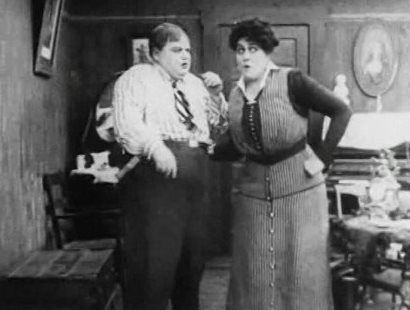
This film have all aforementioned elements, plus actors with broad, exaggerated gestures. Arbuckle is a henpecked husband by a wife who is domineering, to the point of being rude. Apparently, whenever his wife left him alone he found himself in trouble and, after being caught in a poker game, Arbuckle was locked at home by his wife while she was away.
Arbuckle found a way to leave his apartment. Meanwhile, another neighbor left his house and said good bye to his wife. Unfortunately, the poker players were interrupted by the police and a fight ensued, which gave room to some really silly gags, including typical shots of smoke on actor’s buttocks and messy scenery.
As Arbuckle did not manage to return to his apartment, he found shelter in the neighbor’s house and it made people think he was romantically involved with the wife of his neighbor. This conflict provided the funniest gags of the film, specially one with a bed coming and going between both apartments.
Although this film is not very funny, its plot is easy to follow and it provides a precious historical witness of typical slapstick comedies of 1910s and it has a plenty of action for a film of one reel (around 11 minutes).
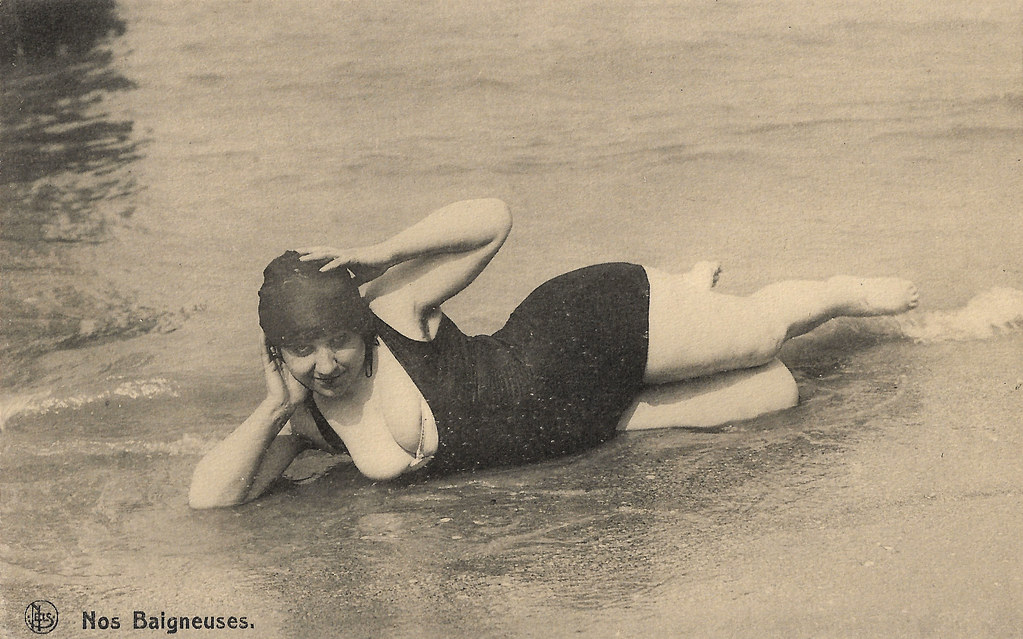
Back to a time when flirting on the beach was not something common yet and women in bathing suits was a new phenomena. The style of girls on the beach had a close resemblance to the Bathing Beauties of Mack Sennett studios, which signals a spoofing of the rival studio by Larry Semon, of Vitagraph Studios. The style of this film is very different from usual films by Semon, which were usually very cartoom-like (Semon used to be a cartoonist in real life) and with expensive special effects. It is also uncommon to see a studio spoofing each other.
In this film, we see a mix of usual 1910s gags, like people running and falling on water from a pier together with more uncommon gags, like the one where Semon flirted with a woman by holding her hand behind na unbrella and all that the audiences could see were shades of the hands, among other interesting stuff. The pace is also slower than those of traditional slapstick comedies, even when total chaos happened.
It is also noteworthy to see that the initial gag of a guy hidden on the sand with a “monocle” was also used in other 1920s shorts, specially by comedian Billy Bevan, with quite funny effects. The gags were also innovative for its era, making the most of sunny beaches, beautiful girls and flirty guys.
Another remarkable thing is the insensitive jokes on both black and chubby people, back to a era when being politically correct was not a habit. The gag towards the black woman and how offended Semon was upon realizing he was flirting with her and her answer in a intertitle with a clearly substandard English is even disturbing for nowadays’ standards.
The plot itself is very simple and it revolved about Semon trying to impress the father of his sweetheart by staging a fake robbery, but unfortunately a real crime happened and he had to solve this problem.
This cute, weird comedy provides lots of fun and it is the witness of the culture of a era when attending the beach to swim and getting a tan was slowly becoming more common and how it could still be daring for some people. A lifestyle that was gone a long time ago, but quite enjoyable anyway.
In addition to be a valuable historical witness of a era gone a long time ago, when cars were still rather new, hats were commonly worn by both men and women, etc this film is also famous for having placed together two people, who were then working for a studio which would become a integral part of history of cinema, D.W.Griffith, Mack Sennett and Biograph studios. Although they both started their cinematic careers in the same studio and were even friends in real life, their careers would turn completely different ways only some years later.
One of few common points among both Griffith and Sennett is that both of them gave up acting in favor of directing, Griffith having remained a director throughout his career and Sennett having given up firstly acting, then directing during his first years with Keystone studios, to focus only on being a studio mogul, which he was until his studio was closed in 1933.
It is definitively unusual to realize that Griffith directed a slapstick comedy with such simplistic plot, but we must have in mind that Griffith was still at the very beginning of his career as a director, after previously been a actor. His first directorial experience was in Biograph studios, after having briefly been a actor there. At this same studio, Mack Sennett began his career before founding the Keystone Studios in 1912.
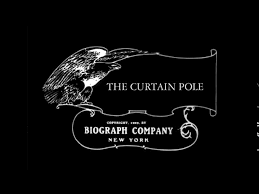
Sennett (who is barely recognizable due to a fake mustache and a disguise) is in a party in a upper class residence (the very opposite to sceneries of his subsequent comedies with Keystone studios, which usually portrayed the reality of working class citizens) and inadvertently breaks the curtain pole of the owner of the house. He volunteers to buy a new one, but ended up tripping and hitting everyone on the street with the pole on his way back to the house were he was, which caused Sennett to be chased by nearly everyone he upset.
Against all odds, Sennett managed to return to the house, but the pole had already been replaced. The final scene shows him chewing the curtain pole out of frustration.
It is impossible not to see the similarity with 1910s films by Keystone studios, whose one of main characteristics were the fast-paced chases. Who could guess that a film with uneventful gags, broad gestures and no psychological deepening of characters could be a sample of history if cinema? Although not a particularly funny film, it is still very worthy of being watched by nowadays’ audiences.


+085.jpg)
+090.jpg)
+421.jpg)
+457.jpg)


+029.jpg)
+038.jpg)
+060.jpg)
+151.jpg)
+347.jpg)
+466.jpg)

+028.jpg)
+140.jpg)
+253.jpg)
+344.jpg)
+398.jpg)
+423.jpg)


+022.jpg)

+348.jpg)

+014.jpg)
+144.jpg)
+343.jpg)
+500.jpg)

+on+Path%C3%A9scope+055.jpg)
+on+Path%C3%A9scope+165.jpg)
+on+Path%C3%A9scope+249.jpg)
+on+Path%C3%A9scope+295.jpg)
+on+Path%C3%A9scope+470.jpg)




 Silent Beauties

