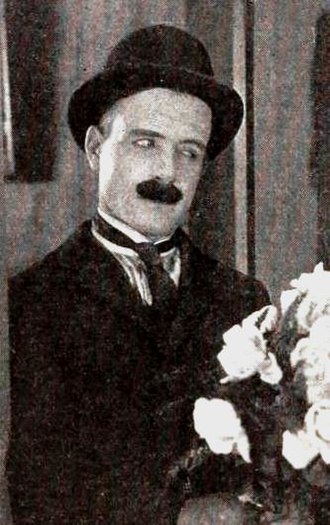
A Bill of Divorcement (USA,1932)

Despite an outdated plot, about female sacrifice and an approach to mental health that is out of the question nowadays, this film portrays some famous actors like Katherine Hepburn (in the beginning of her cinematic career) and John Barrymore with their usual impeccable acting.

A middle-aged English woman Margaret, who is the mother of a young woman called Sidney, is about to remarry. Margaret’s first husband was called Hilary and he had been in a mental hospital for 15 years, reportedly due to shell shock in World War 1. Sidney has barely known her father and she is also engaged. They both lived well despite Hilary’s absence, however his sister also lived in the same house and she had the hope that someday he would eventually leave the hospital even though it did not seem likely.
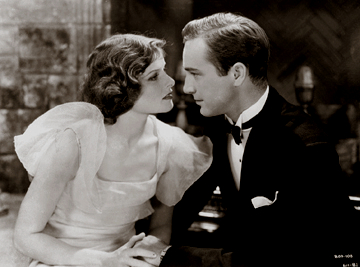
At Christmas time the family received the news that Hilary disappeared and he returned to his old house immediately. At first, he met his daughter all grown up and could not recognize her. After she introduced herself both got along right away but had a heated argument in the next minute, which portrayed them as sensitive and emotionally voluble people. However, Hilary expected everything to be as it used to be even though Margaret had got to divorce him while he was in the mental hospital, but he was not aware of it yet.

In the middle of this mess Sidney was accidentally told that mental illness run in her family, which mad her worry if she would ever have the same symptoms as her father’s and if it could impact her prospective children, after all, she had plans to have many children with her fiance after they get married.

After a while, Hilary realized that Margaret was about to remarry and he begged her to reconsider her decision. Although Margaret truly loved her fiance and no longer had any feeling for Hilary, she felt she had a kind of social obligation to remain with her first husband in addition to pity him. But Sidney considered it was morally wrong her mother to give up marrying the woman she loved just because her father reappeared.

In order to convince her parents to carry on with their lives separately, Sidney broke up her own engagement even though she was about to marry the love of her life. She could not make her love bear the burden of having to deal with a future wife and children who would possibly have mental disease. Although he told Sidney that he didn’t mind it and would like to marry her anyway, Sidney was adamant.

After her broke up, Sidney convinced Margaret to travel with her future husband and start a new life with him. In exchange, Sidney would live with her father, never marry and take care of him until the last day of his life because “they both had the same blood”. Margaret did not find it right her daughter to make such big sacrifice, but she was eventually persuaded to marry her love. Sidney also succeeded convincing Hilary that it was for the best he let Margaret go without hard feelings. At the end of film, it was just Hilary and Sidney at home and they both eventually got along well while Sidney loyally remained with her father.

As it was said in the beginning, the plot is terribly out of date, but the cast acted well and the film has a relaxed, slow pace typical of classic films of it’s era and therefore it is well-worth watching.

That Ragtime Band (USA,1913)

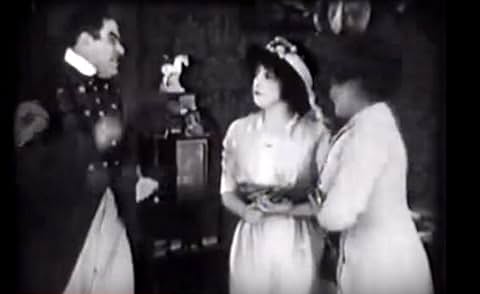
This film fits perfectly into the tradition of Keystone studios of portraying people of working classes. There is a very young Mabel Normand, fake mustaches and Ford Sterling in a comedic acting too over the top for nowadays’ standards, even bordering the grotesque. But we must not forget that such acting was still made back to 1910s, a heritage of ways of entertainment older than the cinema, like vaudeville, circus, stage, etc.

There is a band playing in front of a house. Then, the same band is shown in a rehearsal. Mabel goes to the place where the band is rehearsing to watch it, as she was apparently very excited about the band. There is a fight and Ford Sterling kicks out one of members of the band. Mabel goes outside, sees that guy who was kicked out and listens to his music with lots of interest. A short time later Ford Sterling goes outside, sees what’s going on and gets really outraged. Sterling leaves the scene with Mabel and they return to her house to see her mother. 

The band leaves for the performance. Mabel is in the audience. Before the band’s performance begins, there is a weird performance by women who had a kinda doubtful reputation, holding placards with her names and addresses. The audience laughed, but not everyone was happy with those women on stage. Even before the band comes to the stage, we can see the audience wasn’t exactly well-educated. Then the worst happens: The audience throws lots of vegetables on the band members. Sterling reacts and throws a vegetable back towards the audience, but ends up hitting Mabel instead. 

Finally, there is a general mess with a plentybof food being thrown and Sterling tried to solve the problem by getting a hose and wetting the entire audience. He fell on his butt (a common gag of slapstick comedy of that era) and this is the end of another typical early film by Keystone studios.

Those Bitter Sweets (USA,1915)

Considering the usual frantic pace, rather physical gags of Keystone studio films of 1910s, this film is much slower in comparison, providing a more naturalistic, life-like result than usual output of Keystone films in that decade. 

In a sunny day, a man is taking his sweetheart for a ride in his car. Another man with a noticeable fake mustache enters the car with them, but, as the first intertitle says “Three is a crowd”. The poor woman ends up barely having a place to sit. The second man is clearly interested in the girl too. Then, the three of them go for a ride in a relatively fast speed for 1915s standards. 

One of the girl’s suitors meets her father, but the other one ends up showing up at her house with a dog, then both suitors start fighting. However, the girl makes things complicated by giving preference to one of suitors, then she turns down that suitor in favor of the second one. She goes with one of her suitors to a restaurant, but the other suitor ends up being the waiter of the place and, apparently, he lied to his sweetheart about his actual occupation because his first reaction on seeing the pair is hiding himself rather than immediately confronting his opponent. Then, the waiter puts on some clothes over his uniform as if he had accidentally met the pair in the restaurant, but his lie doesn’t work as the girl sees the uniform under his clothes. In the middle of the argument between the three of them (the girl and both of her suitors), the waiter’s boss shows up, which confirms that the waiter actually worked there. 

The turned down suitor-waiter, dominated by jealousy, poisons some chocolates. The restaurant’s delivery man delivers the chocolates to the pair, but the girl ends up giving the box of chocolates to somebody else, instead. The waiter regrets what he did and looks for the pair to have the box of chocolates back, but it was too late. Then, the three of them (again, the girl and both of her suitors) try to recover the box of poisoned chocolates. What follows is a very fast chase (extremely common throughout silent comedies of all American studios), involving more than one means of transportation. It was necessary to be fast, as the box of chocolates ended up being got by a group of people and eaten at any minute. 

At this point of film we see something that became one of trademarks of Keystone studios: Beautiful women in bathing suits, something very innovative for the era. The diving scenes of the girls are among the funniest of the film. Of course, the poisoned chocolates weren’t eaten and a tragedy was avoided just in time. A happy end, but it didn’t prevent lots of slapstick from taking place. 

The Dippy Dentist (USA,1920)

Beautiful scenery, ingenious intertitles, as we can expect from a comedy by Hal Roach. This film really provides a nice excerpt on how people lived so many years ago. A black boy is part of the cast, although his character is very stereotyped even in his lines in intertitles. Those who have already watched “Our Gang” can see a familiar setting in some scenes of this film. 

Dentists haven’t been new in silent comedy and even Laurel and Hardy had some gags about it. The fear caused by going to the dentist can be very funny sometimes. This film’s plot isn’t really innovative or has gags out of the standard, but it is easy to understand and entertaining. 

In the very beginning of the film we see a “French beauty specialist”, a girl who has many suitors. This scene gives us short glimpses of how beauty parlors looked back to early 1920s. One of girl’s suitors is a dentist, although she didn’t seen very excited about him. 

Then we see Pollard in a rather funny outdoors scene, where we can have a sample of 1920s vehicles. 

In the next scene we see some crooks with a bottle of liquor. We must not forget that prohibition had recently started in the United States, so this kind of trade was considered illegal. The police chases the crooks, who leave a bag behind them in the middle of all mess. Pollard grabs the bag, unaware of its content. A short time later, he steals the clients of the dentist in a rather unorthodox way. Pollard then starts taking care of the clients, in the rudest and roughest way possible. 

Then, old Pollard’s sweetheart arrives at the office, with a toothache. He treats her pain, but takes advantage of his position to kiss the girl as much as he wants while she sleeps on the chair. A police officer arrives and sees what Pollard is doing and the officer chases him, both guys completely ignoring the sleeping girl on the chair. 

A Cure for Pokeritis (USA,1912)

John Bunny was one of first comedy stars of American cinema. The comedies he made to Vitagraph studios (a pioneer cinema studio in the United States) together with English actress Flora Finch stood out due to their sophistication compared with other comedies of the era, being the forerunner of situational comedies, like those Hal Roach studios made so extensively in 1920s. Considering that situational comedies were not so common back to 1910s and that slapstick was more widely produced, those “Bunny-Finch” comedies were even ahead of their time.

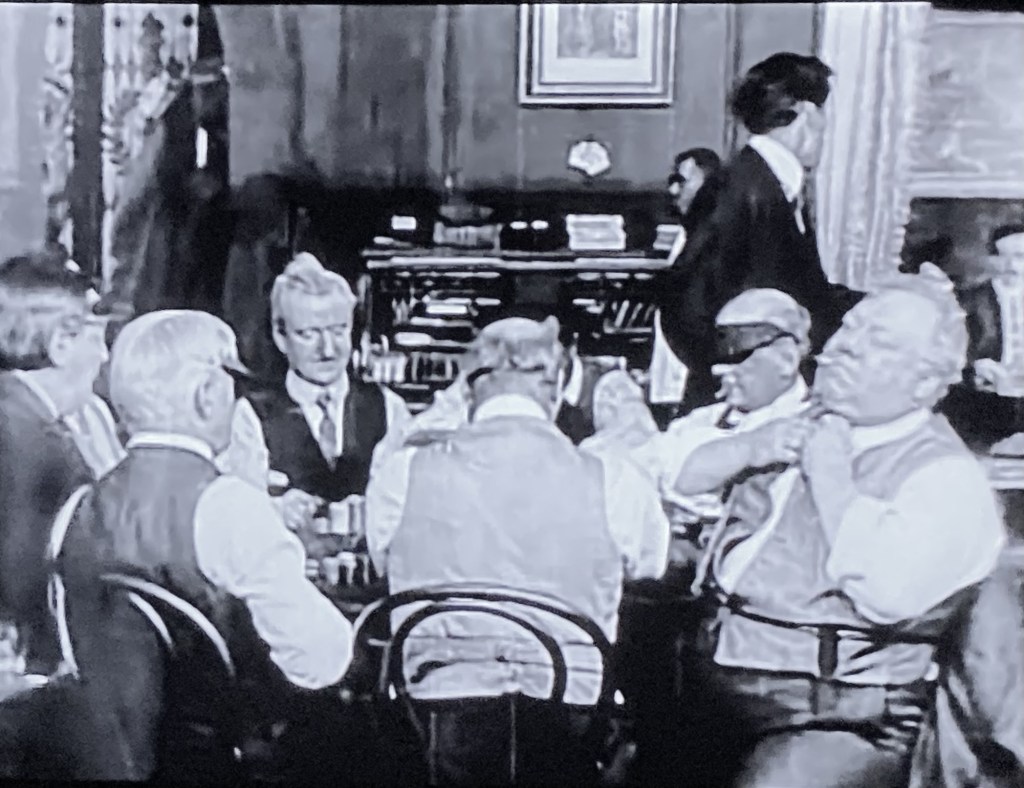
The husband plays poker quite often and loses equally often. As expected, the place where he played is a quite masculine environment, with men smoking cigars and elegantly dressed. No women is seen there.

In the next scene Flora Finch (who plays the role of gambler’s wife) is seen in a living room with very beautiful furniture. The husband returns home and the wife seems really annoyed. Upon careful inspection of the house where the couple lived, the furniture and objects we can see that they were relatively well off people.

Considering how annoyed the wife was, the husband swore he would never play again, but even the audience could see that it would not really last. The husband soon finds an excuse to leave home, so he could play poker again without his wife realizing it. And the gambling starts all over again. However, while he sleeps he inadvertently starts talking and his plan of hiding his poker habit of his wife goes down the drain. But the wife also has her own plans, with the assistance of her cousin.

Then, the wives of all gamblers gather together and a poker meeting of the guys is suddenly disrupted.

Although the acting of cast is reasonably naturalistic, we can see some vestiges of stage acting, like exaggerated gestures or facial expressions in some scenes. Such stagy acting was already a bit outdated even in 1910s and would soon be replaced by fully naturalistic acting, like those of Lillian Gish and Mary Pickford.

Be Reasonable (USA,1921)

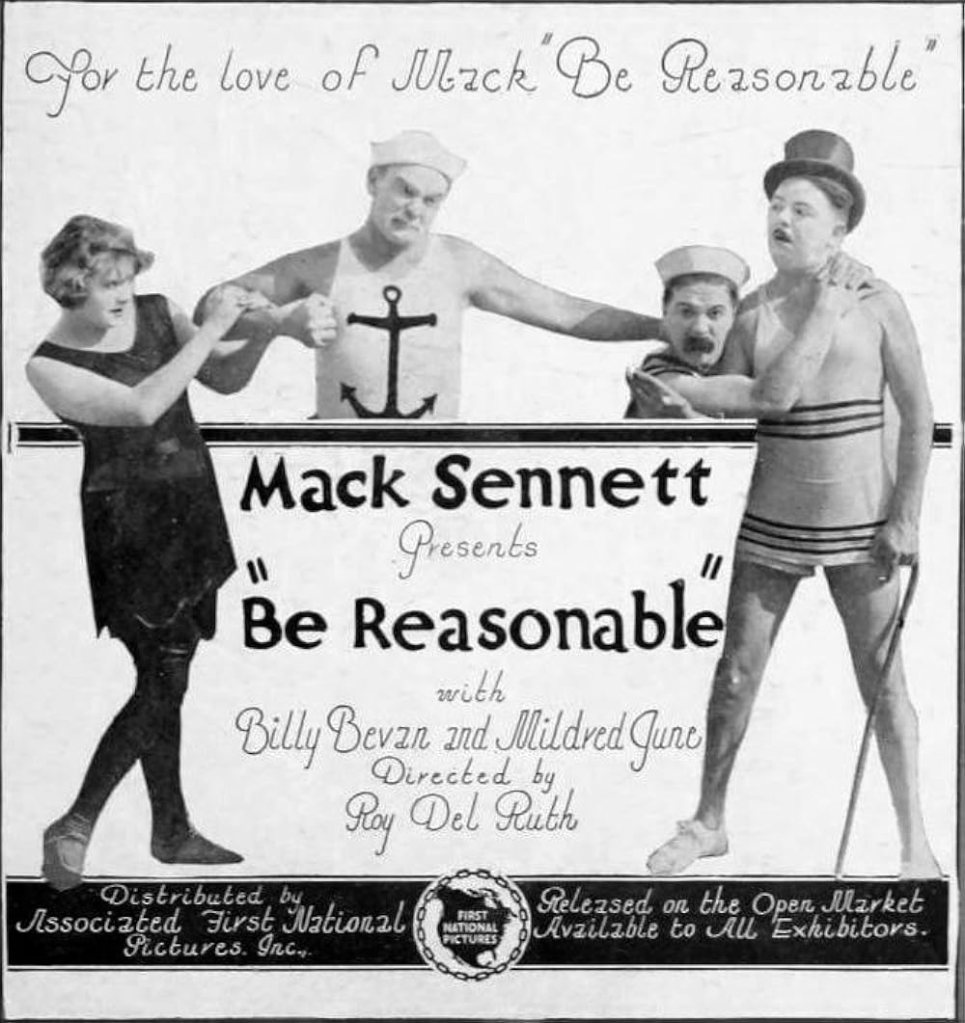
A fine and highly original film, which has the craziest situations you can imagine. But being unrealistic is part of its charm. This film is far from slapstick or situational standards, as it is neither grounded on physical gags or situations from the real life. The plot is permeated by over the top situations that run smoothly regardless of their incongruence and within a mega fast pace and the result is even a bit “surrealistic”. These sort of comedies were relatively common in Mack Sennett comedies throughout the 1920s (of which Charles Bowers was one of exponents, among many others). 

Billy Bevan is one of many underrated silent comedians, who was successful in 1920s, but ended up being nearly forgotten after the end of silent era. This is something really undeserved, as he was a good comedian and even innovative on his own right. 

Undoubtedly, one of most praised scenes of this film is the one with the periscope on the beach. Bevan goes to the beach, but he does not want to miss any beautiful women and he looks for them with a periscope while he is buried under the sand. Needless to say that the beach provides a great opportunity for the Bathing Beauties show up, together with the characteristic swimming suits of the era. Since the very beginning of Keystone studios, back to 1912, Mack Sennett made the most of beach sceneries in his comedies, not only to fill them in with beautiful women, but also making the sea part of the films and showing people swimming, enjoying the nature, etc.

Then Bevan finds a very beautiful girl (who had a equally cute dog) on the beach with his hilarious periscope and all of a sudden he gives her a pearl necklace. Unfortunately to Bevan the girl is more interested in the handsome life saver. Bevan tries to recover the necklace but the girl refuses to give it back to him. 

But Bevan has other problems, he has to pay for the necklace or return it to the store. Since the girl did not want to return it, his only alternative is going to her house (Yes, we have no idea how he got to find out the address of a girl he has just met, but this film isn’t supposed to be reasonable, despite the title). Of course Bevan is not exactly a skilled burglar, the girl finds out her house is being robbed and calls the police. 

What follows is another famous and hilarious scene of this film, which shows Bevan being chased by the police. This scene is even compared with the famous chase scene of Buster Keaton film “Cops!”, that was made on the following year. If you watch both of these films, you will realize it is impossible not to make the comparison, as the scenes of both films have many similarities. 

After the chase, there is the end of the film, which is also really funny, with perfect timing and many insane situations happening in a matter of a couple of minutes.

This is a very funny film, which original gags, quite good comedic timing, good acting and production. Really worth to be carefully seen. 

Wall Street Blues (USA,1924)

Del Lord is a director who became best known for the Three Stooges films he directed in 1930s. But in 1920s he directed some of the weirdest films by Mack Sennett Comedies. Weird films in the regard of portraying mega crazy situations, even within comedy’s standards and having a cartoom-like style. This film is a good example of it, with a plot that is not really linear, although the pace is not as frantic as of slapstick comedies, for instance.

The film starts with some rather crazy and unusual gags in a bank, where Bevan works. Then we see gags with objects that seem to have a life of their own, which is a characteristic of this type of comedies. A particularly noteworthy gag is when Bevan accidentally vaccums the poodle belonging to client who has just arrived the bank and the poor little animal ends up inside the vacuum cleaner, to the dismay of the owner. But things can always get worse and it is exactly what happened when the dog suddenly disappears as if by magic. 

Some crooks try to make a dishonest scheme, a robbery occurs, which gives room to many insane gags related to heights. The bank cashier fights the robbers and then there is a rapid succession of gags, which end up in a marriage inside a ship and its crazy results.

This film is very nice and has a style that was not common not even in its era, the gags are nice, actors look confident and skilled, with good comedic timing. However, as it is a kinda unusual sort of comedy it can be confused to some people and even make others feel ill at easy, which does not really affect the good quality of its production. 

Hoboken to Hollywood (USA,1926)

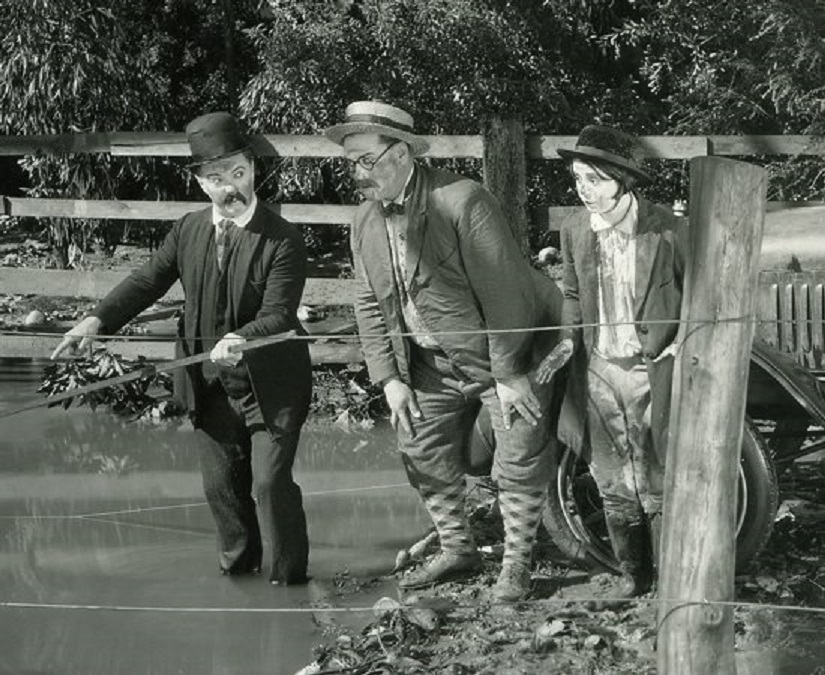
Billy Bevan plays the character of a typical office man, both formal and stressed. But his routine changed when the president of the company where he worked transferred Bevan to California to start the company’s office there. Bevan got very excited about this change, probably in the hope of having a less stressful lifestyle. He called his wife to tell her to make the arrangements and then it is shown the car they will use to drive to California. Considering the amount of things they carried and how they were disposed, it seemed they were going to spend a long time in California or, at least, that they were not organized people. After a brief conversation, Bevan, his wife and mother in law started their journey.

We can also see another couple who is heading West in a journey that doesn’t seem calm at all. 

Both couples meet and everyone’s problems only seem to escalate. At this point of film the gags with cars are particularly funny and very skillfully performed, which is admirable, considering the difficulty of stunts in those scenes. Actually, comedy films involving mechanical gags were not so rare back to 1920s (this is particularly noticeable in Buster Keaton’s films, among others), which indicates how machines and automobiles were already an integral part of people’s lives back then. The audience really wonders if those people will ever be able to reach their destination, considering their everlasting difficulties on the way among rough desert landscapes. The elements of landscape were explored as much as possible as prompts to the gags, including the animals and plants around.

In the end, everyone got to arrive in California, but a huge surprise would wait for Bevan and things would not be as good in California as he imagined. When he arrived at the office, Bevan realized he would have to work with a fellow who was very familiar to him. It would end up causing completely unexpected consequences to Bevan and his family.

Another highlight is the kinda ethnically insensitive jokes related to the black servant, who was always too afraid of everything and spoke incorrectly, which is not something uncommon in 1920s films by Mack Sennett Comedies. The stereotypes of California as being the land of sunshine and Hollywood as the place where dreams come true were also employed. 

The Grab Bag Bride (USA,1917)

This comedy is somehow similar to rural comedies by Roscoe ‘Fatty’ Arbuckle and Mabel Normand made for Keystone studios in 1910s (specially in 1915-1916). Actor Al St John (who was Arbuckle’s nephew in real life) was good to play the roles of naive country men, often riding a monocycle, which was a stunt this actor was a specialist and we can see it in this film too. 

In this film Al St John is the suitor (identified in the beginning as a “ardent wooer”). Then, we are introduced to the widow’s daughter, who looks forward to have a good marriage. It is made the most of animals as prompts to gags and the result is pretty interesting as a reminiscence of an era when many people actually lived in the countryside and could easily relate to those characters. 

The widow planned to spoil the marriage due to social status of the love interest of her daughter. Some scenes are quite funny due to their spoofing of romantic conventions on courtship, which is something that was explored at its most at the film Tillie’s Punctured Romance (USA,1914), also made by the Keystone studios. Another funny and original fact is the intertitles, which had rhymed lines, like poetry, but the content was another spoof of the Victorian idea of romantic love. 

St John is the villain also interested in the girl, with the approval of her mother. The opposition between both suitors starts. The girl decides to marry the suitor she loved, but St John had another plans and hired two other villains to help him stop the marriage. Almost immediately, the three villains kidnap the girl, by putting her inside of a bag. The groom realized something was wrong, a chase was started. 

When it seemed that he villain would really get to marry the girl, it was shown that he had actually kidnapped her mother instead. Meanwhile, the girl was at home all dressed up to be married. When she realized there was no one around she sensed something was wrong and ran away.

At the end, the girl was able to find everybody and could finally marry the man she loved. About Al St John, he got to be married to: With the girl’s mother. He didn’t realize he had kidnapped the wrong person on time to prevent his marriage from taking place. 

Know Thy Wife (USA,1918)

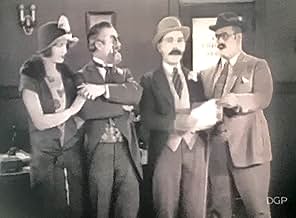
In this typical situational comedy, Bob is a lad away from home and he met and fell in love with Betty. In the beginning of film she asks him what his parents would think of her. He told her she should wait and see what would happen, as he had the right to pick out his own wife. That answer did not sound very promising. Perhaps it was a kind of sixth sense that made Betty wonder it?

However, his parents were looking forward to Bob return home and they had their own matrimonial plans to his son, including choosing a prospective wife to him called Lillian. Lillian really looked wealthy and socially respectable, as it was said on one of intertitles.

Bob got shocked when he knew his parents had already chosen a wife to him. Seriously, it was something quite outdated, even for 1918 standards, but comedies are not often realistic, so let’s not think about it. 

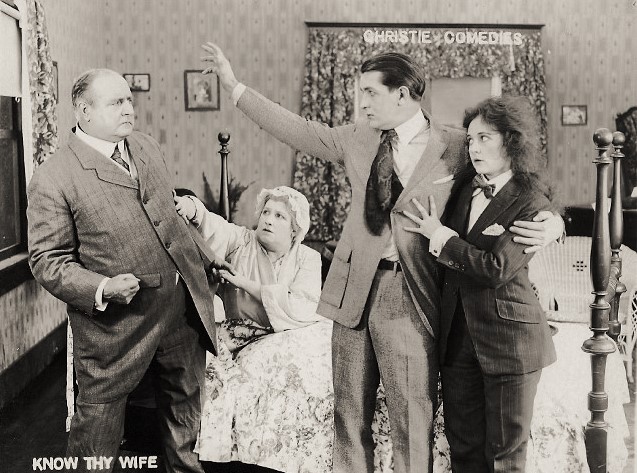
One day Bob received a letter from his parents, saying that they would love him to bring his roommate home, so he could be the best man of his wedding. And this is how Bob brought Betty home, disguised as his old friend, Steve. 

Then, Bob’s parents made him take Lillian to the theater, while Bob’s father took Steve (who was actually Betty in drag) –against his will –to see the bright lights. What could possibly go wrong? Some women flirted with poor Steve. On the other hand, Lillian tried to get closer to Bob. Then, Bob and Lillian coincidently show up after the theater in the same restaurant his father and Steve were and all of them start sharing the same table. 

After a while, it was impossible to hold that lie any longer and Bob ended up confessing to his parents he had married Betty. Fortunately, his parents ended up reacting very well to the sudden news and Betty got along very well with her in laws. 

Although the plot ended up being too compressed in such short film and the gags could be exploited for a longer time, the film is rather light. The gags were by non means innovative, but it is a cute romantic comedy, with a sophisticated touch and beautiful scenery and clothing. 

Flapper Fever (USA,1924)

Like most situational comedies, this one also talks about equality of genders and marriage. 

At the Rosebud Theater, located in the town of Bird Center, there will be a presentation by the Rawsbury Sisters and the local men are very excited about it in advance. We can see by the placard that the girls would not wear lots of clothes in their act and their legs were bare. How outrageous! The actresses clearly represented the 1920s young liberated women, the so-called flappers. 

By the way, in one of intertitles it is mentioned that the guys were not exactly Valentinos, in a clear reference to Italian actor Rudolph Valentino, then at the height of his popularity in America, as a symbol of beauty and desired by many women. Another mention to Valentino is made in “The Sheiks of Bird Center”, which was a reference to his most famous film. 

The guys were very excited about the show in the opinion of their wives, who are not happy with their husbands’ behavior. The wives are defined as “watch dogs”, which signals their morally strict posture, related to Victorian values and they are also older than the actresses. We can see here another traditional prompt in 1920s comedies: Henpecked husbands. So, the wives bring them to the purity league, probably to avoid them to misbehave during the Rawsbury Sisters act.

However, the husbands would not miss the opportunity to meet the girls in person and they went to the hotel where the actresses stayed to greet them. Unfortunately to those men, their wives caught them red-handed having fun and dancing with the actresses at the hotel. But the guys would not give up the actress so easily. So, the wives tried to censor the Rawsbury Sisters’ act by inspecting their costumes and act before they appear at the theater, as one of intertitles says. And the opposition of Victorian X modern 1920s moral standards gets even more noticeable in this part of the film. Such clash would remain unsolved and not even the misunderstanding in the end of the film could sweeten the wives. 

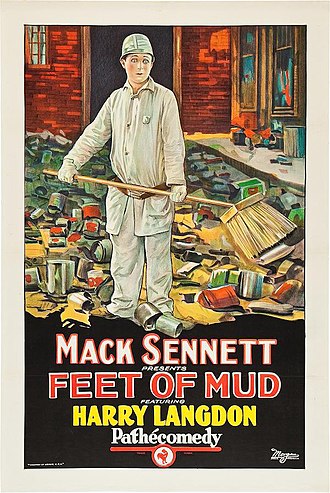
Feet of Mud (USA,1924)

The character that would bring Harry Langdon world fame was already fully well-rounded in this film. There was a football game (American football, to be more precise) between the Mohicans and the home team. Then we are introduced to Harry Langdon’s character, naive, not understood by others and helpless on circumstances around him. Langdon is in love with a girl who has another suitor and was a substitute in the football team, merely because there were not better players available. 

Football is always a very physical sport, but that specific game seemed to be particularly violent and players left the field in a very bad condition, looking more dead than alive. Comedy films about physically weak guys who overcame difficulties were common and were made even by the most famous comedians of silent era, like Charlie Chaplin, Buster Keaton, Harold Lloyd. So, this is Langdon’s version to a rather known comedic plot. 

Langdon is called to play and the audience does not take him seriously, specially because he was not a strong, muscular man. However, against all odds, Langdon got to stand out in the game. 

Then, he tries to marry his sweetheart, but her father did not give his permission, unless Langdon got to keep a job with the City Engineer. The girl’s father wanted Langdon to be as skilled in his professional life as he was in the football field. The “engineering” job ended up being street cleaner in a rather crowded and busy city, full of garbage. Langdon tries to do his best in the new job, but he cannot help being involved in many troubled situations. 

Langdon catches the train and finds himself in the Chinese area, where a kind of inner war was going on. His sweetheart shows up there with her father and a group of tourists. Violence suddenly escalates, the girl is in danger and it’s Langdon who saves her despite all his initial fear. 

The Chinatown was portrayed in a rather stereotyped way, as a place of poverty, violence and a kind of exotic curiosity to be seen by white tourists. Those jokes can be considered ethnically insensitive. 

Create a website or blog at WordPress.com

Up ↑