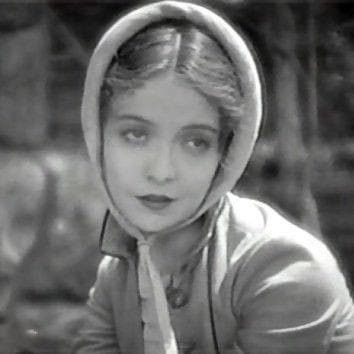
An article of the American magazine Screenland, October 1922.
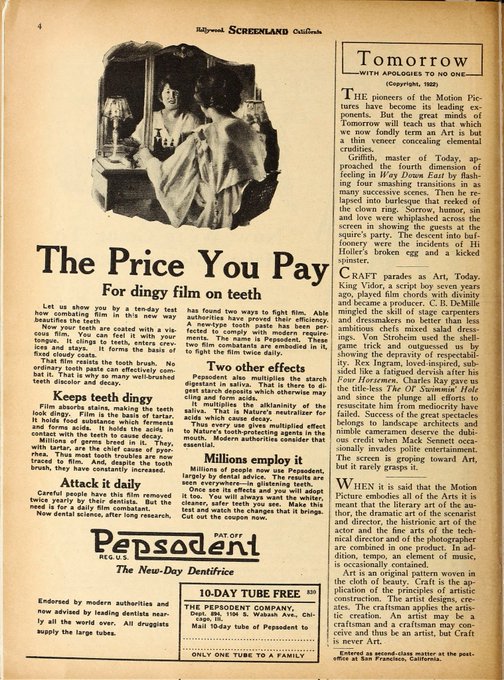

An article of the American magazine Screenland, October 1922.

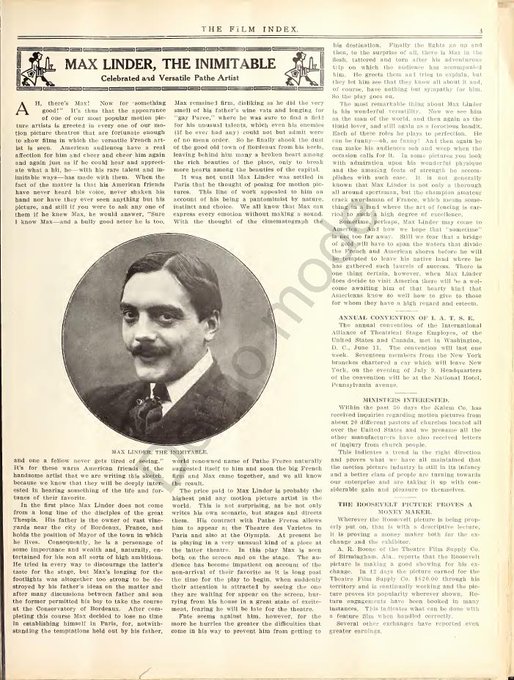
An article about French actor Max Linder in the American magazine The Film Index.
New York, July 16, 1910.
Gabriel-Maximilien Leuvielle (16 December 1883 – 1 November 1925), known professionally as Max Linder, was a French actor, director, screenwriter, producer, and comedian of the silent film era. Wikipedia link: https://en.wikipedia.org/wiki/Max_Linder

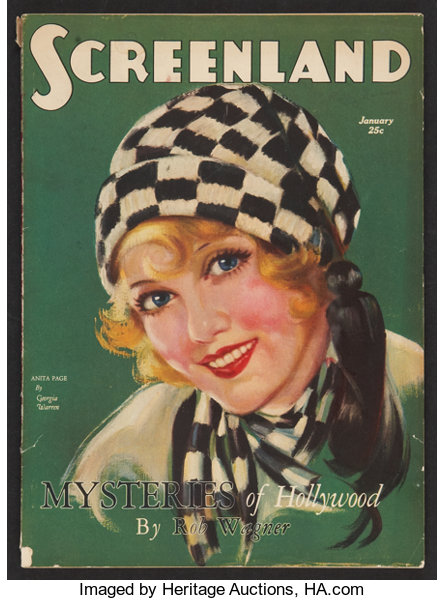
Anita Page (born Anita Evelyn Pomares; August 4, 1910 – September 6, 2008) was an American film actress who reached stardom in the final years of the silent film era. Wikipedia link: https://en.wikipedia.org/wiki/Anita_Page

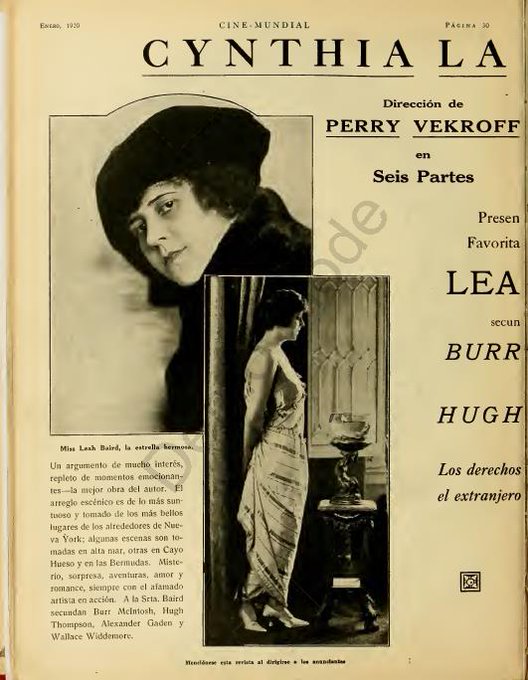
A page of the Mexican magazine Cine Mundial, January 1920.

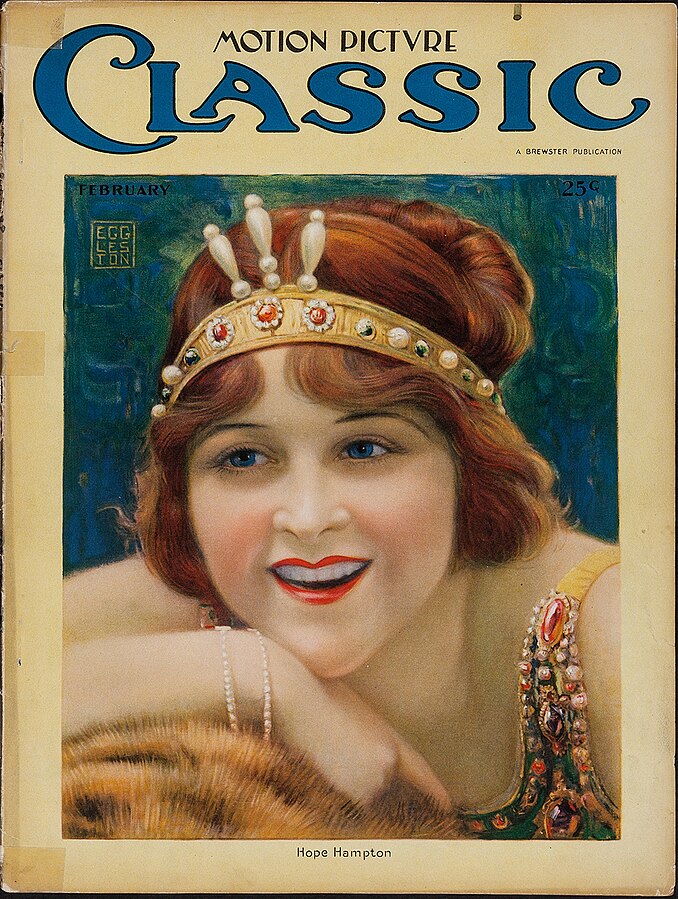
Hope Hampton on the cover of Motion Picture Classic magazine, February 1922, cover art by Benjamin Eggleston.
Mae Elizabeth Hampton (February 19, 1897 – January 23, 1982), known professionally as Hope Hampton, was an American silent motion picture actress and producer noted for her seemingly effortless incarnation of siren and flapper types in silent-picture roles during the 1920s. She was also an aspiring opera singer. Wikipedia link: https://en.wikipedia.org/wiki/Hope_Hampton

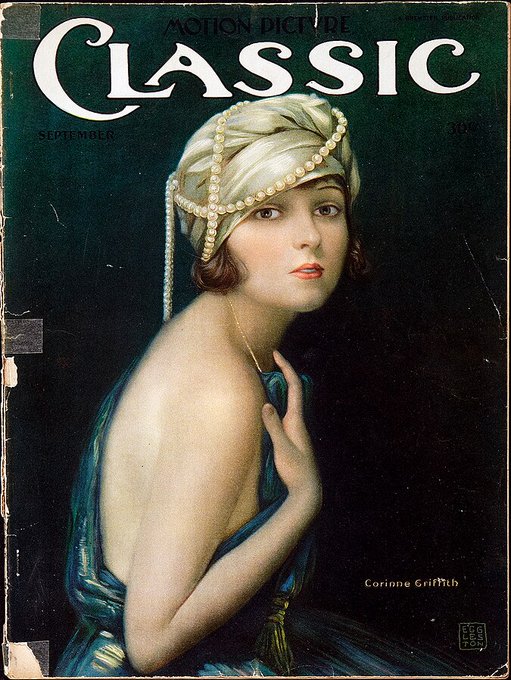
Corinne Griffith on the cover of Motion Picture Classic magazine, September 1921, cover art by Benjamin Eggleston.
Corinne Griffith (November 21, 1894 – July 13, 1979) was an American film actress, producer, author and businesswoman. Dubbed “The Orchid Lady of the Screen”, she was widely regarded as one of the most beautiful actresses of the silent film era. Wikipedia link: https://en.wikipedia.org/wiki/Corinne_Griffith

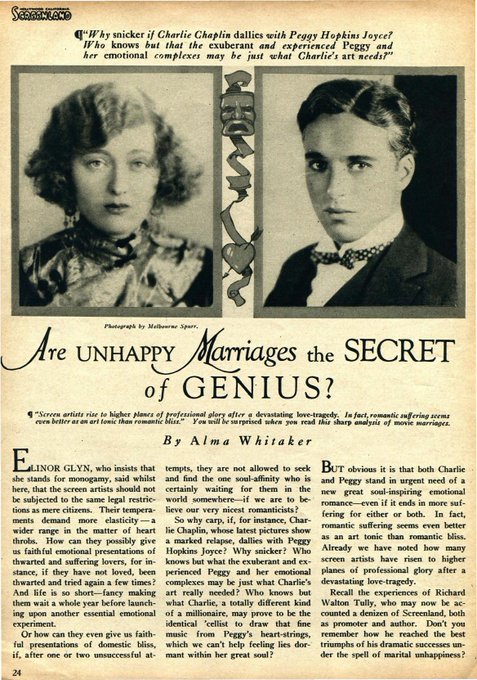
An article in the Screenland Magazine – December 1922.

Cover of the American magazine Screenland, October 1922.
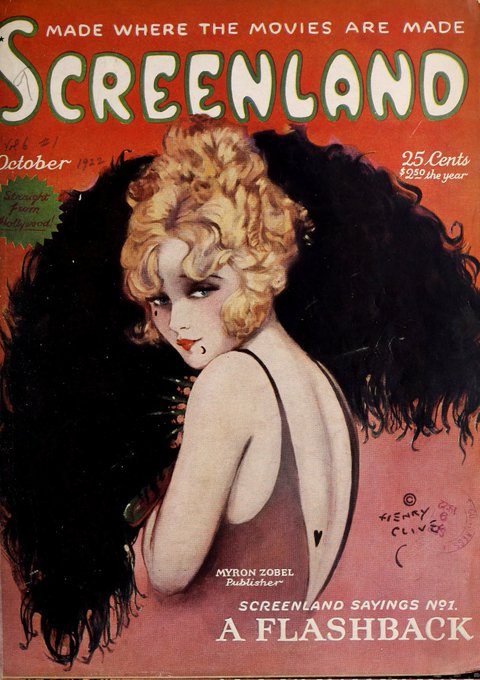

An article of the American magazine Screenland, October 1922.
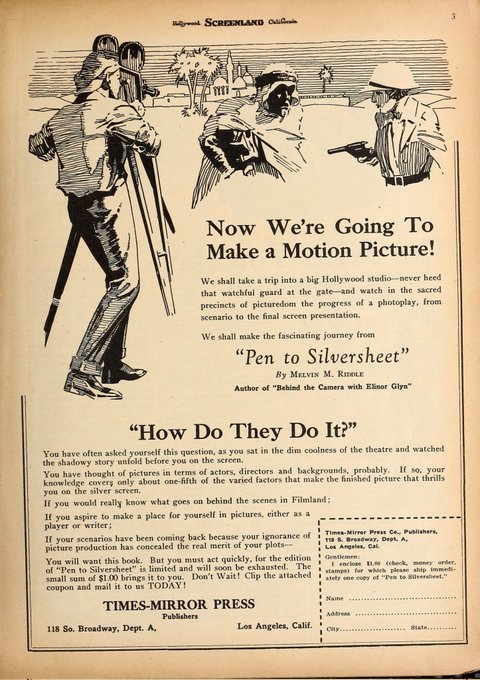

Clara Marie Horton (July 29, 1904 – December 4, 1976) was an American actress of the silent film era. Wikipedia link: https://en.wikipedia.org/wiki/Clara_Horton
Clara Horton was born in Brooklyn in 1904. Her mother’s name was Gertrude May Wilcox, from Detroit, who was once an aspiring musician, having graduated from the New England Conservatory of Music in Boston. Her father, it seems, may have died while Clara was very young since there isn’t a mention of him and the early census records state that Gertrude was a widow. However, Gertrude apparently gave up her musical aspirations shortly before her daughter, Clara, was born.
Clara first appeared on the stage at the age of 4 in a production of “Jack & the Beanstalk,” followed by a staged adaptation of “Cinderella.”
With her blue eyes and blonde hair, eight-year-old Clara broke into motion pictures with Eclair American, playing a boy in the 1912 film, Because of Bobbie. After working steadily in a number of short films on both the East and West Coasts, she gained notoriety as a child star known as “The Eclair Kid,” before leaving the Eclair Studio in 1915 to work for other small production companies, usually playing supporting roles. In 1917, she signed with Universal. Later, she worked with First National and later Famous Players – Lasky.
Though still a minor, she attained greater stardom in 1919 when she was promoted as an ingenue, after gaining favorable notices from playing opposite Jack Pickford in an adaptation of Tom Sawyer. In the late 1910s, Clara was often dressed and made-up to appear older than her years.
Oddly enough, her career took a mystery turn in 1922, making a brief appearance in only one film. The press was tight-lipped, saying that in late 1923, she moved to New York City to make a film (which was never made) and to appear in a play. In 1923, she primarily acted in short films and in 1924, she didn’t seem to fare much better. When she returned to Hollywood in 1925 to make her comeback after a “two-year absence,” newspapers claimed that she had given up her career for marriage, but that she was now back to reinvent her image.
Horton briefly reclaimed her stardom in 1925, but by 1927, she again disappeared from the screen for a number of years after appearing in a “B” western. Times grew harder and by the 1930s, Horton’s principal job was working as Joan Blondell’s stand-in. Occasionally, she was cast small roles for $10-$15 a day, working at Warner Bros. and Paramount. By 1942, her career was over, having been reduced to playing extras.
Very little information is given about her private life –
In the 1930 U.S. census, Hyman B. Brand is listed as her husband and both were living in Beverly Hills along with Clara’s mother, Gertrude. Apparently, the couple had a son, Donald Brand, age 1.5 years old.
According to the 1940 census, Clara Horton was divorced and living with her mother in Glendale. Sadly, in the 1940 census, Clara’s occupation was listed as “stock company leading lady,” and that her age was 32 years old (she was really 36), which seems to suggest that either Clara or her mother still hoped for a comeback. In the 1940 census, Donald Horton was listed as being 12-years old.
Clara died in obscurity on December 4, 1976, and now shares a grave marker at the Rose Hills Memorial Park Cemetery with Edwin H. Laufer, who died in 1983. ~ Craig Owens.
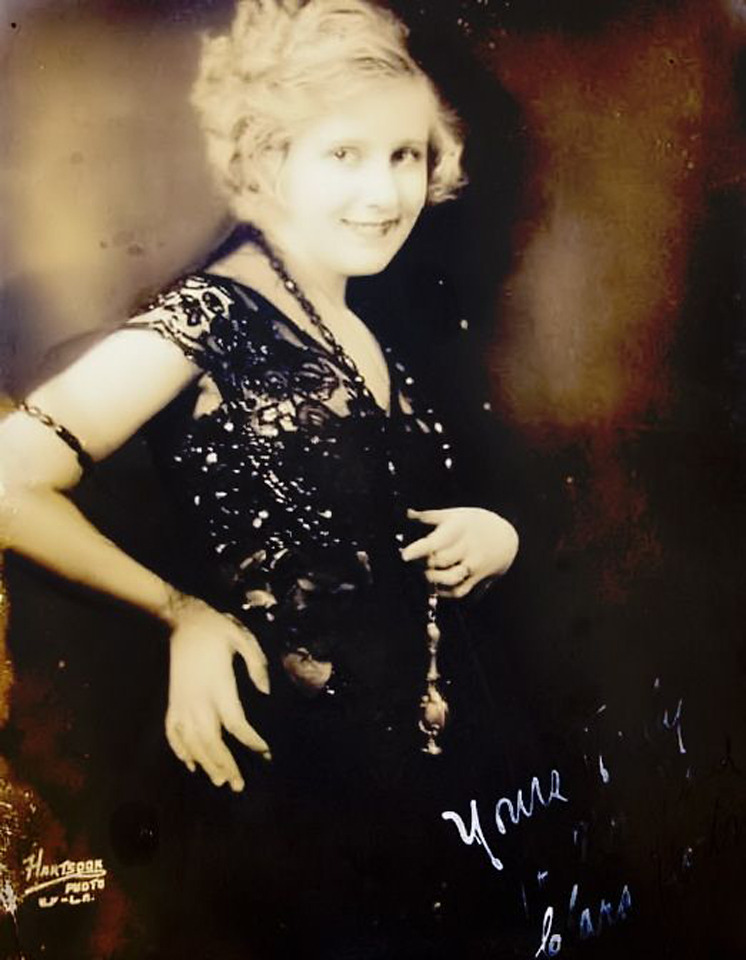

Marie Eline (February 27, 1902 – January 3, 1981) was an American silent film child actress and sister of Grace Eline. Their mother was an actress.
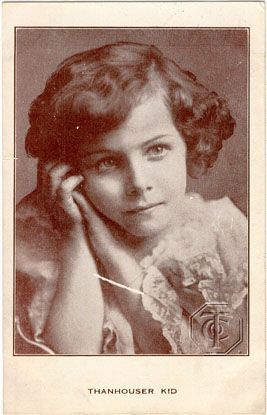
Eline acted on stage for three years before she acted in films. Nicknamed “The Thanhouser Kid”,[3] she began acting for the Thanhouser Company in New Rochelle, New York, at the age of eight and starred in exactly one hundred films between 1910 and 1914.
Wikipedia link: https://en.wikipedia.org/wiki/Marie_Eline

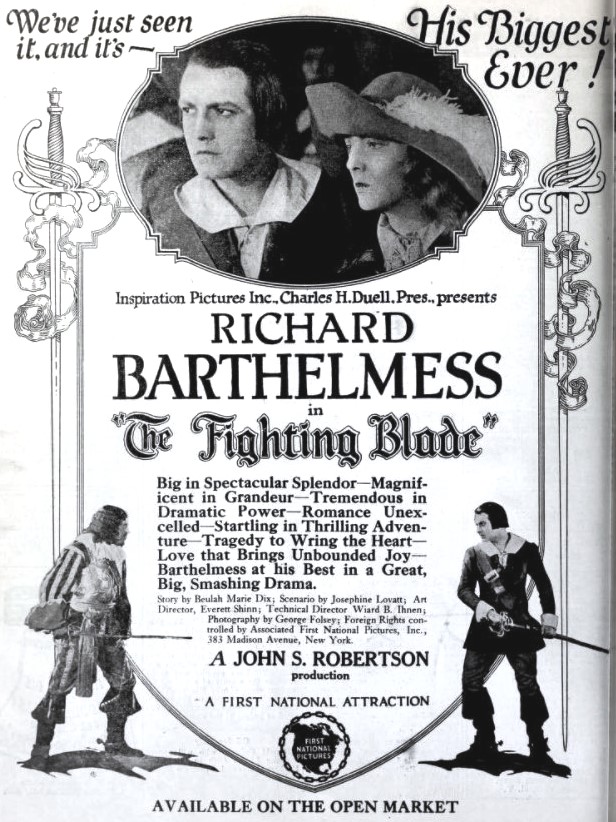
Advertisement for the American drama film The Fighting Blade (1923), on page 7 of the August 31, 1923 Film Daily.
Fighting Blade (USA,1923). IMDB link: https://www.imdb.com/title/tt0014039/
 Silent Beauties