The Furs (USA,1912)

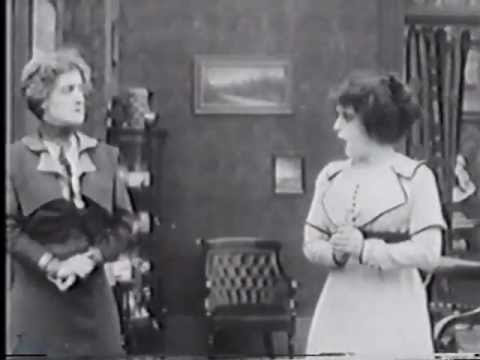
This film is a rare surviving silent short made by Mabel Normand and Mack Sennett at Biograph studios, which was released in 1912, only some months before Keystone studios was founded by Sennett in California.

Despite being at the height of her youth and vitality, Mabel`s acting is more restrained here than it would be in her subsequent Keystone slapstick comedies, which is adequate to the slower pace of this film. Still, we can see here some trademarks of future output of Keystone studios, especially by portraying Mabel as an intelligent woman, with some independence and strength of character, which is a contrast with Victorian women, damsels in distress who were totally dependent of their male guardians.

Mabel is a spendthrift and her mother-in-law does not agree with her extravagance, while her husband tries to please both Mabel and his mother. It is clear that both women do not really get along, but they have to live very close (or perhaps even in the same house) and it causes conflicts on a daily basis.  Mabel shows that she is not the type of wife who would tolerate a bossy mother-in-law without fighting back.

Mabel is not satisfied with the interference of her mother-in-law and goes shopping anyway. Upon her return, Mabel clashes with her mother-in-law again.  Meanwhile, her husband is running out of patience with all this conflict at home.

On the following day, Mabel gets some money out of her husband`s pocket without his knowledge. He realizes the money is missing, but does not attribute it to Mabel and thinks he lost it somewhere else. He stands up to have breakfast, only to see Mabel and his mother arguing again. Therefore, he says that “one must leave”.

Mabel sees some beautiful furs in a shop window and finds them simply gorgeous. Then she had the idea of pawning her furs, but unfortunately her plan would not have the result she expected, as the furs she wanted so much ended up going to her mother-in-law. And Mabel does not disguise how furious she really is.

This cute little film shows two legends of cinema (Sennett and Mabel) in the beginning of their careers in films and their unique comedic style could already be observed. It is also interesting that Biograph`s films by the duo tended to focus more in the lives of wealthier citizens (even Mabel`s clothing and hat were more elaborate than those she usually wore in her subsequent characters in Keystone films). Such paradigm would be deeply changed at Keystone studios, famous for showing the lives of working-class citizens.
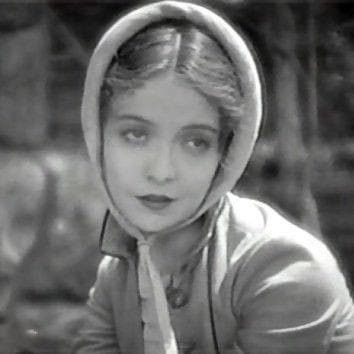
Tomboy Bessie (USA,1912)

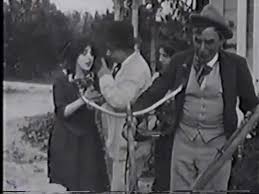
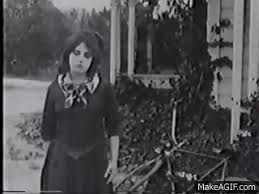
Although Mabel Normand was really young when she made this film (circa 20 years old), we can observe that she played a character much younger than herself. This is particularly noticeable by the way she hopped, the big ribbon on her head and some slight overacting. But it does not compromise the quality of her performance anyway.


Mabel plays here a rather different role from the determined, strong-willed and independent women that she portrayed on screen so often in her films at Keystone studio. Still, the vibrant comedic style of Mabel was already visible. The characters of this film were also more human-like, realistic and without that frantic pace that would be so famous in films by Keystone studios, which would be open only some months after this film was released.


This film was made by Biograph studios, the same famous studio where D.W. Griffith started his career in films. As Griffith was more focused on dramas, Mack Sennett ended up being responsible for the comedies of the studio. Both men had started in Biograph as actors before 1910. That was something natural, as it was an era when film crew could have different roles in the studio, sometimes even in totally different areas, like direction, acting, wardrobe, etc. This multitasking gave a chance to actors be involved in all aspects of film production and realize what would be most comfortable for them to work with.


Mabel was a very mischievous and active kid, always full of energy to play. It was tiresome for adults around her to handle such energetic little one. She was also a headache to the love life of her aunt.
The suitor of Aunt Cissie (Andrew) was supposed to amuse the kid in order to be authorized to marry his sweetheart (he was “pleading for the hand of fair Cissie”, as it was said in one of intertitles). However, Mabel proved to be a hard task.


Another noteworthy thing is the nearly Victorian courtship shown in this film, where the man had to prove himself worthy of his sweetheart by doing something rather impressive. That was part of the plot of countless other silent films throughout the world. The simple outdoors landscape, with animals and without cars or crowded places shows to modern audiences a lifestyle that has been away for a very long time. 

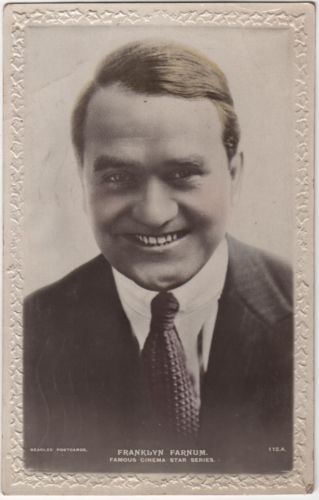
Franklyn Farnum (June 5, 1878 – July 4, 1961), Postcard- 1920

Vintage Postcard. Early black and white/sepia card. Silent Movie/Film Actor Franklyn Farnum.

Published by:  Beagle’s. Real photograph

Date:  1920.

William Smith (June 5, 1878 – July 4, 1961), better known by his screen name, Franklyn Farnum, was an American character actor and Hollywood extra who appeared in 433 productions between the years 1916 and 1961. Wikipedia link: https://en.wikipedia.org/wiki/Franklyn_Farnum

Ralph Kellard (1882–1955), Pathe Freres Cinema Ltd – undated picture

Postcard, silent film actor, Ralph Kellard, Pathe Freres Cinema Ltd – undated picture.

Ralph Kellard (1882–1955). Ralph Kellard was born on June 16, 1882 in New York City, New York, USA as Thomas J.J. Kelly. He was an actor, known for The Precious Parcel (1916), Her Mother’s Secret (1915) and The Veiled Marriage (1920). He died on February 5, 1955 in New York City.

Wikipedia link: https://en.wikipedia.org/wiki/Ralph_Kellard

Virginia Chester (1896–1927), original signed photo, silent actress – 1910ies

Virginia Chester (1896–1927). Virginia Evelyn Chester was born August 27, 1896 in San Francisco to Louis Chester and Kathleen (Kate) Judge. Her film debut was in “The Yaqui Girl” (1910), for Pathe Films. She was a leading lady with the Bison-101 Ranch Company and with Universal Pictures. Other film credits included “The Frenzy of Firewater” (1912), “A Shot In the Dark” (1912).

IMDB link: https://www.imdb.com/name/nm0156346/

Charles Sale (August 25, 1885 – November 7, 1936) in Who’s Who on the Screen, 1920, Publisher New York City: Ross publishing co., United States

Picture taken from Who’s Who on the Screen, 1920, Publisher New York City: Ross publishing co., United States.

Charles Partlow “Chic” Sale (August 25, 1885, Huron, South Dakota – November 7, 1936, Los Angeles, California) was an American actor and vaudevillian. Wikipedia link:  https://en.wikipedia.org/wiki/Charles_%22Chic%22_Sale

Create a website or blog at WordPress.com

Up ↑