Peeping Pete (USA,1913)

The subject of peep hole had been explored in films virtually since the invention of cinema and this split reel (a film shorter than a one-reeler, in other words, lasting less than 11 minutes) shows this theme in a typical slapstick fashion. 

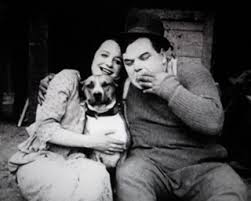
The greatest distinction of this film is not really its simple plot, but the fact that it is the earliest surviving appearance of Roscoe “Fatty” Arbuckle in films, back to 1913. He worked at Keystone up to 1917, and it did not take long until he was very popular among the audiences. During this time, his pairing with Mabel Normand was also very successful, which can put those actors among the pioneers of romantic comedies, a genre that would end up establishing itself in the next decade.

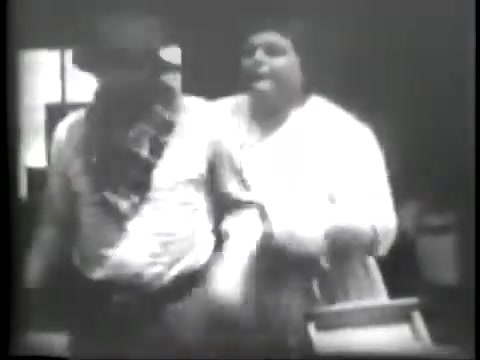
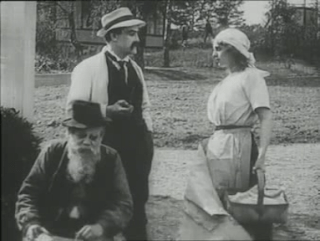
Pete (played by Mack Sennett, the head and founder of Keystone studios) spies on the wife of a neighbor through a hole on the fence. Her husband (Ford Sterling) finds it out and gets furious. 

Sterling had his typical acting of broad gestures, ridiculously fake mustaches and an almost surreal temper. However, Sterling is less over the top here than in other films because all the other actors are equally exaggerated. The wife is played by Fatty Arbuckle in drag, which gives an. extra funny effect to the film. The trend of appearing in drag on screen was with Arbuckle throughout his career and he performed quite well in this type of role. 

Sterling also had some quite funny scenes when he tried to take revenge of Sennett for spying his wife and carried a revolver (which shot lots of smoke) with him, causing a plenty of confusion and misunderstandings when he inadvertently intimidated and scared people away while he was trying to find Sennett.

We can also see Arbuckle falling and tripping often in this film. Do not be fooled by his overweight, as Fatty was a quite skilled physical comedian and dancer and he often displayed such skills on screen. Arbuckle also had a very pleasant voice and it is said he could sing very well. Were not for the scandal that virtually ended his career in 1921 and it seems he could have made a smooth transition to talkies, if only he had a chance of doing so. 

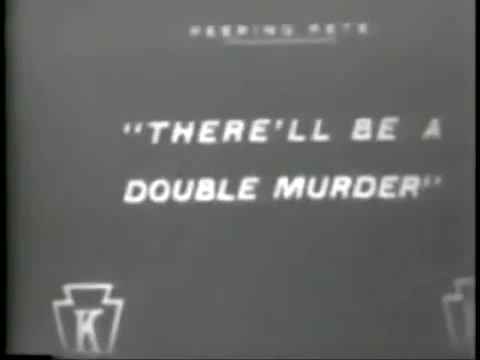
In the end, both husband and peeping Pete ended up forgetting their disagreements and became friends. Not before the wife and a plenty of other neighbors got desperate in fear that a double murder would happen (as one of intertitles of the film) said. 

Not really an easy film to be understood by modern-day audiences, as the film is very short and it’s logically not possible to develop the psychological profile of characters well. The plot is also not narrative, but revolves around a simple premise and random gags. Still, it’s interesting to see how Arbuckle was a good comedian from the start and how comedy shorts would develop more and more each year. On the following year. Keystone studios would hire Chaplin (who was also starting his career in films) and produce its first feature-length comedy with most of famous Keystone comedians + Marie Dressler (already a famous stage actress). But this is another story.

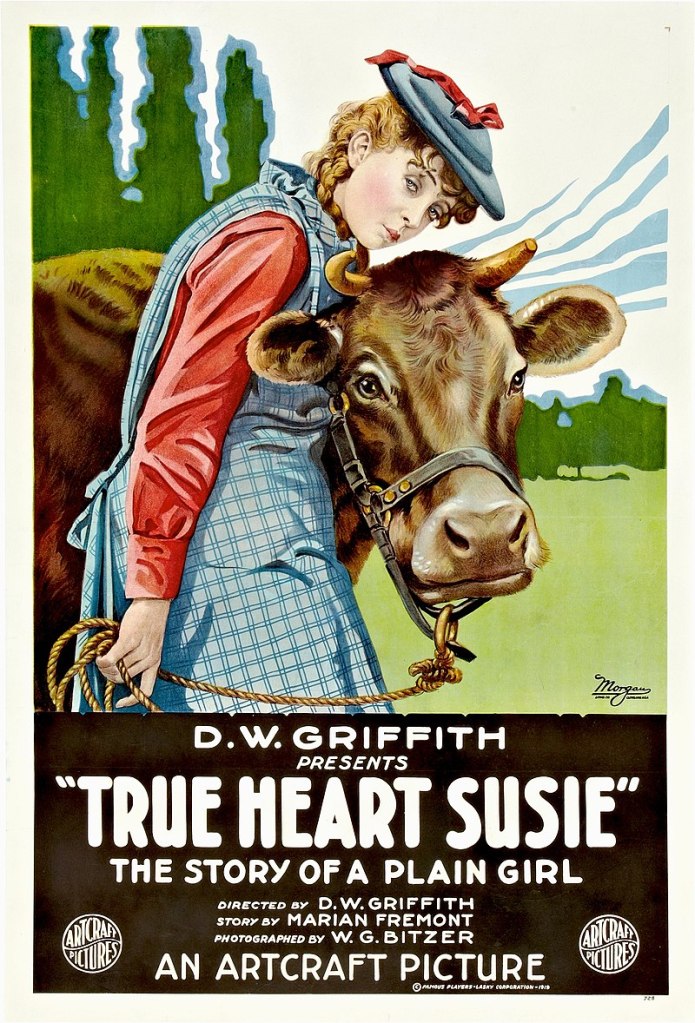
True Heart Susie (USA,1919)

With a plot that was already outdated to its own era, reflecting the recurrent theme of D.W. Griffith of portraying Victorian, virginal young heroines, this film gets to touch the audience and make them nostalgic about an era gone a long time ago. An era of good country people, a more peaceful interaction with nature, and without all worries that come with a more urban environment.


In addition to it, the fate of two actors who played important roles in this film proved to be dramatic, as both actors Robert Harron and Clarine Seymour died young, not too long after this film was launched.
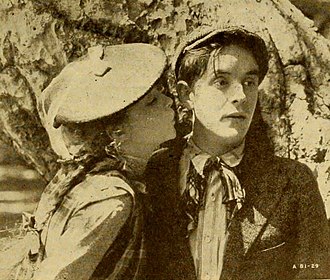
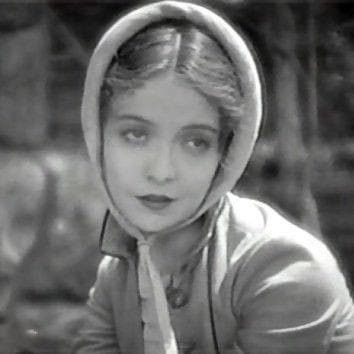
Actress Lillian Gish -in a surprisingly stiffy and exaggerated acting -is True Heart Susie, her love interest is her old childhood friend, William -played by her brother in law in real life – Robert Harron. Susie has always loved William since they both were very young, but William has never seen her in the same way. However, Susie was a completely innocent girl and kept her hopes high that someday William would correspond to her love. She lived with her elderly aunt, her mother having previously passed away and there was no mention to her father.


William has always dreamed about attending college, but his ambitions were not encouraged by his family, who thought he would do better if he focused on farming. His father even claimed: “A good farmer is better than a poor lawyer or preacher”, as it is written in one of intertitles.


Once, when both William and Susie made a trip to the village, it was evident how he enjoyed flirting with the more “modern”, “flirty”, “better-dressed”, “not too innocent” girls along the way. This fact per se must have alerted Susie that William was not really interested in her, but her love remained. Fortunately, Susie had a “sister” called Daisy who liked her much more. It was actually a cow she loved as her sister.


Touched with William’s dream to further his education and determined to help him, Susie decided to sell many of her belongings, including her beloved cow, to help sending William to the country college. Lillian got the money and made William believe that the money for his tuition plus a sum for extra expenses came from a philanthropist.


After a hard adaptation period at college, William graduated and returned home being a different man. This was inevitable, as time passed and he broadened his social and intellectual horizons. He eventually became the minister of the village and married Bettina, a gold digger and city girl. In addition to Bettina has never loved William she was too used with the bright lights of the big city and could never adapt to the life in a village. Their marriage, as expected, quickly deteriorated and both William and Bettina regretted their decision. Bettina felt trapped and bored and Willian did not have a domestic goddess at home, somebody who would take care of him as he liked.


Susie continued with her life and kept in touch with both William and Bettina, always being polite and self-contained, never disclosing her love to William to anyone although her sorrow hunted her mind all along.


After a while, Bettina could no longer avoid the parties she loved so much. One night, she told Willian she was indisposed and used it as an excuse to sleep in a spare room, but she actually left to go to a party with her friends behind William’s back. Bettina’s home key ended up being dropped at the party without her realizing it and after she left the party, she was caught in a rain storm. She only realized her key was gone after she was on her doorstep and she took shelter at Susie’s house. Susie took care of Bettina, but both the strain and the rain ended up making Bettina seriously sick.


Bettina had told William before dying that she had taken with a neighbor a reference book William needed and she had also seen Susie and they both got caught in the rain that night. Having believed that Bettina died while doing him a favor he vowed that no other love would ever come to his life. However, without knowing about it, Susie’s aunt inadvertently delivered to William the receipt of his college tuition, claiming Susie had sacrificed herself so much to get the money. William got very touched, but he still wanted to stick to his vow. However, things changed when one of Bettina’s friends visited William because she had a guilty conscience that Bettina had passed away because she had attended her little party and asked for William’s forgiveness. Thus, the truth was suddenly revealed to William.


Having realized he loved Susie all his life, William proposed to her and in the end the audience is led to believe that they both got to recover the bliss they both enjoyed back to the time when they were two country youths.


This film does not really solve the everlasting enigma if men marry plain, simple girls or those who put on paint and powder on their faces, but it definitely provides a beautiful witness of self-sacrifice and romantic love. Perhaps due to the fact we do not see such deep manifestations of love that often nowadays, it makes us miss that simple, past era, when material comfort was not abundant but it seems for some people it was easier to give themselves that much. It might be the biggest appeal of this film, even greater than the good production values.

The Close Call (USA, 1914)

Until Our Gang series of comedy short films started being made by Hal Roach studios, in the 1920s, it was not a commonplace in Hollywood children being portrayed simply playing and with their own universe being shown in films, where children played themselves in main roles, rather than being portrayed by adult actors, without plots being grounded on fantasy.

Without doubt, the most famous 1910s adult actress who played such fantasy roles was Mary Pickford. Pickford’s superstardom and the undeniable commercial success of her films, did trigger the appearance of other petit actresses playing children roles on screen, like Marguerite Clark, who would star Snow White (USA, 1916), among others. But, although those films did portray the children’s universe on screen, the actors were still adults and situations were not often real life ones.

In the 1910s, children did take part in films, more often in supporting roles when the plot was not really related to them. They could even be shown in films revolving around their matters, but studio moguls have not yet found out the potential of showing children’s actors in naturalistic acting, simply being themselves. But this situation would slowly change with time.

In this film we can see some cute children, boys and girls together, walking outdoors in a beautiful and tranquil nature landscape. A pair of children is younger than the other one. All of them are portrayed unaccompanied by adults and even mischievous. After a while, the youngest girl started walking all by herself and ended up falling down a cliff in a deserted place. 

The older children realized something wrong had happened and cried for help. Meanwhile, the young boy tried to save the younger girl. The mother of the little girl was located and she gathered more adults to help saving her daugther. 

While the adults tried so hard to save the little girl, she was actually being saved by the little boy, who got to find his sweetheart before anyone else. As time passed and the adults could not find the girl on the cliff they got very nervous, but after a while the girl was found safe and sound in the company of the boy. Everyone was very happy and after the girl had told what happened and how she was rescued, both children embrace.

Something that may have helped giving a naturalistic touch to this film is that some of those children were too young to read, which made them not adhere to a script and it consequently gave more freedom to improvisation. The landscape, not much altered by the human hand and without cars and big cities around also give a good atmosphere. We can also observe that first love was shown subtly and innocently, which was also something uncommon in children’s films of the era. At this time, the border between films to adults and children was not still very clear, so this film was surely watched by both adults and children cinema audience members alike. All those elements reinforce the innocence of the playing. 

The Broken Spring Rose (Sweden, 1912)

A fine melodrama, with good and subtle acting, good use of nature landscapes and a narrative, straight plot. That means the plot has a narrative style which would become the norm in cinema ever since, opposite to so-called “trick films” (like those made by French director Georges Méliès on early XX century). When it comes to acting, the plot developed without broad gestures or epic plot twists, differently from some other melodramas of the 1910s.

Although the plot may seem manicheist and outdated, it is not very different from what many other directors produced at the same era, such as D.W. Griffith in the United States, Urban Gad in Denmark, Yevgeni Bauer in Russia, among many others.

The film starts in a rather idyllic way, with good country people enjoying their lives in total connection with nature. The landscape helps to settle the atmosphere of tranquility to the audiences and gives an extra nostalgic touch to the film of an era that was already fading due to early XX century urbanization. Unfortunately, this tranquility is suddenly shattered due to an unsolved love story. 

The engagement between a wealthy boy and a girl who worked to his family was suddenly broken up by his father, which caused a big heartache on the couple. To make things worse, the boy’s father suddenly took an interest to the girl, until the point he started chasing her and raped her, which truly disgraced her life and made her fall into prostitution. The theme of the innocent girl who has a tragic fate due to circumstances had already been common both at the stage and cinema.

This film is also considered the first to ever be censored in Sweden. Although there were not any actual rape scenes and the event was mostly suggested rather than shown, this per se was enough to shock the censors. It was also considered a lost film for many decades until it was found in 1980 and it seems some scenes were removed from this printing compared with the original full film. 

The director Victor Sjöström, after already been successful in his native Sweden, became known worldwide in the 1920s due to his work in Hollywood, where he directed high-budget films and worked with the stars of his day. When the talkie era took over, he returned to Sweden and barely directed again, devoting himself solely to acting. This film shows that Swedish silents have already been quite well developed in the previous decade to such 1920s golden era and that professionals who went to Hollywood were already active and producing films at the same level of best silent films from Europe and the United States.

The Perils of Pauline (USA, 1914)

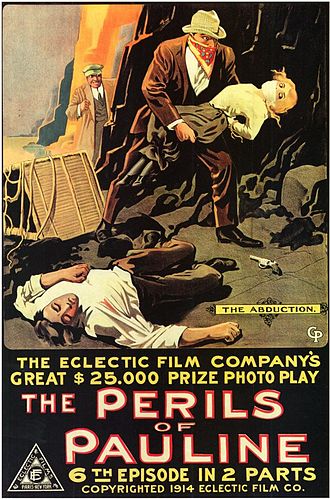
It was one of the first female series in Hollywood, although it was not the very first one. It is often mistaken as the very first serial because it was the first one to have had a huge popularity among audiences. Pauline was a rich heiress, who is pushed to marriage, but prefers to wait a little more and live more adventures in life, while she gets ready to become an author. Her refusal is understandable, as having a husband would make her leading a life totally focused on family affairs rather than exploring the outside world.


Furthermore, Pauline`s guardian wants to make sure that she will end up dying before getting married, so he can keep the money to himself. He interferes with Pauline`s adventures so that they are more dangerous than they were supposed to be.


Although the psychological profile of characters is somehow shallow, including in some rather simple matters like, for instance, who were Pauline`s parents? Which was her past? Was she a romantic lady or more modern-oriented? And so on. We can compare her with other 1910s characters, such as those made by Lillian Gish in Biograph studios and we can see how independent and less Victorian Pauline was compared with her contemporaries. This approaches Pauline to characters played by actress Mabel Normand in Keystone studios, all of them independent, bold, fierce, untamable women, ready for an adventure and strong in their own right.


Broad gestures and exaggerated facial expressions are still noticeable in acting by different actors and it is understandable, as the transition to a more natural acting style was still ongoing in American films in middle 1910s. However, a more natural style was starting to take root and it would not take a long time until the theater-based gestures and mannerisms was overcame.  For example, films by D.W. Griffith and Mary Pickford were already popular when this serial was launched and the subtle acting portrayed in them would soon become the norm in Hollywood.


Although associated with the stereotype of “damsel in distress” Pauline was less helpless than typical women of her era and despite all problems, she did get to have adventure moments. The plot has a plenty of adventure and exoticism, both of which were into fashion back to the 1910s. In this first chapter we can even see Pauline in a balloon. In an era when travelling was difficult and time-consuming, audiences could experience different things, even though those things were often portrayed in a stereotyped way.


It was originally filmed 20 chapters, but the only surviving version is from a French print edited into nine chapters, released in 1916. We can also observe that the villain had a German name (Koerner) due to animosity against Germany during World War I. There were also problems with the re-translation into English of intertitles which were previously translated into French in this nine-chapter version which gives modern audiences the impression of involuntary humor due to typos and weird structure of sentences.
Actress Pearl White made most of stunts of this serial and while filming it she suffered a spine injury which would bother her for the rest of her days. White was athletic in real life and her physical skills matched her role completely.


As it was previously said, many chapters were cut off this re-release, but the remaining ones give a good overall idea of how this serial was like. In an era when cartoons were not popular yet, it was real-life actors who had to make the dangerous stunts, so audiences would get their own thrill. Years later, it would become hard for actors to keep up with cartoon characters and the nearly infinite possibilities of what they could do to endanger their lives and remain alive anyway, but it was not yet a reality back to the 1910s. It must also be added that this series does not use the cliffhanger, but the episodes are self-contained instead. It was a popular hit and made Pearl White become a star. She remained in high demand in serials until the end of the decade and after this time she worked in Europe until her retirement some years later. 

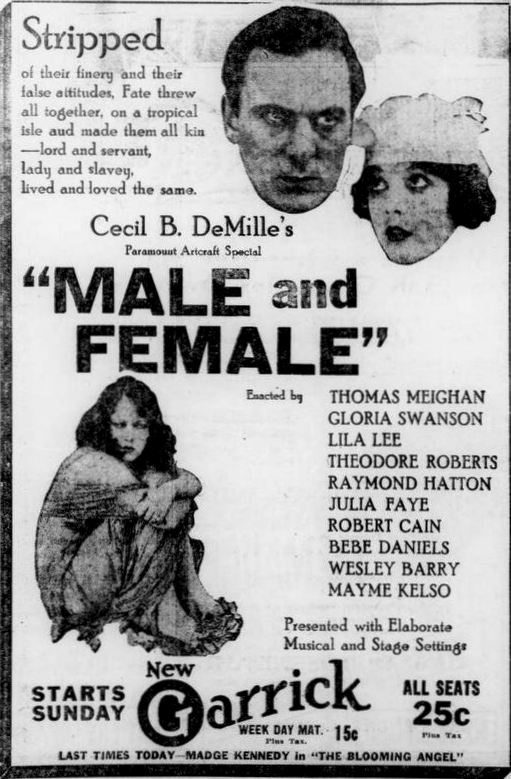
Male and Female (USA, 1919)

Cecil B. de Mille being himself in a film that turns extravagant –and also with sceneries of great proportions at some moments – and a young Gloria Swanson. Although unknown for many people, Swanson started her career very young being an actress in slapstick comedies (she even worked for Keystone studios, which produced some of the most frantic comedies of silent era), but she had dramatic ambitions all along and by the time this film was made she started pursuing them.

An adaptation of the play “The Admirable Crichton” by J.M. Barrie, the film approaches differences of classes with subtle humor and sometimes audiences do not even feel time pass because the film has a very relaxed vibe. How a British aristocrat (Gloria Swanson) connected with her butler gives room to some original gags, especially after they both get involved in a shipwreck. Needless to say that none of those rich aristocrats have the required skills to survive in a stranded land, but it turned out that the butler could handle the situation. It also comes from this film the famous scene where Swanson is lying down with a real lion around her. 

In the beginning of the film lives of rich people are depicted as opulent and empty. The scenes are funny with the futility of people`s requests towards the servants and we can also see Gloria Swanson in beautiful clothes. The servants are shown as slightly more grounded people, as their lives are closer to realism. A maid is in love with the butler, who is in love with Swanson. On the other hand, Swanson has a friend who married her chauffeur and had to face lots of social difficulties because of that. Needless to say that Swanson disapproved the marriage, which made her butler heartbroken.

The scenes of those people mingling together while stranded in the islands are entertaining, even though they are far from realistic. Clothes were always in good conservation state, they never faced real famine and could even have access to some comforts, such as books. This gives a touch of involuntary humor to the film, which makes it even more enjoyable to modern audiences.  Although the plot is sometimes exaggerated, the acting of main actors remain relatively self-controlled and subtle and it reinforces the good portrait of lives of educated and refined characters.

There is also the interesting approach of not sugar coating the difference of classes and that love does not always overcome it. No, the plot is not about the so-called battle of the sexes. Intertitles can be witty but they are also sometimes a bit too long, even tiresome. If they were kept simpler, it would be perhaps easier for audiences to understand the subtle humor and it is also a factor that makes the film seem outdated nowadays.

The Babylonian sequence may be a feast for the eyes, but it is not really necessary to the development of the plot. By the way, a Babylonian king having a Christian slave? Perhaps it is a little historically inaccurate? We can see here the famous sequence of Swanson with a real lion (who was presumably dangerous) and legend has it that she insisted on doing that scene herself. This might be true, because if we analyze the comedy films Gloria Swanson made earlier in her career we can observe that she have already done a plenty of relatively dangerous stunts already in her teens. 

What Happened to Rosa (USA,1920)

Mabel Normand made a name for herself for her slapstick comedies for Keystone studios in the 1910s, even though she had worked for other studios both before and after that.  And even had her own modelling career before becoming an actress. Normand was a real pioneer of early cinema because she was brave, did her own stunts with competence and got a really spontaneous and relaxed screen persona back to an era when the helpless damsels in distress were so popular. Furthermore, she also directed her own films already at the time when she worked at Keystone (consequently, before this film was shot).


At the time this film was made, Normand was inclined to make more situational-oriented romantic comedies, without the frantic rhythm, broad gestures and physical gags of slapstick comedies, similar to those by her real-life friend Mary Pickford. This shift in her career could show the audiences that Normand was also a very good, natural actress, who could be funny and emotional in all kinds of films.
Produced by Goldwyn studios, this film is not usually considered one of her best, it is entertaining and in touch with cinematic trends of its era, including those of exotic environments being portrayed in the most stereotypical way possible.


A hard-working saleswoman in a department store with a boring life, looking forward to some excitement, once met a clairvoyant woman while working. Although it was clear that the clairvoyant was a charlatan, Mabel ended up scheduling an appointment and ended up being told she was a Spanish dancer in a previous life. Mabel got carried away with this story and started acting like a Spanish dancer, which made those around her think she was losing her mind.


The appointment`s scenes are among the funniest of the film. The clairvoyant`s house was full of exotic objects from Egypt and at the same time that Mabel was scared, she was also fascinated for being there. The more exaggerated acting of the clairvoyant is also a good contrast to the more self-contained acting by Mabel, which highlights the awkwardness of the entire situation.


Although Normand`s acting is not as groundbreaking as it was back to 1910s, her talent was still there and she got to be entertaining and the audiences can even see pathos in the poor working girl who was stuck in a life of hard work and boredom and only wanted some excitement and distraction from routine. Things would be even more complicated to Normand after she fell in love, especially because she was often more awkward than seductive towards her love interest.


It is sad to think that Normand would pass away circa 10 years later, but her versatility could be seen in her 1920s output in films that could be modern fairy tales of the ordinary next-door girl with a heart of gold who only wanted to find some happiness in life. It is impossible not to see similarities with the role played by Clara Bow in It (USA, 1927), starting with the similar occupations of characters of both films. The difference was that Bow had a touch of innocent seduction in her character, was Normand was a romantic, optimistic girl.


It is also noteworthy that actor Adolphe Menjou can be spotted in some scenes. His career would still continue throughout the talkie era. 

The Love Expert (USA,1920)

This romantic comedy has an innocent plot about a wealthy young student (Babs) who was more interested in understanding love than in physical or intellectual activities, like most of girls of her age. As she was not properly focused on her lessons, she ended up being sent back home by the boarding school.

As a punishment, her father sent Babs to her aunt`s house in Boston. Upon her arrival, Babs realized her aunt had been engaged for six years with a guy called James Winthrop who worked as a manager of Bab`s father`s branch office in Boston, but there was no wedding in sight anyway. Even more, Babs observed that they were not really in love with each other and it was a relief to the girl because she had fallen in love with her aunt`s fiancé. Fortunately her aunt soon found out she was in love with another man, which prevented a family feud from taking place. 

However, there were other problems, as James Winthrop could only get married after his sisters and elderly aunt married too, as he had to take care of the three of them while they were still single. Babs made her best to assure that the three of them would get married with proper suitors, so she could also marry her sweetheart. Babs` innocent determination may seem outdated for modern audiences, but her pure heart and optimism remain captivating, as she never gave up to fight for her own happiness.

After having read that tropical climate could make people more “susceptible to the influence of love” (Yes, that was an extremely biased and stereotypical statement), Babs decided to take them all to Palm Beach. Therefore, she faked a telegram of her father, calling Mr. Winthrop to go there and bring Babs and his own family with him and many funny situations happen, including the expected happy end.

This movie is remembered because in real life Constance Talmadge was the sister of famous silent actress Norma Talmadge and Nathalie Talmadge, who became best-known as the first wife of comedian Buster Keaton. Although it was not apparently easy being a member of such prominent family in show business, Constance had a talent of her own, being a natural and convincing actress, with good comedic timing. Prior to his film, she had been part of famous film Intolerance (USA, 1916) by the equally famous director D.W. Griffith. It was her first major role in cinema.

The Primitive Lover (USA,1922)

Phyllis Tomley faces a dilemma between a marriage without excitement and attraction for another man. She often reads novels and considers her own life boring in comparison with thrills that the characters of those books live. She ended up having unrealistic expectations about her husband (Hector Tomley) and considered him careless and self-centered because her own romantic fantasies were not being fulfilled. The plot of this film is interesting because it takes into account the wishes and life goals of a woman are something important and worth pursuing. 

However, her former fiancé, a novelist who was presumed dead (Donald Wales), reappeared out of the blue claiming his death was merely a publicity stunt. Phyllis wanted to divorce Hector and Hector`s prompt agreement angers her. Things would not become any easier when Hector tried to prove to Phyllis that her love interest was not as good as she thought and it becomes clear to the audience that Hector actually still loved Phyllis and would fight for her.

Then, Phyllis realized that Hector was not as bad as she thought while Donald Wales was more awkward in the wilderness than Phyllis expected. Hector seemed to act more like a “primitive lover” than Donald, as Hector had the assistance of a local indian to handle life in a wild environment. Donald`s dullness deeply disappoints Phyllis because she expected a life of excitement and thrills with him.

The actors do have some funny overacting (especially in the beginning of the film, in a raft), which was no longer very common in Hollywood in the 1920s. The audiences are soon introduced to the dichotomy refined domestic tranquility X exciting rough instincts, which has been portrayed in novels and films of all eras. Not really an innovative plot (although it does not mean the film is bad, just that it is not extremely different from films of its own era) and Constance Talmadge is not in her best comedic shape here. The characterization of natives often look slightly fake, but it is a light-hearted, naïve film that still entertains the audiences.

Actor Joe Roberts is part of the cast. He made a name for himself due to his films with Buster Keaton, usually as a heavy or authority figure and it was a really fruitful partnership, which would surely last for many years were not for the death of Roberts in 1923. Actor Harrison Ford (no connection with his later namesake) was a high-profile name in Hollywood during the silent era, but unfortunately he was one of those artists who did not get to transition into talkies. He played the role of Hector Tomley. 

Mabel’s Blunder (USA,1914)

Actress Mabel Normand not only starred this film, but she also wrote and directed it. The contributions of Mabel to the history if cinema are known, but her work behind the camera is not always properly mentioned. And she was in her early 20s and in cinema business for less than one decade when this film was made.

A typical slapstick comedy with frantic pacing and again a misunderstanding plays a role in a silent comedy. Mabel is an office worker (which provides to modern audiences a valuable opportunity to observe how an office looked like back to the 1910s) and secretly engaged to Harry, the boss` son. But, according to one of intertitles “Harry`s father likes her too”, which made Mabel uncomfortable. 

Another woman showed up at the office and Mabel caught Harry embracing her and she obviously felt heartbroken. While spying on them through the peephole, Mabel observed Harry talking happily with that woman. At this moment, Mabel`s brother (who worked as a driver) also arrived at the office to pick up both Harry and the woman and take them to a party. Mabel decided to exchange clothes with her brother, so she could further investigate the connection between her fiancé and that unknown woman. 

Mabel`s brother remained at the office wearing her clothes and then the boss returns. Mabel`s brother decided to cover his face with a veil. The boss started to flirt, thinking it was Mabel behind the veil and both of them went out by car and the boss tried to make advances over Mabel`s brother, who repelled him. Meanwhile, Mabel took both Harry and the woman to the party and she observed how warmly that woman was received by the other guests. Needless to say that it made Mabel extremely jealous. 

The boss and Mabel`s brother ended up at that same party with the boss still flirting endlessly. Meanwhile, Mabel tried to comfort another woman who was crying at the party, but the woman`s partner arrived and thought Mabel was flirting with her. We must bear in mind that Mabel was dressed as a man, after all.  

A fighting started when that guy tried to beat Mabel, which called the attention of the other guests. Then, the guy found out that he was actually trying to beat a woman and Mabel run away in fear. Chaos happened and it is also found out it was a man behind the veil, not Mabel. Mabel finally confronted Harry, who told her that the unknown woman was actually his sister. 

In this apparently simple film, Mabel shines at the height of her youth and vigor, being both funny, skilled in her stunts and extremely convincing, she makes people laugh and feel sympathetic for her without any effort. Her type of humor is easy to understand, regardless of culture and era, which makes her films being properly appreciated by modern audiences.  Unfortunately she died young, still in her 30s, and did not even have time to transition to talkies. Mabel`s brother is played by actor Al St. John, who was the nephew of Roscoe Fatty Arbuckle in real life and, opposite to the sad fate of Arbuckle, he managed to have a career that continued through talkie era, especially in western films, where he could show off his physical and acting skills. 

He Did and He Didn’t (USA,1916)

Roscoe Arbuckle started making films for Keystone studios in 1913, and it did not take long for him to become very popular. This film was made only three years after he started working at Keystone and, by this time, Arbuckle already directed a plenty of his films (like this one) and had considerable artistic freedom. And it`s interesting to see how much his humor evolved during this time.


Much more sinister than in previous films Arbuckle (still with occasional mannerisms and facial expressions of his usual slapstick films) plays the role of a wealthy doctor married to Mabel Normand who suspected his wife was cheating on him with her old school mate called Jack. Jealousy had already been quite commonly approached in films back to the 1910s. Another interesting shift was the portrait of life of wealthier people, considering Keystone slapstick comedies usually focused on lives of working-class citizens.


As soon as Jack arrived at his house, Arbuckle could see that both Jack and Mabel had been quite close when they were younger and such fact made Arbuckle instantly jealous. Mabel`s friend has been an overnight guest at home and Arbuckle received a suspicious phone call asking him to leave home. The call was actually made by some burglars who wanted to rob him, but Arbuckle thought it was Mabel who did it only for her to be alone at home with Jack.


To make things worse, the audience thinks that Mabel was actually having an affair with Jack, which was later shown as something that did not actually happen. Actually, Jack did not have any interest to be Mabel`s lover, but a series of unfortunate coincidences have only made Arbuckle more distrustful.


Something noteworthy is that one of burglars (a “bounding burglar”, according to one of intertitles) was played by actor Al St. John, who was Arbuckle`s nephew in real life and also worked for Keystone studios for some years, often as part of Arbuckle`s usual troupe of actors. Al St. John was also famous for his good physical skills, which he often employed in his films.

Finally, it was all just a bad dream due to the lobster they had eaten at dinner time and while both guys were almost getting mad out of fear, Mabel slept peacefully and it became clear that she had never been unfaithful to her husband.


This film, in having shown Arbuckle playing a more shady character on screen, became ironic considering that Arbuckle was accused five years later, at the height of his career, of having murdered an aspiring actress called Virginia Rappe. The resulting scandal caused much pain to Arbuckle, destroyed his career and popularity.  Mabel Normand kept the same high level of performance and spontaneity of her slapstick films and she would competently make good romantic comedies and dramas some years later. Her career would also have problems due to bad publicity and poor health and she did not get to make the transition to talkies. Arbuckle, despite having been blacklisted due to the aforementioned scandal, made a brief comeback at early talkie era, but he unfortunately passed away right afterwards before his career could take off again. 

Young Romance (USA,1915)

Two youths (Tom Clancy and Nellie Nolan) worked in different sections of the same department store without knowing each other and longed for both romance and adventure. Therefore, they decided on their own to pretend for one week that they were upper class members and ended up travelling to Hotel Imperia and Belleview Mansion, places attended by such wealthy people. During this time they met and fell in love with each other.

During her trip, Nellie took the identity of a wealthy client of the store, but while she was travelling she was notified that the person she was impersonating had inherited a fortune due to recent death of an uncle who lived abroad. And some people thought Nellie was the actual heir. Another funny scene is when the couple go to a fancy restaurant not too long after they met and Tom was very nervous about how he would pay for such expensive dinner. 

Unfortunately, the publicity around the inheritance of Nellie made her being the target of unscrupulous people who wanted to steal her money and another guy started romancing Nellie, who unfortunately fell for him.  Nellie was invited for a ride in his motor boat and she accepted it. However, Nellie was left in an abandoned island and forced to give part of the money to the guy who was romancing her, but ended up being a scoundrel.  Even after she agreed to give 10 thousand dollars to the guy, he still kept her in that island until the money was cashed.

Nellie`s ordeal is over when Tom overheard a conversation about the scheme to rob Nellie and went to the island to save her. Love was still there and flourished smoothly.

After one week passed, they both returned home, without having the courage to tell to each other that they were actually poor and their love story was over, although the heartache remained. Tom ended up being promoted to the same section where Nellie worked and they immediately bumped into each other. Rather than questioning each other about why they lied that they were rich, they got so happy to be reunited that they fell into each other`s arms and there was the expected happy end. 

A film worth seeing also for its romantic, nostalgic touch of an era when love was far more innocent and life was simpler. This has an undeniable appeal with modern audiences. The storytelling is also easy to follow and beautiful sea landscapes are also pleasant to the eyes. Subtle, light acting with the bonus of beautiful clothing and furniture. The female protagonist is played by actress Edith Taliaferro, who made a name for herself at the stage, but made only three silent films in the 1910s.  This film is also noteworthy for having been written by William C. de Mille, brother of famous director Cecil B. DeMille. Actor Tom Forman, who played the role of Tom Clancy, despite having been a popular actor, started having career problems already in the silent era and unfortunately committed suicide in 1926. 

Create a website or blog at WordPress.com

Up ↑