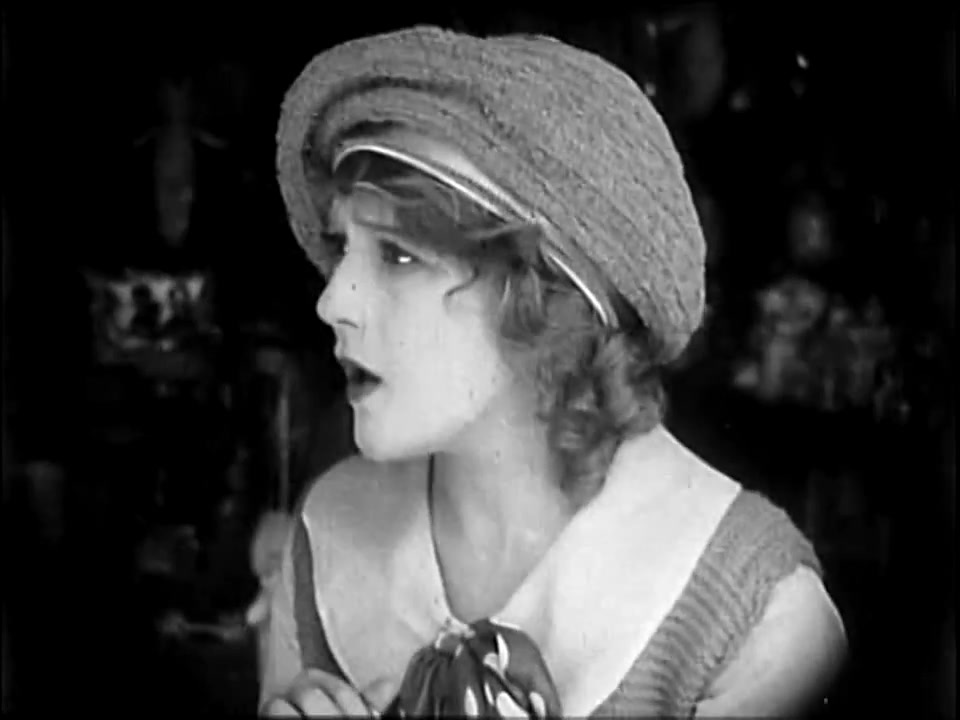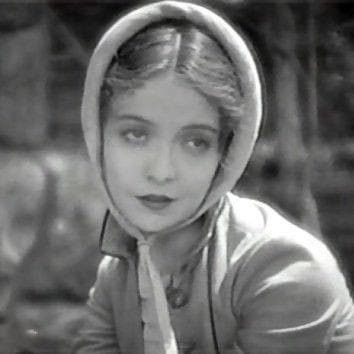
Dog Shy (USA,1926)

Charley Chase was a talented American comedian, who started his career in films in the 1910s and had his heyday in situational comedies of Hal Roach studios in 1920s, both as a actor and director, where he worked in many successful films. During his association with Hal Roach studios he kept the screen persona of a guy with realistic appearance and body language in detriment of knockabout slapstick. 

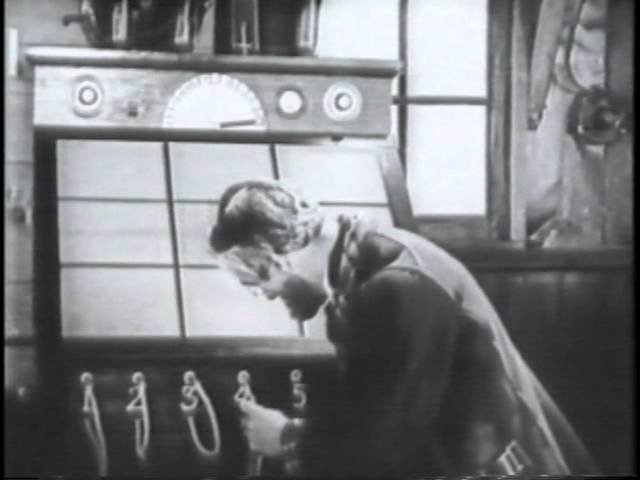
This film has a relatively straightforward plot for a situational comedy. Chase plays the role of a man who has been afraid of dogs since early childhood and while running away from a dog on the street he ended up entering a telephone booth. Right before he entered there was another man in the booth, who left in order to get another nickel to drop in and continue to talk to a girl. Chase picked up the phone and talked to the girl on the other side of line and found out she was being forced by her parents to marry a nobleman. The nobleman was that guy inside the booth before Chase arrived. 
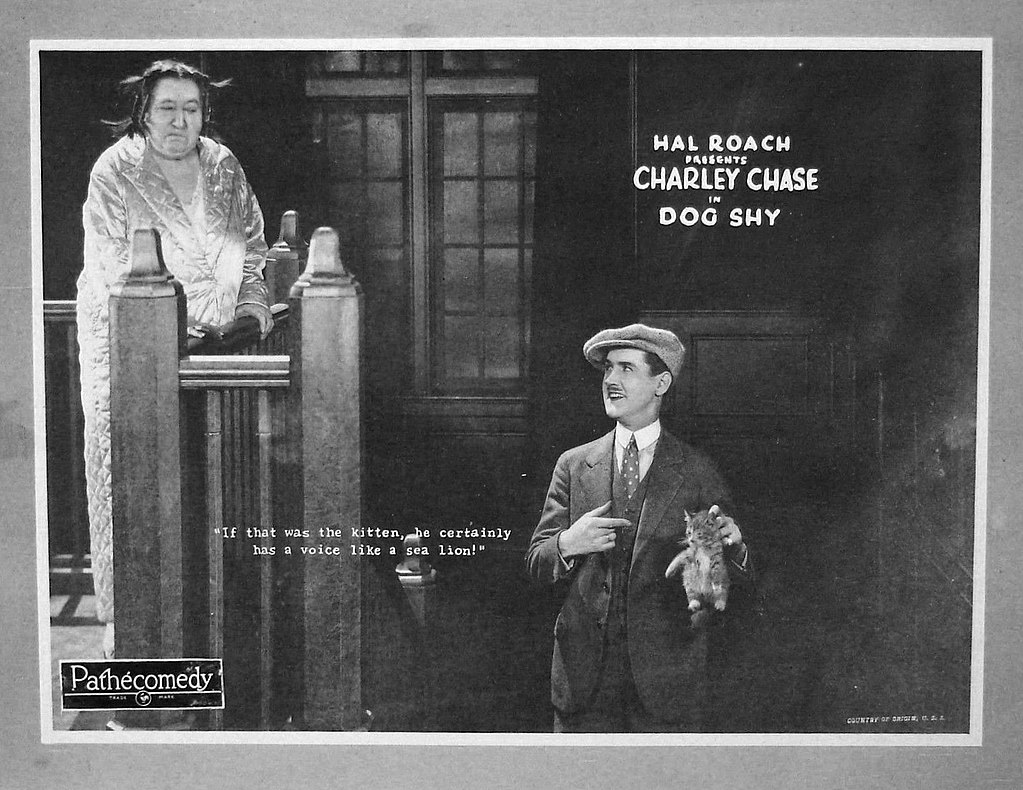
Chase wanted to help the girl to avoid the arranged marriage, but he did not have time to find out more about her, like her address, etc. because the call was interrupted by her mother.

Then, Chase is chased by a dog again and by complete chance he ended up at the girl’s house. Due to a misunderstanding, he also found himself with a recommendation letter to apply for a job in that house as a butler. At first, Chase is not interested in the job, but when he saw the guy from the telephone booth entering the house he connected the dots. He recognized the guy as being the nobleman, realized he was at the girl’s house and accepted to be the butler of her family. 

The nobleman proved to be very popular among all girls in a social gathering at the house. After some problems to find his girl among all other girls, Chase started doing his tasks as a butler. His first duty was to give The Duke a bath. Duke was the dog of the house, but he thought he was supposed to bath the nobleman instead. This misunderstanding created some of funniest scenes of the film, specially because the girl’s mother told the butler that if Duke was hard to handle, he could use force with him, if necessary. 

So, the nobleman was almost forced to take a bath, but Chase eventually found the right Duke and he had to bath the dog despite his fear of dogs. But it would not be the end of the problems.

The nobleman was actually a crook, who wanted to steal the house’s safe, the girl’s father wanted to get rid of the dog and Chase and the girl wanted to elope. So, all of them would do those things at midnight and they would howl like a dog as a signal and their respective accomplices would howl back. 

Of course that all those people howling at the same time and all those overlapped facts caused a major chaos, but it was all for the best. The crook ended up being caught, nothing was stolen and Chase was considered a hero by the girl’s family, which made things quite easy for them to marry. Eloping was no longer necessary.

Although this film is not particularly funny (except, perhaps, for the bathing scenes), it is still entertaining enough, with a realistic pacing and gentle humor. Sometimes Charley Chase gesticulates a little too much, but it was nothing in comparison with the broad, exaggerated gestures of actors of slapstick comedies. It is also interesting to see that Chase did speak most of the time during the film and it is even possible the audience do a plenty of lip reading. 

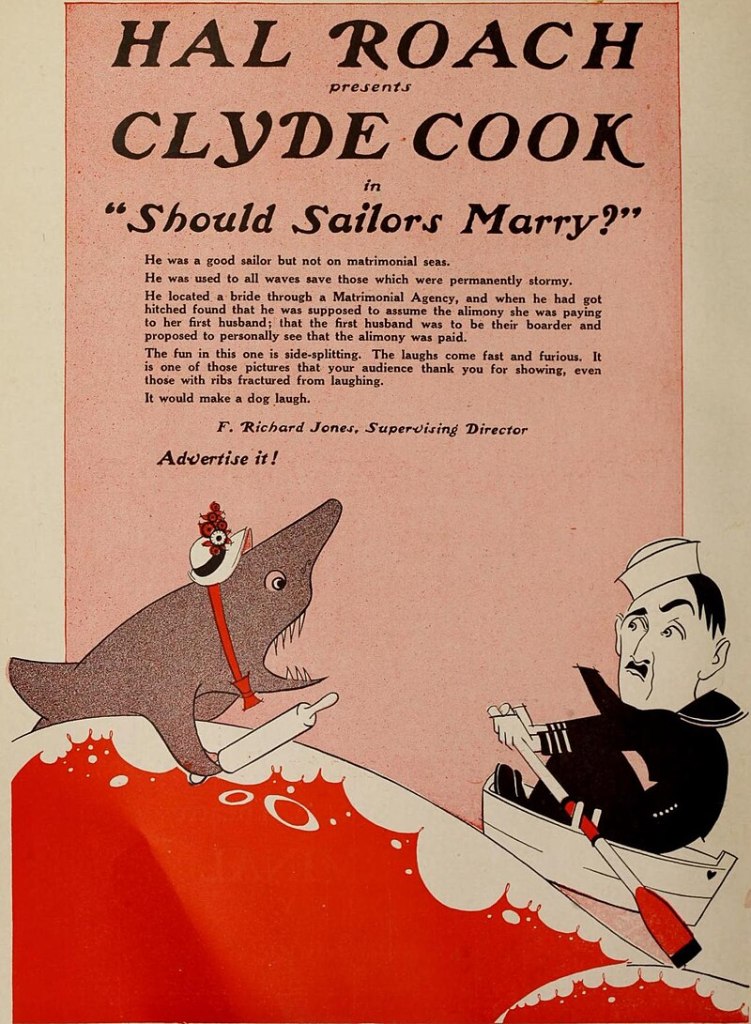
Should Sailors Marry? (USA,1925)

The diminutive Australian-born comedian Clyde Cook was one of many comedians who ended up being forgotten as time passed, although he was quite popular in his era and had a long career that spanned even to talkies. His heyday was on Hal Roach studios in the 1920s. He was known by his acrobatic skills, which unfortunately were not always portrayed in his films. His films were not quit original or funny and were often a bit below average, specially in comparison with the work of more famous comedians like Chaplin, Keaton, Lloyd, Langdon, etc., which can partially explain why Clyde Cook’s popularity did not endure for too long. 

In this film, Cook portrays a physically fragile sailor, who had some savings and corresponded with a woman who he was about to meet with the intention to marry her.

What the sailor did not know is that this woman paid alimony to her first husband and intended to remarry in an attempt to take money from him, so she could still pay the alimony to her ex. So, she had a plan with her ex husband to make the sailor remain married to her for as long as possible, so her ex would have a guaranteed source of income. The help of her ex husband would prove valuable because, after all, he could use his physical skills as a wrestler to physically threaten the sailor. 

When both the woman and the sailor met, things turned out to be a nightmare to the latter. The woman was not as beautiful as she claimed she was and was rather tough. To make things worse, he moved to her house and was introduced to her two children, who were quite misbehaved and, to add insult to injury, her first husband still lived at home. 

After a while, the woman found out that her new husband (the sailor) had lost all his savings and she decided to make him work in a hazardous job. To make the most of his labor, she purchased a insurance policy, which would pay her in case an accident happened to her husband. So, both the woman and her ex wrestling husband make up a plan to kill the sailor at work. But the plan backfired and he escaped both the marriage and the accident with his life.

This film is interesting due to a participation of Oliver Hardy as a doctor who was examining the sailor, prior to his pairing with Oliver Hardy. Hardy’s scene was among the funniest of the film. Although the gags were not very funny, the final gags outdoors, when the sailor was fighting for his life were pretty ingenious for both camera use and special effects. 

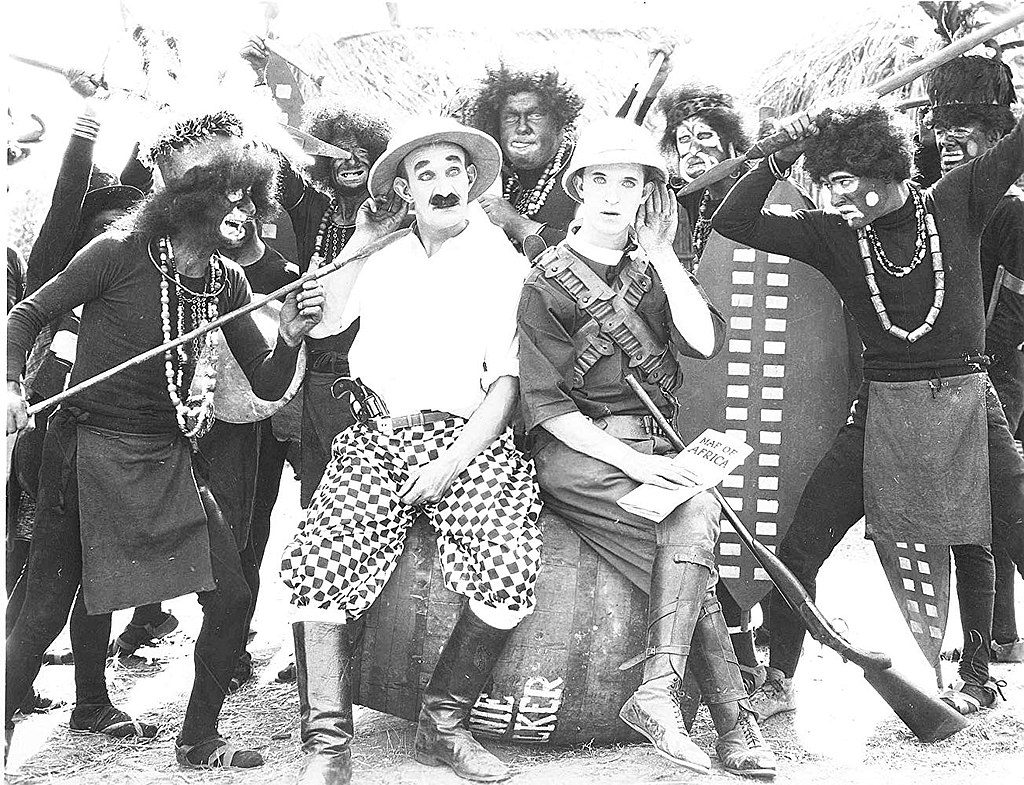
Roughest Africa (USA, 1923)

Another film by English actor Stan Laurel before his successful regular pairing with Oliver Hardy. Laurel had been in films for around 10 years before he started working with Hardy, mostly in films that did not stand out both in quality or humor. Perhaps, were not for the Laurel & Hardy duo, if those comedians kept on working on their own, they could ran the risk of not having their proper place in the history of cinema.

Despite having a kinda original plot for a situational comedy, the material of this film has average quality and does not provide much laughter. It is a politically incorrect film for nowadays’ standards because the characters are supposed to hunt animals, including a scene where Laurel tries to shoot a elephant. Although the animal was not hurt, such scene would be of bad taste for current standards. The scene where the elephant swallows a gun is also far from pleasant.

The film remains interesting, as it spoofs  travelogues that showed “exotic” parts of the world, their native populations, wildlife, landscapes, etc, often with a imperialist tone. Such documentaries were into fashion in the first decades of XX century.

Some pioneers are in Africa, although they really lack the bravery they were supposed to have. The scenery and natives look terribly fake already on first sight. The natives, for instance, were white acctors in black face, with make up that was far from sophisticated even to its own era. 

The pioneers face unfriendly natives and wild animals. Not surprisingly, they really lack any hunting skill whatsoever and it is apparently easier to them to shoot each other than to shoot a animal. 

Still talking about animals, it is not hard for nowadays’ audiences realize that neither bears nor Asian elephants are native species of Africa and even the fauna around the actors sometimes look really like the fauna of Northern America. A mistake that would not really go unnoticed in a current film. 

The interaction between people and animals in the jungle and the attempt of pioneers to film the animals provide the input to the gags of this film. The plot became old with time, but this film retains some historical value of an era when hunting animals to death was considered an accomplishment and socially acceptable.

Super-Hooper-Dyne Lizzies (USA,1925)

Although many people associate Mack Sennett with 1910s slapstick comedies with frantic pace, damsels in distress, awkward cops, custard pies, villains with bizarre fake mustaches, etc. his studio always managed to adjust well to changing tastes of audiences, different comedic styles and even new technologies. 

In the 1920s, Mack Sennett studios (which was also known as Keystone studios in the first years of its foundation back to the previous decade) made situational comedies (with slower pace, less focus on physical gags and more realistic situations than the so-called slapstick comedies). 

Sennett also made very original comedies back to 1920s, specially with actors like Ben Turpin, Billy Bevan, Andy Clyde, etc. with a mix of slow and fast paces, witty intertitles, frequent explosions, cartoon-like special effects, objects that sometimes seemed to have a life of their own and nearly bizarre subject matters. A plenty of those films were directed by del Lord, who would later become known for his work with The Three Stooges. This film has all aforementioned characteristics. 

Burbank Watts is a inventor who tried “to get power for autos from the hot air wasted on radio speeches”. Do not worry if it does not make sense to you. This statement is not supposed to make much sense anyway. Just keep in mind that this new technology meant that cars would work without gasoline. Actually, the technology worked a bit too well, as cars started to move all by themselves, sometimes even without drivers in. 

Other characters of the film, among others, are Hiram Case, who was his helper, and did not seem to be very skilled. Winnie Watts was the inventor’s daughter.

It is also noteworthy that this new technology upset the oil merchant of the town and, to make things worse, he was also interested in the inventor’s daughter. The oil merchant tried to prevent this new technology from taking off, but the inventor’s assistant did not allow any sabotage to occur. As a bonus, the love of the inventor’s daughter went to his assistant and the oil merchant ended up being arrested.

A particularly funny gag in this film with a car out of gas really reminded of ones made by Hal Roach studios to films of Snub Pollard (It’s a Gift, USA/1923) and Laurel & Hardy (Two Tars, USA/1928). This cute, weird comedy has its moments of fun, lots of creativity and it is still funny and amusing, even to nowadays’ audiences.

Afgrunden (AKA: The Abyss or The Woman Always Pays) (Denmark, 1910)

The plot might seem moralist for modern-day audiences at first, but if we consider that, for instance, on the other wise of the world the famous American filmmaker D.W. Griffith was making movies with similar content in Biograph studios at that same time we realize that the plot fit into the morals of the era, irrespective of the country.

This film is infamously known for its “gaucho dance”, which was highly controversial at its time. Take a look at pictures below and try to imagine the effect of this choreography on audiences in 1910.

Asta Nielsen


afgrunden, 1910(2)


afgrunden, 1910(3)

But there is much more in this film than that. With a beautiful photography, this film is surely part of the so-called Golden Age of Silent Danish Films. Asta Nielsen acts beautifully, as usual. It portrays the story of a respectable music teacher who becomes fallen after a circus comes to her town and she run off with one of circus’ artists. Unfortunately she is not happy with him afterwards. She was dominated by her passions and now has to deal with social and moral consequences of it. This film is rather tame for nowadays’ standards, but it was risqué back then for having shown how a woman of good family and morals became an outcast.

Some stuff worth being observed: We can see many landscapes of Denmark of that time as well as means of transportation, which can offers us some glimpses of their urbanization. Furthermore, there were many outdoor scenes in sunny places. Perhaps to make as much use of sunlight as possible while filming?

Barney Oldfield’s Race for A Life (USA, 1913)

A damsel in distress? Definitely not Mabel Normand.

Barney Oldfield’s Race for A Life(6)
Barney Oldfield’s Race for A Life(1)

This film portrays some stereotypical items of silent films, such as a villain with a fake moustache, a damsel tied to railroad tracks and a hero to save the girl, usually in the last minute.

Actress Mabel Normand is the damsel, who loves her boyfriend, played by Mack Sennett (who in real life was president and founder of Keystone studios) and rejects the advances of the villain played by Ford Sterling. As a revenge, he ties the girl to the tracks. 

Barney Oldfield’s Race for A Life(7)
Barney Oldfield’s Race for A Life(3)

We can see some details in this film that show Mabel plays a less fragile damsel in distress than her predecessors. Pay attention and observe that it was necessary two men to kidnap the girl. And even before that, the girl makes it very clear to the villain that she was faithful to her boyfriend and hits Sterling. Although the villain was far from being the smartest guy in the world, the girl’s bravery was impressive for the time anyway. 

Barney Oldfield’s Race for A Life(4)

However, it does not mean that the female protagonist had an easy life in this film. She spends around half of the film trying to be free from the chains while her boyfriend and some friends try to save her from a certain death. This attempt to save the girl provide us with a delightful chase scene, typical of films by Keystone Studios.

Barney Oldfield’s Race for A Life(2)
Barney Oldfield’s Race for A Life(5)

Barney Oldfield (1878- 1946) was an American early car racer in the real life, a famous one. At that time, celebrities like him and Harry Houdini (1874 – 1926) were often invited to be in films as themselves. We have to remember that there was still some prejudice towards cinema, specially compared with theatre, which was considered a more respectable art for by some people. Studios were only starting to rely on the appeal of stars in their films, so a face that was familiar beforehand would not only bring more respectability to films, but would also attract more people to cinemas.Of course that this reality would be completely overcame with the advent of what came to be known as the star system, but this is another interesting story which deserves being analyzed in another post.

One Hundred Percent American (USA, 1918)

This is a typical propaganda film, even the intertitles are clear enough about it. In one of them it can be read: “President Wilson is giving every ounce of his energy! The war workers are giving twenty-four hours a day! Pershing[1] and millions of our boys are giving their life blood”. Clear enough, right? So, before you think this film is just a simple piece of propaganda and there is no reason to watch it, let’s talk about Mary Pickford and how good she is in this film.

One Hundred Percent American (1918) - MARY PICKFORD - Arthur Rosson 26
One Hundred Percent American (1918) - MARY PICKFORD - Arthur Rosson 12

Regardless of any political view whatsoever, this film is worthwhile, as Mary Pickford shines in it. She looks as cute as ever within the last fashion. Already a superstar in 1918, she was personally involved together with fellow stars Douglas Fairbanks and Charlie Chaplin in helping the sale of Liberty Bonds, which was a war bond sold in the United States to support the allied cause in World War 1. Being the speakers of an official patriotic campaign of the American government meant that actors had obtained a high level of respectability as people capable of influencing the opinions and choices of a whole country. Things weren’t really like that when most actors’ of Mary Pickfords’ generation started in films, specially in the previous decade, but that was changed relatively fast.

Mary’s acting does not disappoint in any minute. She started acting on stage when she was a child and always did whatever she could to improve her technique.  As a result, she was an experienced actress already in her teens. Her debut in cinema was in 1909 in Biograph studios, just one year after filmmaker D.W. Griffith had joined. Although, as usual, she plays a nearly virginal girl with noble heart, she does not play here a child role and can show much of her versatility as an actress. Here she is a selfless girl who realizes the importance of not spending money with unnecessary things and use this money to purchase liberty bonds and help her country. We must not forget that Pickford was a Canadian in real life and IMDB web site says that when this film was launched in Canada, it was named “One Hundred Percent Canadian”.

One Hundred Percent American (1918) - MARY PICKFORD - Arthur Rosson 05

In 1918 Mary was already the first mega star of films, famous and beloved worldwide. She saw films as a work of art and she was personally involved in every aspect of film production. In this film, for instance, Mary wrote the scenario. As she was such good and successful actress, she obtained a level of artistic independence that was unprecedented for the time. And she made a wonderful use of that to make films that were better and better.

She was so beloved by the audiences that she became admired as a person too. Not only as a great businesswoman, but her way of dressing, her marriage with Fairbanks in 1920 and her charity work became symbols of stardom wherever she went. And that was already in 1910ies. Isn’t it wonderful?

 All in all, no matter what you think about the film’s plot, this cute little girl with a big TALENT called Mary Pickford will put a smile on your face. A good and intelligent actress, who will likely make you fall in love with her films.  And here you are some pictures that prove how beautiful Mary looked throughout the film and how her clothes were beautifully chosen.

One Hundred Percent American (1918) - MARY PICKFORD - Arthur Rosson 08
One Hundred Percent American (1918) - MARY PICKFORD - Arthur Rosson 14
One Hundred Percent American (1918) - MARY PICKFORD - Arthur Rosson 40

[1] John Joseph “Black Jack” Pershing (September 13, 1860 – July 15, 1948), was a general officer in the United States Army who led the American Expeditionary Forces in World War I. Pershing is the only person to be promoted in his own life time to the highest rank ever held in the United States Army—General of the Armies (a retroactive Congressional edict passed in 1976 promoted George Washington to the same rank but with higher seniority[1]).

Source: Wikipedia http://en.wikipedia.org/wiki/John_J._Pershing

Accessed on August05th 2013

A Flirt’s Mistake (USA, 1914)

If you expect realism , don’t ever watch this film. But if you just want to relax and laugh without further questions, this is the film for you.

However, we have to admit that never has the sentence “He flirts with anything that wears skirts” made so much sense.

A typical film by Keystone studios with a basic plot filled with unrealistic situations, to say the least, and many physical gags, but this is exactly what makes this film so charming.

Here Fatty Arbuckle is a married man who can’t help flirting with beautiful girls all the time. He can’t even conceal it from his wife, who clearly doesn’t like his behavior at all. According to imdb website the actress who plays his wife is Minta Durfee, who also happened to be Fatty’s wife in real life.

A Flirt's Mistake (1914) - FATTY ARBUCKLE - George Nichols _ Mack Sennett 09

In one occasion, after his wife sees Fatty flirting with a woman she argues with him. Then, he decides to go outside and relax a little and ends up in a park, which was a typical setting for many silent slapstick comedies, including Keystone ones, and he sees what he considers a beautiful woman. He immediately follows her and starts his usual flirting, but the “girl” happens to be a Indian rajah who was inadvertently walking down the park in weird clothes. And the rajah has an umbrella, guns and a sword and unfortunately no patience at all with flirts.

A Flirt's Mistake (1914) - FATTY ARBUCKLE - George Nichols _ Mack Sennett 22

You may think: “My Goodness! Couldn’t Fatty know the difference between  a girl and a rajah?” No, he couldn’t. And the film is rather over the top for many other reasons. Isn’t it just a little strange that a rajah in typical clothes was carrying guns and an umbrella? This isn’t the only crazy component of the plot, as rajah’s chacracterization was over the top even within standards of silent slapstic comedies, as his fake beard looked so fake that it seems the actor (Edgar Kennedy) had cut a rug and attached it directly to his face. Fatty also has a very boyish temper, behaving like a kid who can’t control any of his impulses rather than acting like a grown up man.

Two other men had already flirted with the rajah when Fatty approached him and the rajah is already running out of patience then. As a result, he assaults Fatty and then runs after him with two revolvers. For some unknown reason, the rajah’s guns never need reloading and all bullets hit Fatty only on the butt. Perhaps, the rajah had eyesight as bad as Fatty’s.  Anyway, considered the amount of smoke coming from those guns, it wouldn’t really come as a surprise if Fatty died of smoke intoxication.  Something that also must be highlighted is that even though Fatty was shot many times on his butt throughout the film he doesn’t seem to feel much pain out of his injuries. Furthermore, some situations are rather hair-raising and this is perhaps the reason why Fatty’s hair was untidy throughout the film even though his clothes were always in perfect state and weren’t even dirty after he falling on the floor so many times.

A Flirt's Mistake (1914) - FATTY ARBUCKLE - George Nichols _ Mack Sennett 26

Fatty is getting desperate and runs away back to his home, but is followed by the rajah, who “miraculously” end up having a sword in addition to his revolvers. And his house, as most houses in Northern hemisphere, doesn’t have a fence or wall around the property, so the rajah ends up easily entering the house. Fatty locks himself and his wife in a room.  It must also be highlighted that Durfee doesn’t have the most naturalist acting in the world in this film. Some of her gestures are histrionic and we can see that she spoke a lot throughout her scenes. But all situations are so over the top that her acting ends up being not even noticed among so many unrealistic things happening at the same time.

In the middle of all that mess at home, Fatty’s wife gets to approach the window and cry for help. Who will help her? The Keystone cops, of course. The cop who listens to her cries also have a fake moustache that is crazy even within the crazy standards of fake moustaches of slapstick comedies. It really seems as if the actor (William Hauber) had cut off a cat’s tail and attached it directly to his face. It´s even surprising that such big moustache didn’t affect his balance while walking. Fatty gets to run away from the bedroom and try to hide in the backyard, but with no success. Meanwhile, the cop gets other cops to help him to solve this problem in Fatty’s house. After a while, the cops arrive to Fatty’s house, but since those cops aren’t the most competent policemen on Earth, they have difficulty handling the angry rajah. The rajah uses his revolver against the cops and much smoke is produced out of that. Then Fatty and the rajah start fighting and Fatty’s wife, instead of helping her husband beat the rajah, just yells and jumps like a typical Victorian damsel in distress, unable to defend herself and her peeers. After Fatty got to beat the rajah a little the cops got to leave the house with the rajah, although it was a hard task for THREE cops to arrest ONE man.

A Flirt's Mistake (1914) - FATTY ARBUCKLE - George Nichols _ Mack Sennett 34

After all that trouble , when we think Fatty will finally get to have a happy time, despite having many bullets on his butt and being severely beaten by the rajah, he ends up being beaten by his own wife. All of a sudden, the same woman, who behaved like a Victorian maiden some minutes ago, gets a violence outburst and beats him without mercy. And the same man who could beat a rajah who had two revolvers and a sword can’t resist being beaten by a woman.

Hide and Seek (USA, 1913)

Some people have already said that Mack Sennett, the head of Keystone studios, was an uneducated man. I will not argue with this statement, although I am a big fan of his work. However, there is something that even his detractors have to admit: He knew what the audiences liked and it is no wonder why his films set some standards of slapstick comedy.

This film has a very simple plot and is less physical than typical films of the studio, which usually involved relatively dangerous stunts. On the other hand, it is a typical Keystone film in some regards. The female star of the company, Mabel Normand, is one of the protagonists, together with some cute little girls wearing big ribbons. One of the girls is playing hide and seek with Mabel. While Mabel closes her eyes, so the little girl could hide, the little girl ends up entering the vault near them. Mabel finds the girl at once, but she is called out of the room as soon as she spots the girl in the vault and this makes Mabel lose track of the girl. Meanwhile, the clerk locks the vault. Mabel comes back to the room, realizes the vault is locked and thinks the little girl was locked inside. As a matter of fact, the girl had gone to the street to play while Mabel was away.  Mabel raises the alarm and everyone in the house get very nervous. 

While everyone is trying to rescue the girl who they thought was locked in the vault, the little girl was having a great time playing on the street with her peers.  And the group even finds a four-legged friend, a dog.

The family looks for help and called guys who looked like firemen or similar officers. Then the comedy becomes a typical Keystone film: Chaos ensues, the firemen start fighting and we can see a man who clearly looks like a policeman, with a fake moustache and everything which would really qualify him as a Keystone Cop.

Then, the policeman opens the vault and, for any unexplained reason, much smoke shows up, the door of the vault falls right over the poor incompetent mustached policeman. While this chaos happened, the girl was found playing on the street and brought back home.

The film ends with everyone celebrating the girl returning home and with the policeman being released of the door over him.

Some highlights of this film: Here Mabel is more fragile than she would be in other films by the studio, as she does not perform the dangerous stunts she would do in other films. However, the faces she pulls and how she express her anxiety with the whereabouts of the girl are very funny.

Crossed Love and Swords (USA, 1915)

This comedy has really stood the test of time and still stands out today. Being grounded on absurd and nonsense situations, it can still make people laugh. One of best performances of the film is delivered by Al St. John, the highly acrobatic nephew of famous Roscoe “Fatty” Arbuckle, who was very different from his uncle not only physically, but also in comedic style. Having a steady career in silent-era comedies, he also made a name for himself in westerns during the talkie era.

The film starts in a party where social climbers gather, as it says one of intertitles. After some weird dancing and matrimonial arguments, we see Al St. John, who becomes instantly popular among the women at the party. 
 

However, regardless of how good Al St. John is in the film, the acting of a great scene-stealer, and one of the most menacing creatures ever produced by a film, must be emphasized. There is no Frankenstein, there is no Dracula, there is Fido, the poodle. Lol! The dog was owned by the always-competent Louise Fazenda, a sophisticated woman to whom both Al St. John and his “bossom friend” are attracted. Apparently their attraction for the same woman shakes their friendship and Fido was the victim of St. John’s friend rage after he realized that his friend was being too friendly with the woman he liked. 

Fido embodied very well the old comedic joke of the coward who got to succeed in his adversities due to luck and good intentions. Fido’s complete helpless look while the craziest situations happened around him added some more laughs to the scenes, specially when he shivered and stood on his rear paws. 

The dog was unfortunately caught in the fight of two friends for the love of Fazenda and ended up being put adrift. Then, the film starts getting even more bizarre when hostilities peak into a duel with swords while poor little Fido was all alone on the lake trying to fight for his life. After a crazy duel involving swords on men’s butts and some attempted cheating, Fido is finally found and the guys are called to save the poor little poodle before it’s too late. 

The dog was found shivering, on his rear paws, wet, and looking as if he would fall apart at any moment. This is perhaps the funniest moment of the film. And the worst was about to happen: Fido was at the point of being attacked by a crocodile. Fortunately, both Fazenda’s suitors get to jump in the lake and save the dog. Something that is noteworthy is the fact that although those men swam and spent some time on the water, their fake moustaches bravely resisted and did not fall off. They were probably quite well-attached to their faces.

All in all, with a competent gag and a comedy focused on quite crazy situations and the acting of an excellent and funny dog, this is a fine example of a film by Keystone studios at its top form.

Oranges and Lemons (USA, 1923)

Having a very simple rural plot of an orange packer involved in conflicts and trying to escape his pursuers and with the support of the scenery for its gags, this film is still entertaining today. As the western world was still relatively rural on early 1920ies, the plot of this film comes as no surprise.

It is a typical product of Hal Roach’s studio, which produced comedies with a much less frantic pace than his competitor Mack Sennett. This film stars a relatively young Stan Laurel before his successful pairing with Oliver Hardy. Stan was English and a member of famous Fred Karno English music hall troupe that also gave Charlie Chaplin to the cinematic world. An experienced comedian even before entering films, he was in Hal Roach comedies for a while before working with American comedian Oliver Hardy.

Even though this short has a less frantic style than many of its counterparts, it is, however, a bit more physical and fast even compared to other films produced by Roach. In this film we can also see some witty intertitles, a standard practice in films by Hal Roach studios, which had some quite funny ones.

Every gag the scenery could provide was employed in this film, for instance with fruits, machinery, facilities, etc. 

An institution of silent comedies is also evident in one of the characters. A crazy fake moustache, which also emphasizes who menacing the man is. 

Some people might think it is a poorly produced film, but it is not true. We must have in mind that those “bread and butter” comedy shorts were highly popular during silent era and studios kept a steady and growing output of them to meet audiences’ demands. Some studios even produced those shorts on a weekly basis.

What’s the World Coming To? (USA, 1926)

This film follows the tradition of situational comedies by Hal Roach studios, as opposed to the faster pace and greater emphasis on physical humor and typical of slapstick comedies of that era. Featuring Australian actor Clyde Cook, a silent comedian not well known today, the plot deals with the inversion of gender roles in society. This film was made in the Roaring Twenties and its plot reflects the values of its time. Indeed, it is no surprise that henpecked husbands were shown with some frequency in films by Hal Roach’s studios back then.

In 100 years from now (as the first intertitle says) newlyweds live with the wife being the prominent member of the family while the husband had his traditional role dramatically reduced. This has made clear all along even with the bride wearing more masculine clothes and having a more proactive attitude while the husband acts shyly, just like a Victoriam “blushing bride” would do. 

Those stereotyped scenes reflect a common misconception theoretically held decades ago that more liberated women would have end up being too masculine, aggressive rather than delicate and motherly, as they were supposed to be. In other words, this “new woman” would also be “anti-virtuous” and “anti-natural”. 

During the wedding ceremony we can notice a mysterious woman named Lieutenant Penelope “casting a sinister shadow over the happy event”. She had a rather masculine look and was watching the wedding from a distance. No further information is given about her in this scene.

Realizing Clyde has made a fool of himself in front of the whole society, his father arrives and finds Clyde sitting at home reading, while his wife was away, a complete inversion of the usual custom of women being involved in domestic activities while the husband was away for the day as the breadwinner of the family. There is even a spoof of “Ladies’ Home Journal” as “Husband’s Home Journal”. At that time this journal, having been founded on late XIX century, was already very popular among American women of the era.

Then, urged by his father’s words, Clyde confronts the daily absences of his wife. As soon as they start arguing, the wife finds out her father-in-law was hiding in the living room and threatens to leave her husband. However, the argument is cut short by a mouse who appears out of turn. It is very interesting the brief use of animation in this scene when the mouse is shown. But the argument does not change the fact that the woman is away from home, even overnight, and detached from her family most of time. 

After a while, the final “insult” happens. Penelope appears out of nowhere, with an even more masculine appearance than the wife, and she gives to the husband some make up and a necklace as a present, both of which he is ready to wear as if they were the most natural items of a typical men’s wardrobe. No reason is provided for where Penelope came from and why she gave those items to the husband.  We can perhaps assume that this character appeared as if to show that if the wife does not take a good care of her husband, another woman will propably do. Anyway, this is just an assumption. When the wife arrives back home and realizes there was another woman there trying to seduce her husband, a serious fight starts to take place. 

After this second woman is kicked out of the house, the film reaches its most absurd point, which is that, while the father in law is helplessly hanging on the window, a stork appears with a baby, who looks just like his father. We may assume that it shows the couple had a child and it melted the wife’s heart and she magically starts being motherly and attached to her family, just like all “delicate” and “natural” women must be. 

A noteworthy detail in the film is the background scenery shown outside the house, which represents a 1920’s vision of a futuristic city that helps reinforce the prediction that women would become liberated like that in the following century. In the time elapsed since this film, we are able to judge for ourselves how accurate their predictions were and what was sheer exaggeration.

Although it is not a slapstick comedy, we can notice some physical gags, including kicks on the butt of characters, buckets of water being thrown at Clyde, some falls and even broad gestures by Clyde Cook when, for instance, a mouse hides under his trousers and he starts jumping and making some over the top gestures that audiences perhaps would not expect in this sort of comedy. But we must not forget that the distinction between so-called “broad slapstick” and “subtle comedy” is not always 100% clear and that some actors, after having acted in slapstick for a while both in films and vaudeville, had perhaps incorporated those broad gestures and physical gags to their acting and “old habits die hard”.

Create a website or blog at WordPress.com

Up ↑