Love, Loot and Crash (USA,1915)

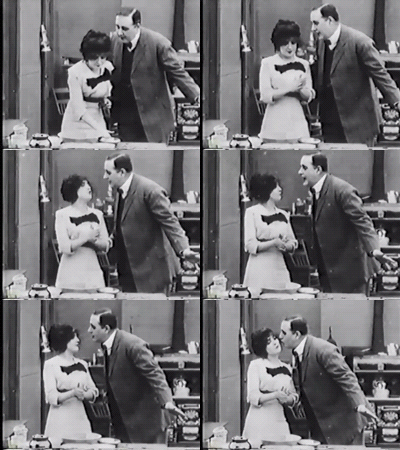
A film with the typical elements of a Keystone comedy of 1910s: Misunderstandings, fake mustaches, Keystone cops, chases, a damsel in distress, a simple plot. The paced is slightly slower than the frantic pace of Keystone comedies, though. 

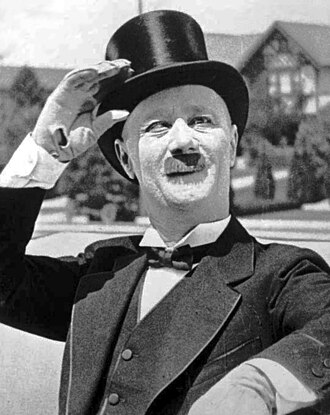
Another interesting particularity of this film is a very young Charley Chase, prior to his heyday with situational comedies of Hal Roach studios in the 1920s. 

A banker and his daughter do not seem to be particularly skilled when it comes to cooking, so they decide to look for a cook through a newspaper advertisement. Two crooks read the advertisement and decide to infiltrate one of them in the banker’s house with the purpose of stealing him. 

But the banker’s daughter also has a secret. She has a suitor who her father does not approve of. Therefore, they both decide to elope and the suitor sends her a note telling her to get ready and leave the house as soon as he whistles. The problem is that the crooks had used the whistle as a code too, so they could leave the banker’s house without being noticed. To make matters worse, at the exact moment when both the crook and the banker’s daughter were waiting for their respective whistles, a policeman shows up at the banker’s house. 

Both the crook and the suitor appear in the banker’s house almost at the same time and they managed to get both the girl and his accomplice. The problem is that the suitor picked up the crook and the crook’s accomplice picked up the banker’s daughter instead. The banker realized there was something wrong, releases the cop (who was locked inside the kitchen of his house) and a chase occurs, very much within standards of Keystone studios’ chases.

When it comes to the chase (which is typically at the end of the film), the part of it that take takes place in a pier and portrays a plenty of characters (including the Keystone cops themselves) falling on the sea from a pier, is very similar to the final chase of famous feature length film Tillie’s Punctured Romance, produced by the same Keystone studios in the previous year of 1914. For those who have seen both films, I would strongly recommend to pay attention to what those chases have in common.

Max Juggles for Love (France, 1912)

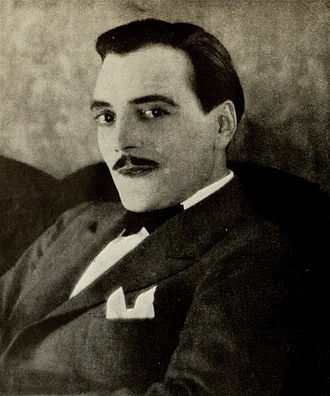
Max Linder was one of most influential comedians of early cinema and one of first characters to be recognized on screen. His screen persona was one of a dandy, often in hot water due to his fondness for the so-called good life and beautiful girls and Linder gave a touch of sophistication to comedy shorts in a time when slapstick was considered vulgar and working-class related by many people. It helped to give comedy more respectability in a time when cinema was at its infancy (Linder started making films before 1910). Linder’s influence was so deep that he was highly regarded even by Charlie Chaplin, who considered him his teacher. Unfortunately Linder’s death in 1925 by committing suicide together with his wife sometimes overshadow his successful career.

The setting of this film is the living room of what seems to be a healthy French family. Max wants to court a girl and brought flowers to her. The girl vehemently refused the flowers and is rather temperamental. Weirdly enough, she claims she will only accept Max’s courtship if he learns how to juggle and she was apparently quite skilled in it too. It seemed that the girl wanted to be too demanding and make Max give her up. 

Max accepted the girl’s challenge and tried to learn how to juggle, but he did not have any skill whatsoever and even ended up in trouble with a passer-by on the street on his way home. He tried to practice some more at home, but all he got was to break his own furniture. 

As he was determined to win the girl’s hand he pretended to juggle while somebody else was actually doing it behind a room divider. Unfortunately he was discovered, his plan failed and the girl laughed at him.

An interesting thing to pay attention to is that the actress has a much more stagy acting than Max Linder’s, with broad gestures and everything. On the other hand, Linder’s acting and body language were subtle, quite adapted to cinema language. Another highlight of the film is the beautiful furniture shown, which can also be seen in a plenty of 1910s French films. 

Hot Stuff (USA,1912)

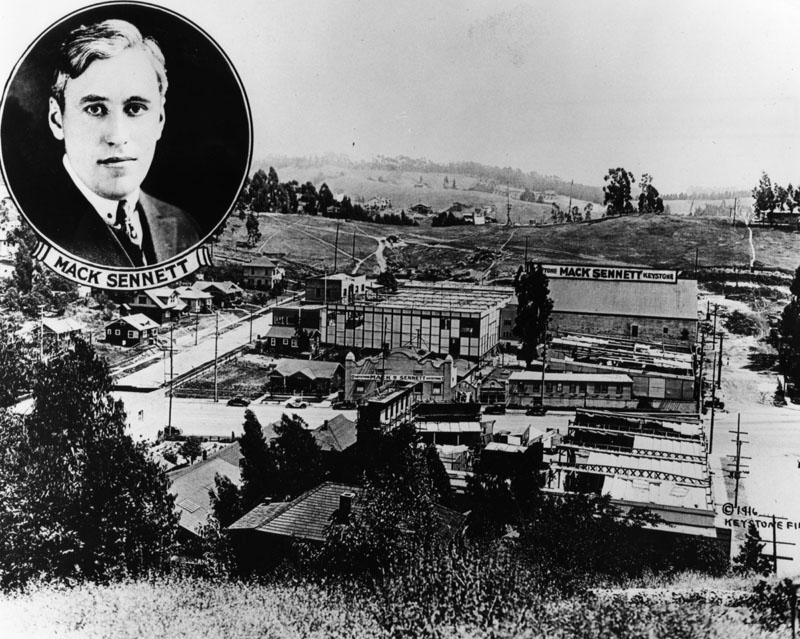
Opposite to what some people might think on first inspection, Mack Sennett did not start starring and directing comedies when he founded the Keystone studios in the second semester of 1912. He already did both back to the days when he worked for Biograph studios, the same studio that gave D.W. Griffith to the world. 

Sennett was in charge of comedies of Biograph and we can see in his output the initial elements he would further develop at Keystone studios, even actress Mabel Normand already worked for him. At the time, comedy shorts where usually one-reelers, which means they lasted around 11 minutes, and the length of films was slowly increased in the next few years. 

Although this film does not have the frantic pace of subsequent films by Keystone, we can see Sennett shaping his own style. He plays Mabel Normand’s sweetheart, but his girl is stolen from him by the cigar drummer, as the first intertitle says. The drummer takes Mabel to a park, where he starts to court her and Sennett follows them.

It is interesting that the drummer is shown as having “stolen” the girl from her old sweetheart (Sennett), but the plot does not show Mabel’s side of the story, why she left Sennett, etc. which can be perhaps interpreted as a effect of a more chauvinistic society or merely there was no time to make a deeper psychological development of the characters, as films where still very short on early 1910s. 

Mabel takes the drummer to a house and  he “makes a hit with the girl’s folks”, which means that her friends instantly liked him very much. Then, there was a party and Sennett’s character was not invited. He’s still following the new couple, as he was very upset to have lost Mabel’s love. Sennett even tried to enter the party, but his presence disturbed the group and he was kicked out by some of the guests.

A short time later, “the drummer makes the taffy” and he left the candy at the window to cool. Upon seeing it, Sennett realized he would have a perfect opportunity for revenge, so he ruined the candy, so the party’s guests would put the blame on the drummer. At first, his plan worked and the guests detested the taffy, but after a while Sennett is found out even though it does not prevent him from winning Mabel’s love back.

Although it is just a one reeler, the film lacked some more development of the character’s reason’s, which would have given a even better understanding of the plot by the audience. However, the film is a valuable witness of lifestyle of an era and its humor matched the kind of humor that was made at its time. 

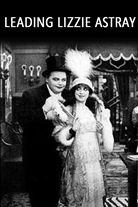
Leading Lizzie Astray (USA,1914)

We can see in the cast of this film two comedians who subsequently developed their careers in completely different ways. Roscoe “Fatty” Arbuckle, was a skilled actor and director, who reached the peak of his career by making memorable films with Buster Keaton at the end of 1910s. It seemed he would enjoy the same success in feature length films, but his career was suddenly interrupted by a scandal in 1921, where he was accused of rape.

Charley Chase became famous in Hal Roach studios at the 1920s, where he acted and directed in many so-called situational comedies, which had more life-like, realistic situations than 1910s slapstick comedies and without the frantic pace. Chase also had the distinction of helping to create the famous “Our Gang” kid comedies, which lasted until the sound era. 

This film has a very simply plot and lots of broad gestures by the cast members. Two guys from a big city were driving in the countryside, when they had a flat tire and were helped by locals.

One of city guys lures the girlfriend of one of countrymen to go to the big city with him. The girl hesitated, but ended up running off with the city guy and her former sweetheart got desolated when he read her farewell note. 

Meanwhile, the city guy takes the girl to a sort of dancing club in the city, although the girl does not seem to be happy about it and the environment seems to be a bit wild for a innocent country girl.

Determined to win his girl back, her former sweetheart goes to the city to try to take her back home. This was a good thing, as the girl was apparently engaged in forced labor in the club and regretted having gone away. The city guy who took her away also treated the girl in a very rude way and even threatened her. 

When the girl started being attacked by the city guy, her former boyfriend got to find out where she was. It is not shown in the film how he found out her whereabouts in such big city, though but this sort of psychological development was hard to be done due to time constraints of 1 reel films (which usually lasted around 11 minutes only). Seeing his girl was in serious danger, the country boy beat up all bad men in the club and saved her. In the end, he proposed to her sweetheart and she accepted it.

The flat tire in a country place provides a good metaphor to the encounter of two completely different lifestyles: The modern, big city-related life, with access to new technologies X a more conservative, relaxed, naïve lifestyle of country people. In the 1910s urbanization was still a relatively new phenomena, which provided new challenges to people and the enchantment with the bright lights of the city could be a trap to those who were unaccustomed to it.

Max Takes a Bath (France,1910)

Max Linder, the pioneer of French comedy, managed to develop a quite simple plot, keeping his subtle, naturalistic acting without broad gestures or loosing the typical dignity of his character, who was merely a normal man who suddenly found himself in trouble. Although his character was by no means rich, he was a honest citizens with morals. 

In this film Max had problems with nervous twitching, went to the doctor and was prescribed a cold bath every day for one month, as the first intertitle says. An interesting detail in this initial scene is the beautiful chair where Max sits in, which is worthy paying attention. He is also shown as having some tics, but never in a goofy way. He was a rather serious man, who was trying to treat his health problem. 

However, Max did not have a bathtub at home. He solved this problem by buying a ornate bathtub, but problems started as soon as he left the store and did not find anyone who would take the bathtub home to him. Thus, the only solution was to bring it home on his own back, which took Max lots of physical effort. 

Problems seemed solved when Max got to take the bathtub to his apartment, but it was only the beginning of all trouble because he had not previously realized there was no tap in his home. The closest tap available was in the nearby corridor. So, he thought he could go outside and fill the tub with one jar of water at a time.

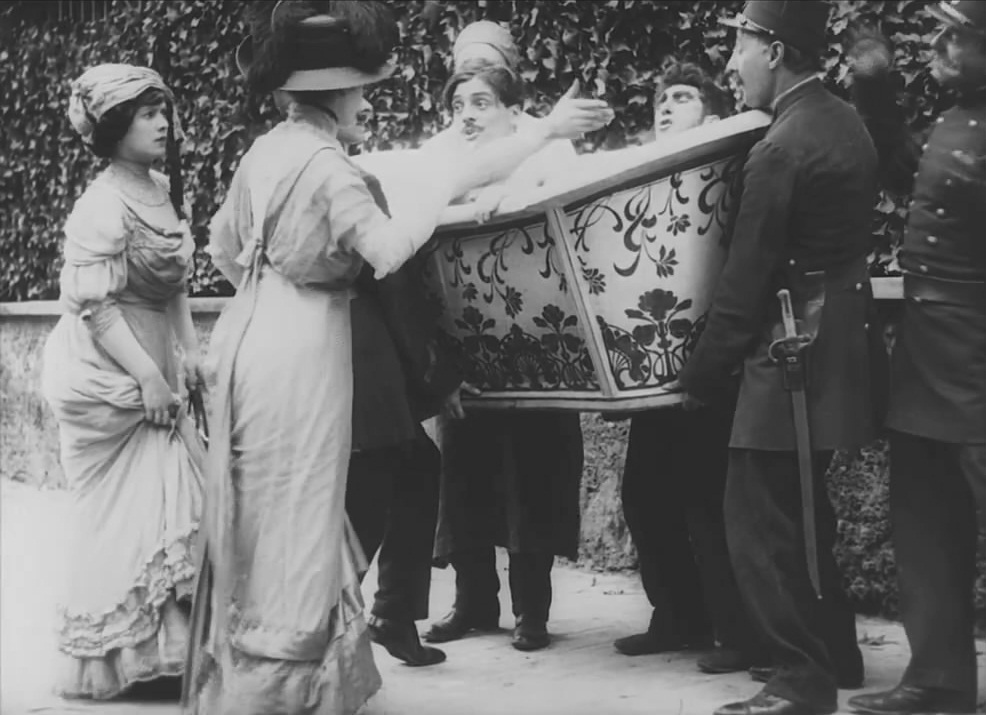
Realizing it would take too long, he decided to bring the bathtub to the corridor and take a bath there, but it was when all problems escalated. Obviously, neighbors did not like to see Max wetting the corridor and washing himself in public and the police was called.

He was taken to the police department together with the bathtub, a discussion happened and Max got to run away in the middle of the chaos and, again, he left together with his bathtub. A chase takes place and even a dog was involved. 

Then, one of the most interesting moments of the film is when Max climbs the building while he was still in the bathtub. It is pretty obvious that the scenery was actually painted on the floor. Although the camera was apparently suspended, the drawings on the floor are too obvious to pass undetected. But it was a pretty ingenious special effect for 1910. Max got to enter his building by the roof and got rid of his chasers by hitting them with the bathtub and this is how the film ends. Considering this film is a one reeler (lasting around 11 minutes, sometimes even slightly less), the sudden ends were a consequence of time constraints and not necessarily a result of bad quality of the film. 

Although this short comedy was not particularly innovative (even the painted scenery was relatively common in films up to 1910) it is entertaining enough and is very historically valuable because it gives a example of how very early comedies were made. 

Just Rambling Along (USA,1918)

Although this film is rather simple and not particularly innovative, it has a big historic value. It is a example of one of first films Stan Laurel made for Hal Roach before being paired with Oliver Hardy and reaching international fame. It was in Hal Roach studios where Laurel and Hardy started working together in the 1920s and where many of their films were made. 

This film is also noteworthy because it shows actress Clarine E. Seymour in a comedy. She became famous for her association with dramas by director D.W. Griffith, which also gave her a chance to work with famous actors like Robert Harron and Lillian Gish. Her career seemed to be promising, but we will never know how it would develop because she died at only 21 years old in 1920. Seymour’s most famous film is probably True Heart Susie, by Griffith, which was made in 1919. 

This film shows a amoral character, played by Stan Laurel, who has some resemblance with Chaplin in both body language and for being a kind of society’s outcast. After a fight with a kid about who would take a wallet that was found on the sidewalk, Laurel followed a beautiful woman into a restaurant and started to flirt with her. Actually, many men followed the woman and it seems she had flirted with them on purpose in order to attract clients to the restaurant. 

However, to go to the restaurant Laurel supposed to have money to pay for the food. Apparently, he was previously known to employees of the place and not welcome there. Laurel solved his financial problem by stealing the money from a kid on the street. The woman was not really flattered with Laurel’s advancements and ignored him completely, but he did not give up. In addition to flirt with the woman, Laurel also did all he could to get as much food as possible without paying and his plan worked well at first. 

But when the bill finally arrived, Laurel did not have enough money to pay for it and he ran away from the restaurant. Unfortunately, on his way out, he bumped into a cop who has been called by the kid whose money he had stolen before entering the restaurant. In an attempt to hide from the cop, he returned to the restaurant and the employees took revenge on Laurel by beating him up. 

Dog Shy (USA,1926)

Charley Chase was a talented American comedian, who started his career in films in the 1910s and had his heyday in situational comedies of Hal Roach studios in 1920s, both as a actor and director, where he worked in many successful films. During his association with Hal Roach studios he kept the screen persona of a guy with realistic appearance and body language in detriment of knockabout slapstick. 

This film has a relatively straightforward plot for a situational comedy. Chase plays the role of a man who has been afraid of dogs since early childhood and while running away from a dog on the street he ended up entering a telephone booth. Right before he entered there was another man in the booth, who left in order to get another nickel to drop in and continue to talk to a girl. Chase picked up the phone and talked to the girl on the other side of line and found out she was being forced by her parents to marry a nobleman. The nobleman was that guy inside the booth before Chase arrived. 

Chase wanted to help the girl to avoid the arranged marriage, but he did not have time to find out more about her, like her address, etc. because the call was interrupted by her mother.

Then, Chase is chased by a dog again and by complete chance he ended up at the girl’s house. Due to a misunderstanding, he also found himself with a recommendation letter to apply for a job in that house as a butler. At first, Chase is not interested in the job, but when he saw the guy from the telephone booth entering the house he connected the dots. He recognized the guy as being the nobleman, realized he was at the girl’s house and accepted to be the butler of her family. 

The nobleman proved to be very popular among all girls in a social gathering at the house. After some problems to find his girl among all other girls, Chase started doing his tasks as a butler. His first duty was to give The Duke a bath. Duke was the dog of the house, but he thought he was supposed to bath the nobleman instead. This misunderstanding created some of funniest scenes of the film, specially because the girl’s mother told the butler that if Duke was hard to handle, he could use force with him, if necessary. 

So, the nobleman was almost forced to take a bath, but Chase eventually found the right Duke and he had to bath the dog despite his fear of dogs. But it would not be the end of the problems.

The nobleman was actually a crook, who wanted to steal the house’s safe, the girl’s father wanted to get rid of the dog and Chase and the girl wanted to elope. So, all of them would do those things at midnight and they would howl like a dog as a signal and their respective accomplices would howl back. 

Of course that all those people howling at the same time and all those overlapped facts caused a major chaos, but it was all for the best. The crook ended up being caught, nothing was stolen and Chase was considered a hero by the girl’s family, which made things quite easy for them to marry. Eloping was no longer necessary.

Although this film is not particularly funny (except, perhaps, for the bathing scenes), it is still entertaining enough, with a realistic pacing and gentle humor. Sometimes Charley Chase gesticulates a little too much, but it was nothing in comparison with the broad, exaggerated gestures of actors of slapstick comedies. It is also interesting to see that Chase did speak most of the time during the film and it is even possible the audience do a plenty of lip reading. 

Should Sailors Marry? (USA,1925)

The diminutive Australian-born comedian Clyde Cook was one of many comedians who ended up being forgotten as time passed, although he was quite popular in his era and had a long career that spanned even to talkies. His heyday was on Hal Roach studios in the 1920s. He was known by his acrobatic skills, which unfortunately were not always portrayed in his films. His films were not quit original or funny and were often a bit below average, specially in comparison with the work of more famous comedians like Chaplin, Keaton, Lloyd, Langdon, etc., which can partially explain why Clyde Cook’s popularity did not endure for too long. 

In this film, Cook portrays a physically fragile sailor, who had some savings and corresponded with a woman who he was about to meet with the intention to marry her.

What the sailor did not know is that this woman paid alimony to her first husband and intended to remarry in an attempt to take money from him, so she could still pay the alimony to her ex. So, she had a plan with her ex husband to make the sailor remain married to her for as long as possible, so her ex would have a guaranteed source of income. The help of her ex husband would prove valuable because, after all, he could use his physical skills as a wrestler to physically threaten the sailor. 

When both the woman and the sailor met, things turned out to be a nightmare to the latter. The woman was not as beautiful as she claimed she was and was rather tough. To make things worse, he moved to her house and was introduced to her two children, who were quite misbehaved and, to add insult to injury, her first husband still lived at home. 

After a while, the woman found out that her new husband (the sailor) had lost all his savings and she decided to make him work in a hazardous job. To make the most of his labor, she purchased a insurance policy, which would pay her in case an accident happened to her husband. So, both the woman and her ex wrestling husband make up a plan to kill the sailor at work. But the plan backfired and he escaped both the marriage and the accident with his life.

This film is interesting due to a participation of Oliver Hardy as a doctor who was examining the sailor, prior to his pairing with Oliver Hardy. Hardy’s scene was among the funniest of the film. Although the gags were not very funny, the final gags outdoors, when the sailor was fighting for his life were pretty ingenious for both camera use and special effects. 

Roughest Africa (USA, 1923)

Another film by English actor Stan Laurel before his successful regular pairing with Oliver Hardy. Laurel had been in films for around 10 years before he started working with Hardy, mostly in films that did not stand out both in quality or humor. Perhaps, were not for the Laurel & Hardy duo, if those comedians kept on working on their own, they could ran the risk of not having their proper place in the history of cinema.

Despite having a kinda original plot for a situational comedy, the material of this film has average quality and does not provide much laughter. It is a politically incorrect film for nowadays’ standards because the characters are supposed to hunt animals, including a scene where Laurel tries to shoot a elephant. Although the animal was not hurt, such scene would be of bad taste for current standards. The scene where the elephant swallows a gun is also far from pleasant.

The film remains interesting, as it spoofs  travelogues that showed “exotic” parts of the world, their native populations, wildlife, landscapes, etc, often with a imperialist tone. Such documentaries were into fashion in the first decades of XX century.

Some pioneers are in Africa, although they really lack the bravery they were supposed to have. The scenery and natives look terribly fake already on first sight. The natives, for instance, were white acctors in black face, with make up that was far from sophisticated even to its own era. 

The pioneers face unfriendly natives and wild animals. Not surprisingly, they really lack any hunting skill whatsoever and it is apparently easier to them to shoot each other than to shoot a animal. 

Still talking about animals, it is not hard for nowadays’ audiences realize that neither bears nor Asian elephants are native species of Africa and even the fauna around the actors sometimes look really like the fauna of Northern America. A mistake that would not really go unnoticed in a current film. 

The interaction between people and animals in the jungle and the attempt of pioneers to film the animals provide the input to the gags of this film. The plot became old with time, but this film retains some historical value of an era when hunting animals to death was considered an accomplishment and socially acceptable.

Super-Hooper-Dyne Lizzies (USA,1925)

Although many people associate Mack Sennett with 1910s slapstick comedies with frantic pace, damsels in distress, awkward cops, custard pies, villains with bizarre fake mustaches, etc. his studio always managed to adjust well to changing tastes of audiences, different comedic styles and even new technologies. 

In the 1920s, Mack Sennett studios (which was also known as Keystone studios in the first years of its foundation back to the previous decade) made situational comedies (with slower pace, less focus on physical gags and more realistic situations than the so-called slapstick comedies). 

Sennett also made very original comedies back to 1920s, specially with actors like Ben Turpin, Billy Bevan, Andy Clyde, etc. with a mix of slow and fast paces, witty intertitles, frequent explosions, cartoon-like special effects, objects that sometimes seemed to have a life of their own and nearly bizarre subject matters. A plenty of those films were directed by del Lord, who would later become known for his work with The Three Stooges. This film has all aforementioned characteristics. 

Burbank Watts is a inventor who tried “to get power for autos from the hot air wasted on radio speeches”. Do not worry if it does not make sense to you. This statement is not supposed to make much sense anyway. Just keep in mind that this new technology meant that cars would work without gasoline. Actually, the technology worked a bit too well, as cars started to move all by themselves, sometimes even without drivers in. 

Other characters of the film, among others, are Hiram Case, who was his helper, and did not seem to be very skilled. Winnie Watts was the inventor’s daughter.

It is also noteworthy that this new technology upset the oil merchant of the town and, to make things worse, he was also interested in the inventor’s daughter. The oil merchant tried to prevent this new technology from taking off, but the inventor’s assistant did not allow any sabotage to occur. As a bonus, the love of the inventor’s daughter went to his assistant and the oil merchant ended up being arrested.

A particularly funny gag in this film with a car out of gas really reminded of ones made by Hal Roach studios to films of Snub Pollard (It’s a Gift, USA/1923) and Laurel & Hardy (Two Tars, USA/1928). This cute, weird comedy has its moments of fun, lots of creativity and it is still funny and amusing, even to nowadays’ audiences.

Afgrunden (AKA: The Abyss or The Woman Always Pays) (Denmark, 1910)

The plot might seem moralist for modern-day audiences at first, but if we consider that, for instance, on the other wise of the world the famous American filmmaker D.W. Griffith was making movies with similar content in Biograph studios at that same time we realize that the plot fit into the morals of the era, irrespective of the country.

This film is infamously known for its “gaucho dance”, which was highly controversial at its time. Take a look at pictures below and try to imagine the effect of this choreography on audiences in 1910.

Asta Nielsen


afgrunden, 1910(2)


afgrunden, 1910(3)

But there is much more in this film than that. With a beautiful photography, this film is surely part of the so-called Golden Age of Silent Danish Films. Asta Nielsen acts beautifully, as usual. It portrays the story of a respectable music teacher who becomes fallen after a circus comes to her town and she run off with one of circus’ artists. Unfortunately she is not happy with him afterwards. She was dominated by her passions and now has to deal with social and moral consequences of it. This film is rather tame for nowadays’ standards, but it was risqué back then for having shown how a woman of good family and morals became an outcast.

Some stuff worth being observed: We can see many landscapes of Denmark of that time as well as means of transportation, which can offers us some glimpses of their urbanization. Furthermore, there were many outdoor scenes in sunny places. Perhaps to make as much use of sunlight as possible while filming?

Barney Oldfield’s Race for A Life (USA, 1913)

A damsel in distress? Definitely not Mabel Normand.

Barney Oldfield’s Race for A Life(6)
Barney Oldfield’s Race for A Life(1)

This film portrays some stereotypical items of silent films, such as a villain with a fake moustache, a damsel tied to railroad tracks and a hero to save the girl, usually in the last minute.

Actress Mabel Normand is the damsel, who loves her boyfriend, played by Mack Sennett (who in real life was president and founder of Keystone studios) and rejects the advances of the villain played by Ford Sterling. As a revenge, he ties the girl to the tracks. 

Barney Oldfield’s Race for A Life(7)
Barney Oldfield’s Race for A Life(3)

We can see some details in this film that show Mabel plays a less fragile damsel in distress than her predecessors. Pay attention and observe that it was necessary two men to kidnap the girl. And even before that, the girl makes it very clear to the villain that she was faithful to her boyfriend and hits Sterling. Although the villain was far from being the smartest guy in the world, the girl’s bravery was impressive for the time anyway. 

Barney Oldfield’s Race for A Life(4)

However, it does not mean that the female protagonist had an easy life in this film. She spends around half of the film trying to be free from the chains while her boyfriend and some friends try to save her from a certain death. This attempt to save the girl provide us with a delightful chase scene, typical of films by Keystone Studios.

Barney Oldfield’s Race for A Life(2)
Barney Oldfield’s Race for A Life(5)

Barney Oldfield (1878- 1946) was an American early car racer in the real life, a famous one. At that time, celebrities like him and Harry Houdini (1874 – 1926) were often invited to be in films as themselves. We have to remember that there was still some prejudice towards cinema, specially compared with theatre, which was considered a more respectable art for by some people. Studios were only starting to rely on the appeal of stars in their films, so a face that was familiar beforehand would not only bring more respectability to films, but would also attract more people to cinemas.Of course that this reality would be completely overcame with the advent of what came to be known as the star system, but this is another interesting story which deserves being analyzed in another post.

Create a website or blog at WordPress.com

Up ↑